



Asking for a raise can be nerve-wracking—even at the executive level. From sleepless nights to sweaty palms, the anticipation often feels worse than the conversation itself.
And yet, it can be more than just a request for higher pay. It’s a chance to practice strategic communication, advocate for your worth, and build deeper alignment with your organization’s goals.
In this article, we’ll walk through:
Individual circumstances will always differ, but there are some common and more general reasons asking for a salary increase can be important:

A raise doesn’t always come in the form of salary. Depending on your organization, non-salary options might even be more realistic, and just as valuable (if not more so) to you.
Examples of non-salary compensation include:
Non-salary benefits can often reduce your personal expenses, enhance quality of life, or build long-term wealth. They’re also often more flexible for the organization to approve.
Why might these benefits be more feasible? Examples of reasons include:

When is a good time to ask for an increase? There are two factors to consider: strong career moments and favorable company timing.
Strong career moments:
Favorable company timing:

One of our clients had a standout year. She surpassed every objective set for her — leading with vision, hitting targets, and elevating her team in the process.
But, when compensation decisions were announced, she received only a standard increase. The same as everyone else.
She felt disappointed and hurt. Her instinct was to stay quiet. Bonuses and raises had already been finalized. What difference would it make now?
But, in our coaching conversation, we reminded her: “Speaking your truth isn’t always about the outcome. It’s about honoring yourself. You’ll feel better knowing you said what needed to be said.”
So she did. Calmly and clearly, she requested a meeting and shared how she felt, not from entitlement, but from alignment. She named her contributions, her growth, and her desire to understand what it would take to be recognized more fully.
And here’s what happened: Her leader listened. The decision-makers reviewed her file again and agreed. She received an additional raise and a bigger bonus. Most importantly, they had a meaningful conversation about what success would look like in the coming year, setting the stage for more intentional recognition going forward.
Sometimes, even when it feels like the moment has passed, it’s still the right time to speak up. Because advocating for your worth isn’t just about money. It’s about trust, alignment, and owning your impact.


What if your request is denied? Let’s say you asked for the increase and you explored non-salary benefits, but still got the no. What next?
Advocating for a raise isn’t just about money. It’s about clarity, confidence, and leadership. Whether the answer you get is yes, not now, or no, each conversation helps define the path ahead – both for you, and the organization.
Approach it with preparation, self-respect, and curiosity. At the executive level, how you ask is as important as what you ask for. The more intentional you are, the more powerful and sustainable your success will be.
If you’re done waiting for permission to own your value—let’s co-create your next bold move.

What keeps you up at night? If you’re like many in leadership, it’s things like:
What impacts all of those things? Change.
Sometimes change is intentional–a new corporate direction or strategy. Other times, it’s situational–economic shifts, evolving workforce expectations, global changes, market fluctuations, and so on.
Regardless of what drives the change, change is challenging. At the same time, transformation is how organizations thrive, and stay competitive.
With these critical concerns in mind (retention, engagement, well-being, agility) how can you, as a leader, navigate change successfully?
It’s simple (simple to say, at least). Leadership today demands strategy + heart.
In times of uncertainty, people need clear direction. In order to put that direction into action, they need connection, trust, and reassurance. That’s what heart-led leadership accomplishes.
Leading from the heart influences motivation, engagement, enthusiasm, innovation and all the things necessary to thrive through change. It’s what’s needed to:
This is why top leaders balance leadership with heart AND strategy. They know that how they lead through change determines whether their teams sink, stagnate or rise.
The bottom line is, top leaders don’t just drive results; they create cultures of trust, where people feel valued, empowered and committed. This is foundational to driving results and creating organizational resilience.
The essence of heart-centered leadership integrates empathy, emotional intelligence, and vision with strategic execution, for incredible, far-reaching outcomes.
But… What does it really mean to lead with heart? What does it look like in practice? How can leaders harness the heart-brain connection to guide their teams through any change that comes their way?

Did you know your heart and brain are constantly communicating? While the brain governs many functions, research from the HeartMath Institute reveals that this heart-brain connection goes beyond keeping a beat.
It seems, rather, that the heart-brain connection plays a crucial role in leadership, decision-making, and resilience. One major disruptor of this connection? Stress.
Studies from the American Psychological Association (APA) show that stress can:
For leaders, this often translates to frustration, decreased empathy, and lower team engagement—all of which impact retention and innovation.
HeartMath’s research highlights:
📌 The heart sends more signals to the brain than the brain sends to the heart.
📌 Stable heart rhythms improve cognition, emotional balance, and decision-making.
📌 Leaders who regulate their heart rate variability (HRV) remain calm under pressure and inspire confidence.
Think about it – when challenges arise, how does your heart respond? Does stress take over, or do you stay clear, calm and composed?
Yes, strategy is crucial as it provides the roadmap. But heart fuels the motivation and courage to follow it.
🔹 Watch this HeartMath video to explore the heart’s role in leadership and resilience.
🔹 What’s more? Your heart’s rhythm directly influences those around you—set the tone for your team. Read the HeartMath findings here.

Image source: https://www.heartmath.org/articles-of-the-heart/global-interconnectedness/each-individual-impacts-the-field-environment/
💡 Have you ever experienced a leader who led with heart during a major change? How did it impact your experience?
💡 Have you experienced a leader who led from stress, urgency or agitation? How did that impact you?
Change is one of the most stress-inducing experiences for teams. That’s why it’s common for people–even leaders–to resist change. That resistance isn’t just down to the logistics of change, but often fear, uncertainty, and emotional discomfort.
💙 A heart-driven leadership approach helps bridge that gap by:
✔️ Creating a sense of safety and trust
✔️ Encouraging open, transparent communication
✔️ Helping people emotionally regulate during uncertainty
✔️ Strengthening team resilience in the face of challenges
❌Leaders who ignore the emotional aspect of change risk:
⚠️ Higher resistance to new initiatives
⚠️ Decreased engagement and productivity
⚠️ Increased stress and burnout among employees
Instead of forcing change through strategy alone, leading with heart during change creates cultures where people feel seen, supported, and empowered to embrace transformation.
Why does that matter? When change is embraced, instead of resisted, there’s less disruption, progress moves faster, and transformation goes through with greater ease.
When people embrace transformation, it’s like moving with the current, instead of fighting against it.

A misconception about leading with heart is that it puts empathy over results. In reality, integrating emotional intelligence with strategic thinking enhances performance and drives sustainable success.
When heart and strategy are aligned, you unlock engagement, innovation, resilience, and long-term success.
Practical Steps for Leading with Heart and Strategy:
✔️ Communicate with authenticity. Transparency builds trust. Acknowledge challenges, address emotional concerns, and create space for open dialogue.
✔️ Empower your team. Invite people into the process to give them ownership over the transition. Seek feedback, listen with curiosity, and ask open-ended questions like:
✔️ Model resilience. Emotional intelligence is contagious. What’s more, leaders set the tone, for better or worse, within teams and organizations. Demonstrate self-regulation by acknowledging challenges without letting them dictate your leadership. That’s true resilience.
✔️ Validate concerns. There’s a tendency for leaders to try to placate or calm fears. Instead, ground people with validation. Simple phrases like “That’s a valid concern,” or “I appreciate you bringing that up” help foster trust and psychological safety. Follow up with clear action steps, but always validate first and foremost.
Protecting Your Energy as a Leader:
Leading with heart requires emotional endurance—and endurance demands recovery. You wouldn’t run a marathon while lifting heavy weights or sprinting at full speed. The same principle applies to leadership during high-demand periods.
Remember, your well-being can indirectly influence the well-being of the people around you. Protecting your energy is as much about effectively leading others as it is about self-care.
During high-stress times, here are ways to protect your energy:
It’s important to remember: Emotional strength is not about suppressing emotions. Suppression leads to volatility—like a shaken soda bottle ready to explode at the wrong nudge. Over time, this weakens resilience and clouds decision-making.
True emotional strength is the ability to recognize, accept, and respond to emotions with intention. This creates clarity, composure, and alignment between your leadership, your team, and your vision.

Can leaders be too empathetic? Where should they draw the line?
The key is intentional balance – leading with heart while maintaining a big picture, strategic vision. Empathy doesn’t mean lowering expectations; it means supporting people while holding them accountable.
Here’s how leaders can integrate both:
✔️ Set Clear Expectations
Great leaders combine high expectations with strong support. Servant leadership is just one example of how you might approach this. It’s an approach that recognizes challenges, equips people to overcome them, and works to remove roadblocks, without lowering the bar on expectations.
✔️ Foster Psychological Safety & Belonging
True innovation happens when people feel safe enough to stumble and learn. When employees trust that they can take risks, innovate, and voice concerns without fear of retaliation, they become more engaged and solution-oriented.
Further, a sense of belonging strengthens psychological safety. When people feel valued within a team, they collaborate, problem-solve, and adapt with greater ease.
✔️ Stay Adaptable
Heart-centered leadership is fluid. It adjusts to both organizational demands, and human needs, recognizing that the shortest distance between two points isn’t always a straight line – it’s the line that moves most efficiently through roadblocks.
Neuroscientist John Lilly said, “Our only security is our ability to change.”
In times of change or uncertainty, people seek out stability. Remind them that adaptability itself is a constant. It’s what makes individuals, teams, and organizations resilient and ready for whatever comes up.
💬 What practical steps can you, as a leader, take today to start leading with both heart and strategy?

An approach that integrates heart and strategy might sound compelling, but does it actually drive success? These real-world leaders have shown that it does:
1️⃣ Jacinda Ardern (Former Prime Minister of New Zealand)
Ardern led New Zealand through multiple crises—COVID-19, the Christchurch mosque attack, and natural disasters—using compassionate, transparent communication, combined with decisive action. She didn’t just make strategic decisions; she made people feel seen and heard.2️⃣ Satya Nadella (CEO of Microsoft)
Under Nadella’s leadership, Microsoft transformed from a rigid, competitive culture to one centred on growth mindset, emotional intelligence, and collaboration. This shift fueled innovation, employee engagement, and market growth, proving that a people-first culture drives real results.3️⃣ Howard Schultz (Former CEO of Starbucks)
Schultz built Starbucks into a brand known for people-first leadership, from providing employee healthcare to taking a firm stand on social issues. His notable commitment to connection and empathy helped shape a culture that strengthened both employee and customer loyalty.
These examples illustrate a critical truth: During times of stress, many leaders resort to fear-based, urgency-driven decision-making. But those committed to leading with empathy and heart don’t just succeed in the moment; they create lasting, sustainable transformation with powerful ripple effects.

Great leadership isn’t just about results—it’s about lasting impact. Leading with heart helps you:
💙 Build trust and psychological safety for high performance.
💙 Cultivate resilient, engaged teams that embrace change.
💙 Navigate uncertainty with clarity, confidence, and purpose.
🚀 Ready to integrate heart and strategy in your leadership approach?
We help executives and high-level leaders develop resilient, heart-led teams that thrive through change.
💬 Let’s start the conversation. Connect With Us / Explore Speaking & Workshops

An estimated 40% of people feel isolated at work. For younger generations, that number is even higher. Think about how that impacts productivity, collaboration, and overall performance.
A culture of belonging is more than a trend. It’s one of the most impactful things organizations can invest in.
A true sense of belonging at work empowers people to contribute fully, share ideas, ask for help, and engage in meaningful and productive collaboration.
In fact, workplace belonging is associated with a 56% jump in employee performance.
It’s more than having a social life at work – it’s having the freedom to thrive.
I opened my latest book with a memory of being excluded from school activities because of my family’s religious requirements. Instead of finding to keep me with my classmates, in a way that respected my situation, I was simply removed from the class and left alone in a hallway.
It was an awful feeling that I didn’t fully understand as a first grader. Ultimately, it set me on a painful, and decades-long path of trying to fit in, instead of seeking out places, careers, and relationships where I felt I belonged, exactly as I was, with my own dreams and perspectives.
When I finally learned to drop my masks, and bring my whole self forward, the shift was huge. It reached all corners of my life. My relationships improved, my self-acceptance skyrocketed, I took my career in directions that energized me, and I began to experience what it means to truly thrive. That shift not only impacted me, but also the people around me – from my son, to my partner, to my clients and colleagues.
When talking about workplace cultures, it’s so important to distinguish belonging from “fitting in.”
Making this distinction matters because we know that employees do better when they can align their work with their values. And, when the culture actively fosters belonging, that drives happiness, engagement, and productivity.
On the other hand, a culture that demands fitting sacrifices psychological safety and trust.

A big question we often get is how can organizations measure workplace belonging. Measuring the effectiveness of workplace belonging strategies (or where you’re at today) comes down to the core benefits of belonging.
Those core benefits include:
Greater Engagement
Increased Productivity
Higher Retention
Creativity & Innovation
Greater Well-Being

How do you create a culture of belonging in the workplace? As a leader, it starts with establishing strategies for yourself that positively influence the people you lead, and ripple out through the organization.
What are the key elements of a culture of belonging at work? It comes down to a culture of openness, trust and respect, where everyone feels accepted, valued, supported, included and welcome.
Here are 7 actionable strategies you can undertake to create that:
Non-belonging can show up as lack of engagement, hesitancy to contribute, lack of social connections, and also overly defensive behaviors or even arrogance.

Belonging isn’t a “nice-to-have.” It’s a competitive advantage that drives engagement, innovation and performance.
As an executive or high-level leader, your influence shapes your organization’s culture. By fostering belonging, you build a legacy of inclusion, equity, and trust.
It’s not about sweeping gestures, but about the intentional choices you make every day – inviting others into conversations, recognizing all contributions, challenging outdated systems, and striving to lift everyone up.
Reflect on the strategies outlined here. Pick one to implement today. Notice what shifts. Build on that momentum. With consistent effort and inclusive leadership, belonging becomes the cornerstone of a thriving workplace.
People want to work for great companies, and they want to feel that they truly belong, as they are. That’s your opportunity. So, what step will you take next?
Sources:
https://hbr.org/2019/12/the-value-of-belonging-at-work
https://inclusiveleadership.com/wp-content/uploads/2022/02/The-Importance-of-Belonging-in-the-Workplace.pdf

Let me ask you… how would you describe a high-performance culture or team? Better yet, how would you go about creating one? And, if you’ve followed all the usual best practices out there, but feel your team still isn’t reaching its fullest potential, what else is possible?
A high-performance culture or team is one that works exceptionally well together, is highly focused, achieves results, easily overcomes challenges, adapts with ease, and has a profoundly positive impact on the overall organization.
It’s the kind of team or culture that organizations dream of having. Yet, it isn’t that common for people to experience, and it can be incredibly challenging to cultivate one. Why is that? What can you do differently? How can you shift your organizational culture so that high-performing teams are the norm for your organization?
In this article, we’ll explore:
There’s so much involved in the makeup of a really strong team, and each one will be different because every project, organization and industry is different. At a very high level, we can identify 4 basic, or foundational elements that high-performance teams have:
Those last two aren’t talked about enough, yet they are core to making high-performance possible on a wide scale. It’s because of those last two that conversations around high-performance teams must include organizational culture, and must include an honest assessment of your leadership and/or executive team.
In Teams That Work: The Seven Drivers of Team Effectiveness (on Amazon), authors Scott Tannenbaum and Eduardo Salas outline seven research-backed elements of successful teams. These 7 elements have been widely adopted as a blueprint for high-performing teams and are commonly referred to as “the 7 C’s.”
Those elements are:
BONUS: Psychological safety – How safe it is for people to drop their self-protective masks and bring their full strength and potential forward.

You could argue that psychological safety is an element of conditions and you wouldn’t be wrong. However…
We feel strongly that this needs to be a standout element when discussing how to make high-performing teams and culture possible within an organization. No matter what other elements you work on, without psychological safety, people can’t be their best, or be their best for those around them.
These 7 + 1 elements provide the ideal setting for people to recognize and embrace their fullest potential, and to drop any self-limiting behaviors or beliefs that may be holding them back. When you achieve that on an individual level, and combine it with supportive and co-creative leadership, magic happens.
Cultivating all 8 elements may seem daunting. Thankfully, there are practices you can put into place that touch on multiple elements at a time.
Let’s say you’ve worked on developing all of these elements. Most importantly, you’ve also worked on yourself and the impact you’re having. You feel you’ve made good strides as an executive or organization, but… those high-performing teams just aren’t happening!
What else can you do? What else might be possible? What can you do differently to achieve different results?
Rarely do we kick things off with something negative, but as this article discusses, the impact of just one toxic employee can be far reaching, and has the potential to derail an otherwise awesome team. If you have someone who is truly and consistently toxic, regardless of their expertise, remove them from the team. That doesn’t always mean termination, but do your best to get them out of the impacted team, and ideally into a role or situation where they will have the support and resources to turn their toxicity around.
To ensure you’re making the best possible hires and promotions in the future, you may consider a tool like Hogan assessments.

Sometimes bringing out people’s highest functions means supporting their most basic functions! As this article from Psychology Today discusses, how we eat impacts how our brains function.
It takes a lot of brain-power to bring your best to your work. And we’re asking this of people who have lives outside of work where they also want to bring their best. You can support that very basic need for good energy by having a strategy that makes nutritious eating easier for people. That could mean providing nutrient-rich snacks in the office, always having a pot of herbal tea ready at the start of meetings, providing protein-rich in-office breakfast, or even providing financial support for groceries.
Sometimes we can focus so much on the team that we neglect the individual development needed to form that team.
Switching your focus to individual strengths and needs can be a powerful investment in team development. This can mean coaching, an internal mentorship program, skills workshops, and so on. It can also be an investment in a program like Positive Intelligence, which empowers people to really tap into their strengths, push past their roadblocks and step into their full potential through intentional daily practice and habit forming. In a team setting, it can be the difference between having expertise and knowing how to use that expertise within a larger project.
This is essentially a growth mindset culture, but framing it as learning better captures the aspect of growth mindset that often gets ignored: mistakes. Mistakes are paramount to learning. Growth simply doesn’t happen within them.
Michael Jordan once said, “I’ve missed more than 9,000 shots in my career. I’ve lost almost 300 games. Twenty-six times I’ve been trusted to take the game-winning shot and missed. I’ve failed over and over and over again in my life. And that is why I succeed.”
Continual learning, with all the mistakes and failures that come with it, is what empowers progress and is the antidote to stagnancy. Embrace that.

For better or worse, the behavior and comportment of executives sets the tone for the overall organization. If you want a truly high-performing culture, where high-performing teams can develop and thrive, your executive and leadership teams need to adopt an approach such as transformational leadership – one that is deeply supportive and holds leadership accountable for the culture they promote.
Asking for help is one of the most productive, efficient and empowering things a person can do within a team. Unfortunately, far too many teams and organizations inadvertently make it unsafe to ask for help. Even if your organization isn’t one of those, it can be a learned and deeply ingrained fear for many employees because of past experiences. This is why modeling asking for help matters. Once again, executives and leadership need to blaze that trail and make it safe by practicing it themselves. It’s also important to regularly encourage others to ask for help, and openly recognize it when they do, but the first and foundational step is modeling.
This is an awesome idea borrowed from Harvard Business Review. Company values can be powerful drivers of employee engagement if those values are genuinely lived in the day-to-day workings of the organization.
To dilemma-test your values, look to past or current dilemmas, and imagine some scenarios that could arise down the road. Try to figure out solutions that align with your corporate values or mission statement. This exercise can tell you a few things:
When the behavior of leadership is aligned with company values, it shows integrity. It demonstrates, through actions, that you can be trusted and that you walk your own talk. That leads to higher engagement, and an engaged team is a truly powerful team.
People naturally work better together when they feel connected. Think about every person within the organization as potential future teammates and encourage that mindset for them. One way to do this is through workshops that aren’t narrowly job-focused. Workshops on communication, for example, can be valuable to anyone in any role, so you would get people from across departments working together. “For fun” workshops, clubs and events can also be really powerful in building relationships. Maybe a knitting circle, cycling club, walking group, pickleball league, pottery workshop, cooking class or book club. Initiatives like these foster relationships that wouldn’t otherwise happen, and that contributes to an overall culture of trust, respect and support.

Cultivating high-performance teamwork is ultimately dependent on the type of culture you allow to take root. There’s a saying that the grass is greener where you water it. If you want to empower high-performing teams in your organization, you need to “water” your organization with all the things that make such teams possible.
If you would like guidance in cultivating high-performing teams, transforming your corporate culture, or empowering your executives to be powerful agents of change, we invite you to connect with us.

Let me ask you… What vision do you hold for your organization? To make that vision reality, will your organization or team need to undergo a transformation? If so, is your current leadership style and/or leadership mix set up to inspire and drive that transformation?
So many companies, leaders and leadership teams want to create change within their organizations. They can often clearly see what they want to create and the results they want to achieve, but it’s the path from A to B that remains unclear. Other times, the path is clear, but knowing how to get the people you lead to walk that path – successfully and enthusiastically – is where the vision gets murky.
This is where we come to the power of influence, and a leadership mix that leans into inspiration, motivation and empowerment. It’s most often called transformational leadership and its effectiveness can be widespread in organizations that fully embrace the approach.
In this article, we’ll explore:
Transformational leadership is a leadership style that was first introduced in 1973 by sociologist, James V. Downton, and was expanded upon in the 80’s by Bernard M. Bass (a scholar in the fields of leadership studies and organizational behaviour) to include methods of measuring the style’s success.
At heart, transformational leadership is an approach rooted in relationships, trust and accountability. It was pioneered as a management style that would inspire innovation without micromanaging, spark excitement for change, empower autonomy within people’s roles, and establish relationships of trust, respect, loyalty and support. The idea was that by focusing on relationship-building, employees would be inspired to want to go above and beyond, to bring their absolute best to the work that they do, and to be motivated by a sense of shared purpose.
In practice, it is an intensely hands-on leadership approach because it demands accountability on the part of leadership in terms of cultivating an engaging environment, building strong relationships and providing full support for employee growth and success. At the same time, it is incredibly hands-off, in that leaders must trust that people are naturally resourceful, creative and whole, and that when given autonomy in their roles, they will bring their absolute best to the work that they do.

Traditional leadership styles are transactional where people have a sense of duty that’s based on rewards and compensation.
Now, it should go without saying that people deserve to be adequately compensated, and there can even be benefits to using money and other rewards to motivate, but as you’ll learn here, those pros come with cons. And, as you’ll learn from Harvard Business Review, the whole spectrum of intrinsic vs. extrinsic motivation is pretty complex. One valuable pearl we can take from it all though, is that if we want people to be engaged with their work, money alone isn’t enough. Further, if we neglect the richness of non-transactional leadership, we could easily see epidemics of burnout and quiet quitting within our organizations.
This is where transformational leadership comes in. It is a relationship-centered style that hinges on leaders working with others – their own teams and others within the organization – outside their own self-interests in order to influence genuine, sustainable change and success.

While the desired result of this leadership style is, of course, business success (which includes financial success), the driving force behind it is deeply human, genuine and passionate. It’s a style of authentic leadership that can become the backbone of organizational resilience because it empowers leaders, teams and individual employees to stay energized, optimistic and focused, even during the most chaotic times.
The benefits can be far-reaching and specific to situations, industries, individuals, and so on.
Some of the more general benefits are that it:

That last one can be particularly impactful as just about every organization will experience upheavals. In such times, it’s common to switch into reactive-mode and focus more on immediate tactics over broader strategy. This can feel like it makes sense in high-pressure moments, but when we step back, we see how this tends to create long term problems, even if it does address short term issues.
Establishing a transformational leadership approach during times of calm empowers you and the people around you to hold onto the big picture vision during even the most chaotic times, which puts you in a position to make those critical short term decisions in alignment with the long term big picture.
If you’ve heard of transformational leadership before, you may also have heard of the 4 elements, sometimes called the four I’s of transformational leadership. Transformational leadership is truly a way of being, so there is no step-by-step guide to implementing it. Instead, we have high-level elements or fundamentals that serve to guide our way of being.
The 4 elements are:

We just did the 4 I’s… and now the 5 C’s? Over the years and leadership research, theory and practice, there have been many efforts to simplify the way leadership styles are taught, making those styles more accessible during stressful or chaotic times. After all, who wants to be reaching for a textbook mid-crisis?
Some of these efforts have been more impactful than others and thus, you’ll hear them referenced more often. When it comes to transformational leadership, the 4 I’s and 5 C’s are the ones that come up most.
There’s a lot of overlap between the two, so I’ll keep the explanations brief here:

One of the most impactful leadership principles I’ve learned through my years of training with the International Coach Federation, particularly through my Master Certified Coach training, is that a true leader takes 100% responsibility. I always work with people to bring this forward as a principle of empowerment, not blame.
Old, traditional forms of leadership and management lean heavily into a sort of carrot-and-stick approach that puts people on the defensive and understandably reactive to the concept of blame. Unconditional responsibility is completely separate from blame. Instead, it’s about recognizing that each one of us has full authorship of how we show up and respond and that it’s up to us to grab onto that, get ourselves into the CEO seats of our own lives, and begin creating what we want for ourselves.
What does that have to do with implementing transformational leadership? Well, the first step of any transformation is to transform your own approach. If you want to transform your team, you have to transform the way you lead. To be able to meet people with the 4 I’s and 5 C’s, you need to first develop your inner leader to ensure that you are bringing your best self to your role before expecting anyone else to do so. It’s key that you do the work to tune into your whole self, to get up close and personal with your own hopes, fears, values and motivations, to connect with your intuition and the messages of your own body, and to fully understand what it means to you to be fully engaged with your work before you turn to inspiring others.
If you would like guidance for yourself, your organization or your leadership team on embracing and implementing transformational leadership, I invite you to connect with me, check out my workshop topics, and see what coaching approaches are available through CEO of Your Life.
Tell me… do you strive to treat everyone equally? What about with equity?
Whether you’re aware of it or not, there’s a good chance you already factor equity into your leadership approach. If not, it’s time to make that shift. Why? Because equity over equality is how you empower the success of your people. It’s also how you, as a leader, can take an active role in making the world a better place.
In this article, we’ll explore:
To start, let’s explain the difference between equity and equality:
In many ways, equity is the roadmap to equality. Let’s explore an example:
Imagine you want everyone on your team to become experts on a new software suite. Some team members have prior experience with the software, others have never used it before.
Treating everyone with equality, you would provide the exact same training to everyone. In that scenario, you would have:
Either way, the outcome is not equal.

If, however, you were to treat them with equity, you might provide introductory training to the people with no experience, then further training for all. In this scenario, by providing resources that empower equal outcomes – instead of equal resources – everyone has equal opportunity to become experts.
The resources are not equal, but the outcome empowers equality.
Seeing this example, it’s clear why you’d want to aim for an equity approach as a leader. Every human being has the same potential for success, but they are not all starting with the same resources. When you get curious about what resources are needed and work to make those resources accessible, it empowers people to actually realize their potential.
Put simply, we can say that equality is sameness while equity is fairness.
Everyone in your workplace has likely worked hard for what they have. But, they’ve also worked hard WITH what they had to start out with. That isn’t the same for everyone AND you often won’t know where they’re starting from.
In the example above with software training, it’s fairly straightforward to know where everyone is at. But let’s imagine a different scenario…
Imagine you have two employees. One grew up surrounded by positive role models, and people with the ability and willingness to guide their growth, education and career. The other did not. Both are hard-working, but because they started with very different resources, the same amount of hard work will have gotten the more advantaged employee much further.
In a workplace environment, these differences in background and life experience are often unknown and unseen. Because of this, growth and development programs must take an approach of:
When we’re talking about equality and equity, our main focus is on improving diversity in the workplace. That means gender diversity, racial diversity, as well as inclusion of other marginalized and systemically disadvantaged groups. It means increasing the diversity of your workplace at all levels, AND making your workplace an inclusive environment where all people feel safe, included, valued, and empowered to bring their best selves.
Meeting people where they are means understanding that many people may not feel like they truly belong. They feel that way because they likely have been excluded and made to feel unwelcome – consciously or unconsciously – in so many environments throughout their lives.
As a leader, to be able to meet people where they are, you first need to meet yourself where YOU are. This means full acceptance of YOU. Yes, you. Recognize where you fall on the diversity spectrum and how that impacts your perspective. Chances are, you have a lot of blindspots (many of us do). So, educating yourself will be your step two.
These 2 steps – accepting where you are and educating yourself – are critical. They will provide your foundation for moving forward in supporting others. Also, these 2 steps do not end. Your own growth demands that you continually revisit them. Check in with yourself. What else can you learn? What new blindspots have you become aware of?
In addition to your inner work, you’ll want to shift your leadership approach to one that meets people where they are.
 Diversify who you spend time with – This is a big one! As a leader, think about the team members you’re most at ease with. People you chat with, go for coffee with, stop to talk to in the halls, meet for drinks after work. Do they… look a lot like you? Share similar backgrounds? This is a really common thing that usually happens unconsciously. But, as Maya Angelou said, “When you know better, do better.”These kinds of friendly relationships are actually informal mentorship, and often gives the other person an advantage in their careers. Even if you don’t actively help them advance, their relationship with you – a leader – helps put them at ease and builds their confidence. That puts them at an advantage when it comes to taking on high profile projects or going for promotions.Part of meeting people where they are is quite literally meeting them. Set the intention to have more informal interactions with all your team members. In an equity approach, aim for more of those interactions with people you haven’t done this with in the past.
When we talk about empowering diversity in the workplace, often the first path considered is to invest in diversity and gender equality training programs.
That can be a good start. However, I highly recommend seeking out training or coaching that works at the leadership level and that takes a mindset approach. The management consulting firm McKinsey & Company focuses heavily on workplace diversity. In their research, they found that most training programs just aren’t working to increase diversity. Why not? It comes down to mindset.
 Many of us might think we have an inclusive mindset but, unconsciously, we don’t. In the McKinsey article above, they use the example of gender-inclusive language in job descriptions. In listing ideal characteristics, we might use the word “assertive”, not realizing that in our society, “assertive” is a highly gendered word, and we might balance it with a word like “cooperative”.
In another example, this Forbes article points out how often “English as a first language” is listed as a job requirement when “Must be fluent in English” meets the same requirement, but in an inclusive way.
These may seem like small things, but it’s the small things – all these “micro-inclusions” we might say – that make up corporate culture. Far more than corporate values or missions, it’s the everyday habits, behaviours and perspectives that form culture, and that ultimately determine if your workplace truly is inclusive or not.
The importance of gender and diversity equality training in the workplace still stands. But we have to rethink the approach. Because so much of the “small” things are unconscious, training must focus on raising consciousness to shift mindsets. That has to start at the leadership level because leadership sets the tone for the organization.
An equity counter argument I’ve heard many times is, “What if someone just doesn’t take advantage of the resources provided? Do I have to keep providing more and more opportunities to that one person?”
The short answer is no. But first, take a good look at the resources you’re providing and how you’re providing them. Do they meet people where they are? Is training accessible? Is it at a time that works for everyone? Do benefits meet the unique needs of different families? Is there enough flexibility built in? Have you addressed any language barriers? Does the corporate culture make it safe to seek help? Is the corporate culture truly inclusive?
Also have the difficult conversation that needs to be had. Find out if there’s a personal issue at play, or even an interpersonal issue at the office. Get curious – no judgment.
If you’ve explored all avenues and the person still isn’t rising to the opportunity, that’s where your responsibility ends. But do your due diligence first. Do it fully, honestly, courageously and with compassion.
When equality is the approach, it’s the most advantaged people who succeed. When equality is the goal and equity is the approach, everyone gets a genuinely fair shot at succeeding. That’s when the organization has the best shot at reaching higher and higher levels, and when the organization becomes a real player in changing the world.
If you would like guidance in cultivating an equity approach for yourself or your leadership team, I invite you to connect with me.

When I’m coaching leaders or leadership teams, I focus a lot on what coachees can do, what they can positively influence, what they can take ownership of, what unique strengths and talents they can grow from, and so on. However, I know it doesn’t serve anyone to focus exclusively on the positive. The flip – and equally important – side is what they should not do – the habits, patterns and limiting beliefs they need to break free of, as well as some common leadership mistakes to avoid in order to bring their best selves to their role.
Before diving in, I’d like to acknowledge that in leadership, learning from mistakes is just as valuable as in any other role. If you feel that you’ve made mistakes in your leadership, or approached things in a way that didn’t honour your humanity or that of the people around you, that’s not the end of the world.
One of my favorite bits of wisdom comes from Fred Kaufman, leadership development advisor for Google, who said that anytime you catch yourself saying, “Oh, sh*t”, try saying, “Oh, fertilizer” instead. One’s just crappy, the other is something to grow from.
When you own something, you can learn from it and grow. We’ll get into that more a little further along.
In this article, we’ll explore:
One of the powerful and influential things you can do in a leadership role is to fully embrace your own humanity. When you find ways to do that – openly and actively – it makes it safe for others to do the same.
So, what should you avoid as a leader? Avoid hiding! Avoid all those self-protective behaviours that do nothing but influence others to hide things, put up walls, and keep their knowledge to themselves. You want an open, trusting, collaborative workplace – after all, openness can directly impact your organization’s bottom line – and that has to start with you.
One of the most human things you can do is to embrace – and own – your mistakes as a leader. It’s the ultimate display of vulnerability at work to say, “I made a mistake.” And that’s what makes it so powerful.
In leadership, admitting mistakes sends the message that it’s safe to share just about anything. Employees tend to avoid speaking up at work for many reasons, almost all of which are protective. They don’t want to look bad, risk becoming an outcast, be seen as not a team player, or even risk their job security.
What happens when people are afraid to speak openly is that creativity, collaboration, effective problem solving, employee engagement, employee retention and more all go down.
As a leader, you can combat that by creating a culture of trust and safety. Admitting openly to your own mistakes, and sharing how you’re working towards growing from them, sends a very loud and powerful message that it’s safe for others to do the same.
Now that we know it’s ok (and so, so human) to make mistakes, and we know that a lot of good can come from owning our mistakes, and we know how important it is to avoid hiding our mistakes, let’s dive into some common and significant mistakes leaders can make, and how to correct them.
In my personal and professional life, I aim to live by Don Miguel Ruiz’s, “The Four Agreements”. His four very simple-sounding agreements are not at all easy to practice, but striving to do so has taken me and my business to heights I never could have imagined. I’ve worked these agreements into my coaching and have seen them pay off time and time again for the people I coach. As such, I’ve based these mistakes on those agreements.
Leaders have a mandate to guide others. When you care about your people, your team, your work, your organization… it’s easy to lose sight of your own growth and development. This can leave you depleted, scrounging for energy, and often coming up short. That isn’t fair to you, or the people around you.
How to correct that mistake:
Make yourself a priority. Self care means doing the work to create a meaningful and fulfilling life for yourself that fuels you up to care for and guide others. That means connecting with others, developing your skills and knowledge, seeking out new experiences, caring for your relationships, doing the inner work to connect with yourself and your inner leader, proactively practicing self-acceptance, and so on. The more you improve, care for, and connect with yourself, the better you can inspire, support and continually take others to higher and higher levels.
Ruiz’s first agreement is to always be impeccable with your word. He refers to “the word” as our power of creation. When you speak, you create images, thoughts and feelings in your mind, and that all goes into creating your world. If you’re telling yourself things like, “I’m just one person. I can shift the whole culture of my organization.” Or, “What I do isn’t going to change the way other people do things.” You’re limiting yourself. You’re embedding yourself with the false belief that you have no real impact. And, whether you’re aware of it or not, this ripples out to the people you lead. It sets a tone of disempowerment.
How to correct that mistake:
Stop telling yourself stories of disempowerment and commit to taking authorship of your life. Anytime you lean into a disempowering story, you’re writing your own story whether you intend to or not. So start being intentional! The one thing you always control is yourself and you are more impactful than you know. Start telling yourself that what you do matters. Tell yourself that how you show up is impactful. Tell yourself that you have the power of influence and that it’s in your control to harness that in positive ways. Tell yourself new stories about what’s possible and then start putting them into action.Your words are your power of creation. The way you speak to yourself creates the way you show up, and that absolutely has an impact on the people you lead.Once you have practice doing this for yourself, start telling yourself better stories about the people around you. If someone’s work quality is slipping, for example, instead of starting a story about how they aren’t good at their job anymore, start a story that embraces their humanity. Tell yourself that you’re seeing someone struggling and that you are uniquely placed to offer support. Lean into curiosity instead of judgment.
Taking things personally puts you on the defensive. It also lets the people and circumstances around you determine how you show up. That’s a choice you make – to put that power outside yourself. Taking things personally also disrespects the people around you by ignoring the fact that they have vibrant, dynamic, complex lives outside of work. It puts all the focus on you, and what you’re experiencing. This becomes a barrier to connection, when it’s connection that drives strong, effective leadership.
 How to correct that mistake:
The truth is, how other people show up is not about you. It’s about what’s going on for them. The way they react, respond, handle stress and so on is all a reflection of where they are at in their journey. When you accept that, fully, you bring power back into yourself. You take blame and judgment off of yourself, and free yourself from any feelings of guilt or resentment. You also honour the humanity of the people around you, and empower yourself to show up for them with curiosity and true leadership. If someone responds to you in an unkind way, you can respond back with curiosity and compassion, instead of hurt and defensiveness, knowing that they’re just reflecting where they’re at.
You know the old saying about what happens when you assume. When you make assumptions, you close yourself off to learning, and actively blind yourself to possibilities. You put limits on yourself and others, holding everyone back.
How to correct that mistake:
If you assume anything, assume that people want to do their best. But even that is going to mean different things to different people. There is so much to be gained from curiosity and yet, making assumptions can be such an ingrained habit that it’s difficult to break. You can defeat it with mindfulness. Start a mindfulness practice of noticing the types of thoughts you’re having as they come up. Just noticing, no judgment. It could be, “Oh, I’m creating right now,” “Oh, I’m remembering right now,” or “Oh, I’m assuming right now.” When you simply notice it, without judging yourself for it, you can stop the behaviour in its tracks, and gradually replace that old, limiting habit with a much more productive one: curiosity. With curiosity, you ask the questions that need to be asked to get the clarity you need to move forward. No assumptions keeping you quiet and clouding your understanding. If you have a question, you can be pretty sure other people in the room will too. When you choose curiosity over assumptions, everyone benefits.
Ruiz’s fourth agreement is to always do your best. So, why am I calling this a leadership mistake? Because so many of us don’t realize that our best is a moving target. It varies depending on what else is going on in your life. And never has that been more apparent than in the last two years of pandemic measures. I’ve seen so many people burn out because they’re expecting themselves to do their pre-pandemic best. It’s great to have high expectations for yourself, but if you consistently hold yourself to unrealistic expectations of what your best is, you’re setting yourself up to fail, and setting a toxic example for the people you lead.
 How to correct that mistake:
Develop your inner connection in order to develop your awareness of what your best is in varying circumstances. The best way to do this is to create a consistent morning routine that includes check ins with yourself. How are you feeling, physically and emotionally? What’s going on for you? What are you struggling with? What are you feeling good about? Once you get in touch with this and make it a regular practice to connect within, you can start practicing kindness towards yourself. Absolutely expect yourself to always strive for your best, just with the understanding that your best will be different each day.After that, strive to be open with your team about your experience. Talk about what impacts “your best” and get conversations going about what’s going on for your team members and how it’s impacting their well-being. A great starting point to begin building a culture of open conversations is Covid. Everyone’s best during Covid times is not the same as their pre-Covid best. We can only do our best from where we’re at and with the energy we have. What are the factors impacting people? What’s different? How have all areas of life been affected and how do they influence each other?
I’ve called these 5 things “leadership mistakes”, but I always prefer to think of mistakes as mis-takes. Meaning, you tried something a certain way and it didn’t work out. It was just a mis-take and you can always take another try, another approach, another perspective. To be a good leader for others, you have to first be kind to yourself. That kindness includes accepting your mis-takes as simply human, and nothing to be ashamed of. Own your mis-takes. Own your humanity. You’ll be much better for it, and you’ll be much better for the people you lead as well. There is so much rich fertilizer in our mis-takes. Embrace it!
If you think it’s scary to own your mistakes, you’re right. It is scary. Especially in a world where so many of our social structures and “norms” shun mistakes. But that doesn’t mean it isn’t worth it, or that you’d be alone in owning up to your wonderful and worthy humanness. Here are just a few example of leaders you’d be sharing company with:
Mistakes are human. And, as the late Fred Rogers said, “Anything that’s human is mentionable, and anything that is mentionable can be more manageable.” Own your struggles, own your success, own your humanity, and embrace the humanity in the people you lead.
If you would like guidance in owning mistakes for yourself, your team or your organization, I invite you to connect with me.
Servant leadership empowers the brilliance of others. It’s being a champion for your people, uncovering their unique strengths and talents, seeking out opportunities for them to grow and shining a spotlight on their value, contribution and potential. It’s a commitment to being aware of your own impact and making it your mission to harness your influence for the benefit of those you lead.
This article will explore:
Like conscious leadership, servant leadership isn’t so much a technique as it is an approach. It also isn’t something you have to choose as your one-and-only style of leadership. Rather, it’s an approach to weave into your overall way of being as a leader, and as a person.
If you look at the co-active leadership model below, for example, you’ll see it includes 5 dimensions: in front, beside, in the field, behind and within. Each of the dimensions is equally important, and are meant to be leaned into as the situation demands. This requires practicing conscious, intuitive response-ability to assess what’s needed and when, and being open to exploring missteps and learning from them.
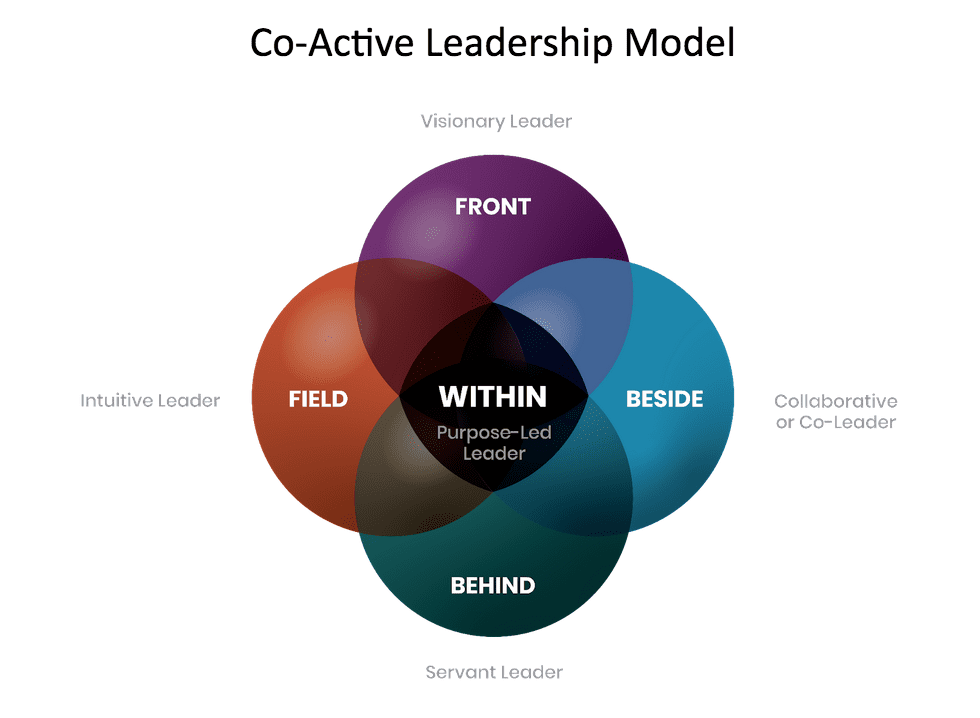
In terms of co-active leadership, servant leadership is a form of leading from behind. In servant leadership, leaders put others first, especially when it comes to celebrating success, sharing opportunities, seeking out ideas and so on. A servant leader assumes that everyone around them is naturally creative, resourceful and whole, and makes it their mission to ensure everyone has what they need to grow, succeed and care for themselves – to bring their natural brilliance forward, for the good of themselves, the team and the organization.
What is an example of servant leadership? Let’s say that a report needs to be presented to a major client every week. A servant leader would see this as an opportunity for a team member to grow their skills and experience, as well as build their personal network and gain esteem within the organization. They would also recognize that it serves the organization for more people to be skilled at dealing with high profile clients. The servant leader would coach their team member, ensure they have the necessary tools and information, introduce them to the client if necessary, and express their enduring trust in the person – not that they will be perfect, but that they will do their best, learn from mishaps, and continue to do better and better.
 In my many years of coaching, I have worked with a diverse mix of professionals – from entrepreneurs and small business owners, all the way up to Fortune 100 leaders, and across a variety of industries. What I’ve learned is that so many people are ready for change, BUT so many people are also caught up in the idea that concepts like servant leadership just can’t be effective.
I get it. That old, carrot and stick style of leadership can sound so simple and effective. You do well, you get rewarded. You don’t, you deal with consequences. Simple, right?
And… ineffective. What’s missing from that style is an understanding of why people do well. What really motivates them? What sparks creativity? What encourages collaboration?
Guess what? It isn’t fear, and it isn’t money. At least not for tasks that require even an ounce of creativity. And there’s science behind that. I won’t go into the research and evidence here because Dan Pink did an amazing job of covering that in his renowned 2009 TED Talk. I highly recommend watching it because, as he says, “This is one of the most robust findings of social science, and also one of the most ignored.
Servant leadership is effective, and we need to stop ignoring the science that proves it. But how? In his book, “Leaders Eat Last”, Simon Sinek takes a deep dive into what it means to lead from behind. In his view, it’s about seeing leadership as a responsibility, not a rank.
“Leaders Eat Last” is a favorite of mine, as it takes a truly holistic approach, even exploring the impact of brain chemistry on workplace engagement. Specifically, the roles of endorphins, dopamine, serotonin and oxytocin, what triggers their production, and their critical role in cultivating trust, cooperation, motivation, goal achievement, altruism and much more. Sinek explores these within the context of creating cultures of safety that actively do away with cliques, office gossip, toxic forms of competition and other issues that are often the byproduct of carrot and stick leadership.
Sinek uses the example of Jack Welch, former GE CEO, in comparison with former Costco CEO, Jeff Sinegal. Whereas Welch opted for a leadership approach of profit before people, Sinegal put people first and focused heavily on the well being of employees. Both companies came out profitable, so which approach was better? The answer is in the rise and fall of stock prices. GE’s stock was unstable, rising and falling again and again. Costco’s, on the other hand, experienced steady, stable growth. Which company would you bet on long term?
“Leaders Eat Last” is another great resource if you’re interested in the science behind why this style of leadership is effective, and I can’t recommend it enough for further reading.

So, if servant leadership is one dimension of an overall approach, and if it’s an effective dimension that fosters the growth and development of others… When is it not the appropriate approach?
Let’s look at our example of presenting a weekly report to a major client, and imagine the client is known to be toxic. They are overly demanding, critical and even rude, bordering on aggressive. Ideally, the client would be dropped. Their toxicity is terrible for the well-being of your people and your organization. But, let’s assume that for some reason, you need to keep this client. Servant leadership would not be the right choice here. Instead, you would probably want to lead from the front in order to shield your people from the toxic client.
As Nelson Mandela wrote, “It is better to lead from behind and to put others in front, especially when you celebrate victory when nice things occur. You take the front line when there is danger.”
We could also imagine the major client scenario another way. You’re mentoring a team member. You know they don’t yet have the experience to handle the weekly report solo, but you recognize that they could benefit from being involved. In that scenario, you might choose to lead from beside by partnering with your mentee, working on the report together, and having them accompany you to the weekly meeting as a partner.
Servant leadership – or leadership from behind – is for when it truly serves your team, allowing them to shine their unique strengths and grow their expertise. If servant leadership would leave people floundering or caught in the line of fire, you need to reach for a different approach.
The concept of servant leadership was first described in 1970 by business leader Robert Greenleaf, who went on to found the Greenleaf Center for Servant Leadership. From Greenleaf’s original essay and teachings, current Greenleaf Center CEO, Larry C. Spears, went on to clarify the 10 principles of servant leadership:
Let’s explore each of these:

Traditional leadership also isn’t a specific technique with exact steps to follow. It, too, is an overall way of being, and one that has evolved over generations. It tends to follow traditional hierarchical models, and to almost exclusively follow the leader in front approach from the co-active leadership model above.
Any time we consider shifting a way of being – our own, our team’s, our organization’s – it matters to consider why and how our current ways came to be. Ways of being tend to evolve in response to circumstances; usually to solve problems. They also evolve in alignment with the beliefs, values and understanding of the time.
Why does it matter to acknowledge this? Because when we look at the world today – circumstances, beliefs, values and understanding – our world is so different from the one people were working in just a few generations ago. Even just one generation ago!
That means, we’re using methods designed for a world that no longer exists.
In the same way that, as individuals, we need to consider how we’re different from our parents, the values we want to carry into adulthood, the beliefs that no longer serve us, and so on… we have to do this same assessment in our professional lives.
Let’s consider some comparisons of servant leadership vs. traditional leadership to better understand how a servant approach can work for our current world:
| Traditional Leadership (TL) | Servant Leadership (SL) | Why SL Works Today |
| Leaders make decisions informed by their individual knowledge and experience. | Leaders tap into the knowledge and experience of the group to make informed decisions. | With the rise of the knowledge economy, workers today tend to possess a wealth of knowledge, expertise and experience that contributes to the overall cognitive diversity of the organization, and can contribute to better, more innovative problem solving. |
| The appearance of success is vital. Any appearance of failure or acknowledgement of mistakes – especially on the part of the leader – is a sign of weakness. | Failures and mistakes are viewed as stepping stones of progress. The servant leader owns their mistakes, accepts full accountability and openly works to learn and grow. They also embrace the missteps of those they lead, celebrate efforts, and prioritize honesty. In servant leadership, accountability and ownership of mistakes is seen as a strength. | We need new solutions to solve today’s problems and that will inevitably mean mistakes and failures as we learn what works, what doesn’t and why. We cannot expect people to truly innovate unless we make it safe to fail, learn and try again. |
| Work and home are separate spheres and must be kept that way. | It’s understood that employees are human beings with rich and dynamic lives beyond the workplace that impact well-being. | As remote work and flexible schedules become the norm, the line between work and home is becoming blurred beyond recognition. Additionally, today we have a better understanding of the burnout experience, its causes, and its impact on work. We miss a huge opportunity for cultivating a more engaged workforce if we don’t take advantage of that knowledge. |
As I said before, servant leadership is just one approach of an overall way of being as both a leader and a human being. The conscious leader practices dancing in the moment, embracing what comes up, and owning their response. There are absolutely times when a leader in front approach is what’s called for, but it cannot be the only tool in our leadership toolboxes.
As Gandhi said, “The best way to find yourself is to lose yourself in the service of others.”
All relationships are mirrors. They show us – if we’re willing to see – what we value in ourselves, what we’re proud of, and what we want to improve. And that isn’t just about addressing your own imperfections, but about celebrating what’s wonderful about you; recognizing it so that you can bring more of it forward
We often talk about growth in terms of healing wounds, strengthening weaknesses, developing our understanding, etc., but a significant part of personal growth is also learning that it’s ok – healthy even – to shine your own brilliance. When you practice serving and supporting others, a whole new perspective begins to grow within you that will help you understand yourself and those around you in a way you never could have imagined.
Servant leadership is an expansive experience. It expands your field of vision, making you a better leader and contributing to an overall richer experience of life for you.
If you are ready to develop your servant leadership skills, or to bring this approach to your team or organization, I invite you to connect with me.

Let me ask you… When you hear “transparency”, what comes to mind?
It’s said that transparency in the workplace builds trust, which leads to better communication, fewer interpersonal issues, greater employee retention, and many other benefits.
But, what does it actually mean to practice transparency? What does it look like? Is it possible to overshare? What about confidentiality? What if everyone else rejects the idea?
I get many questions from many different people. Of course, every situation is unique and there will be different kinks and quirks to work through. But, there are some general guidelines for workplace transparency that can help you start exploring the benefits, even if you’re the only one on board (for now). If you’ve already begun practicing transparency, see this as guidance for how to improve transparency in the workplace.
 Transparency means not having anything to hide, which is different from having things that should be kept private or confidential. It means embracing all of yourself – your shadow and your light – and living as that person, as your whole self, in both your personal and professional life.
The person who has something to hide, has something to hurt. It isn’t that people set out to hurt you, but what you try to hide, or refuse to accept within yourself, becomes a trigger, easily set off by whatever is going on around you. It also creates an energy of distrust that people feel, intuitively, whether they are conscious of it or not.
Whatever you try to keep behind your mask (your figurative mask, not Covid mask) actually becomes more visible. Let’s say you see someone talking down to others while bragging about themselves. It doesn’t take much to realize that their arrogance is a mask, hiding insecurities about their own worthiness. By trying to hide them, those insecurities actually become glaring red flags, continually on display.
On the other hand, if that same person were honest with themselves about their inner struggles, spoke to themselves with kindness, and outloud said occasional things like, “I hope I’m doing the right thing here. I sometimes worry about that.” … Wouldn’t our image of them change? We’d no longer see them as insecure, but as honest, strong and human. They would be much more at peace with themselves as well.
I really like this definition from the Four Winds: “Transparency means establishing congruence between who you say you are and who you really are. It means walking your talk.”
That’s what’s at the heart of workplace transparency. It’s owning who you are with love, and showing up as that person, so that your energy can be directed towards something better than hiding what makes you human.
We hide more than insecurities at work. Often, we hide our true strengths, talents, values and purpose because we feel uncomfortable or afraid. We worry about what people will say or about opening a box that can’t be closed again.
When we hide these things, we aren’t bringing our best selves forward. Not only can our work suffer as a result, our well being and happiness at work suffer as well, as do our relationships with the people around us.
It also isn’t just arrogance that we hide behind. Not speaking up, people pleasing, procrastinating, impatience with others, staying in our comfort zone… all of these things are “mask behaviours”. They are things we do to hide our true selves and stay safe. The problem is, safe means stuck.

When people get stuck, teams get stuck, and the whole organization can get stuck.
A great example is one explored in The Arbinger Institute’s, The Outward Mindset, which reviews the case of Ford Motor Company which, in 2006, was losing about $17 billion a year. Yes, BILLION. A major contributor, as the new CEO, Alan Mulally discovered, was that it was not safe to fail at Ford. Mistakes were grounds for firing and everyone knew it.
Mulally implemented a traffic light system whereby leaders were expected to present a weekly report on their status with anything on track coded in green, anything at risk coded yellow, and anything off track coded red. Well, it was no surprise that at first, everyone reported green. Nobody believed it was safe to be honest – to be transparent – so they hid any issues. Until finally, one person took a risk. They reported RED. To everyone’s surprise, the new CEO thanked him for his transparency. To even greater surprise, the person who reported a red issue wasn’t fired! That’s when things finally started to turn around for Ford.
If lack of transparency can result in a $17 billion annual loss, and cultivating transparency can bring a company – even a company as big as Ford – back from such massive losses, just imagine what it can do for every other organization across the globe!

“Stuckness” is often driven (and upheld) by communication issues, and lack of transparency is a HUGE communication issue.
Why? For two main reasons:
Everyone around you has their own truth, waiting for a safe space to emerge. When you open up to sharing your truth from a place of curiosity, you become that safe space, and that allows more truth to emerge.
Speaking of his emotional experience guiding Starbucks through the 2008 recession, former CEO, Howard Schultz said, “I think the currency of leadership is transparency. You’ve got to be truthful. I don’t think you should be vulnerable every day, but there are moments where you’ve got to share your soul and conscience with people and show them who you are, and not be afraid of it.”
Practicing transparency is a powerful leadership skill and a critical element of better workplace communication, more authentic conversations, greater collaboration, and an overall work environment of trust that leads to higher productivity, employee retention, creativity, ingenuity, self-management, and so much more.
So… what does it actually look like to be transparent in a professional setting? It comes down to integrity – speaking truthfully, respecting the other person as a human being, owning your mist-takes, being open about when you can’t share, and so on.
Here are a few examples of what that could look like:
| Avoiding Transparency | Embracing Transparency |
| “Don’t listen to rumours. I’ll tell you when there’s something to be told.” | “Many of you have heard the rumours about potential cutbacks. I can’t share specifics at this time, but I can tell you that conversations are ongoing and the goal is to finalize a plan in the next two days. I know this is a stressful time. Please come to me if you want to talk.” |
| “Yes, our team can take that on.” | “I need to speak with my team first. Together, we’ll have a better idea if that would fit our current bandwidth. When can I get back to you?” |
| “Let’s not worry about that right now.” | “I don’t know the answer to that. Let me ask around.” |
| “I don’t have time for this conversation.” | “I have a lot on my plate right now and I feel like I can’t give this conversation the focus it deserves. Let’s reconnect first thing tomorrow morning.” |
| “It’s fine, we’ll make it work.” | “I messed up. I thought that would work and it didn’t, and now we have to play catch up to make our deadline. I’m really sorry and I’m in this with you all. Where can I start?” |
| [Saying nothing at all] | “I have an idea. It’s a bit out there, and I’d like to explore the possibilities.” |
What you may have gathered from these examples is how common it is to avoid transparency, but also how ok it is to embrace it instead. Putting transparency into practice might feel scary, awkward or unnatural at first and that’s ok. You can even be transparent about that! “I’m working on being more transparent. It feels weird, but I’m committing to sticking with it.”
What’s really coming through with transparency is truth. And truth always brings more truth. You’ll likely become more truthful with yourself, and others are more likely to share their truth with you. Truth puts people at ease, and it’s when we’re at ease that our real brilliance can shine.
It all starts with you. You cannot control how other people choose to be, but you can exercise your own influence. You can take 100% responsibility for how you choose to show up, for stepping into integrity, and for embracing transparency as a leadership skill.
The bottom line is, if you want employees to feel safe, seen, heard and respected, you need to blaze that trail. If you want them to be honest and raw, YOU need to be honest and raw. If you want them to open up about failures or mistakes so that everyone can progress, YOU need to open up about failures and mistakes.
So, before trying to encourage transparency in others, look inward to the work you may need to do. Specifically, focus on:
This inner work will build the core strength needed to fully embrace transparency, and give you clarity into your inner experience, because it’s a lot easier to speak truthfully when you know what your truth is ;)

Once you’ve started doing your inner work, you can turn your attention outward. To promote transparency in your workplace:
Above all, remember that transparency isn’t just for when you have the answers. In fact, it can be especially powerful when you don’t have them. If you don’t know the answer, or you’re feeling anxious, or you’ve noticed a problem within the team, but don’t have a ready solution… bring it out anyway! As humans, we are so perceptive. Even if we can’t clearly identify “he’s scared of something” or “she’s holding back”, we notice changes in mood, energy, tone of voice and so on. Bringing it out shows people that it’s ok to not know and that it’s safe to ask, to think out loud, or to share a perspective.
Transparency isn’t easy. As much as it’s become a buzzword, it still isn’t the norm in terms of what’s practiced in many workplaces. That sense of moving outside the norm can often feel like the biggest hurdle of all.
Be courageous and be kind. With yourself and with those around you.
I’d like to leave you with a quick practice to help you start embracing transparency:
The more comfortable you get being with your discomfort, the more comfortable it becomes. Like a gritty piece of sand in an oyster, it gradually becomes a smooth, beautiful pearl. If you’re struggling with this, you may want to take it a step further and practice a fire ceremony to help you shift any difficult emotions.
All parts of you are worthy. When you believe that to the point that you feel it, transparency with others becomes second nature.
If you would like guidance practicing transparency or developing a culture of transparency in your team or organization, I invite you to connect with me.
Mélissa Dawn est la fondatrice de PDG de votre vie. En tant que conférencière motivationnelle, coach de vie et d’affaires, auteure, praticienne énergétique et autrefois VP marketing, Mélissa élabore des présentations non-conventionnelles, drôles et inspirantes qui aident les gens à se découvrir sous un tout nouveau jour et à prendre le contrôle de tous les aspects de leur vie. Elle est aussi l’auteure du livre I Attract What I Am: Transform Failure into an Orgasmically Joyful Life and Business, classé meilleur vendeur international sur Amazon. Mélissa a aidé des milliers de personnes à devenir PDG de leur vie professionnelle et personnelle avec confiance, succès et bonheur.
As seen on…..




