



Many people define confidence in decision-making as the belief that their decision is the correct one; that it will bring the best outcome. The thing is, it’s impossible to accurately predict outcomes. Sure, there are times when we have data, patterns, or other information to rely on, which can make our predictions more likely. However, most of the decisions we make in life aren’t like that.
What job should you take? What neighborhood should you live in? What school do you choose? Should you give that relationship another chance? Do you accept that invitation? Do you have that difficult conversation? Should you speak up about something that’s bothering you? Do you quit your job, or stick it out?
These are the kinds of decisions that keep us up at night, and there is usually little-to-no hard data to help us choose. We can never fully predict the outcome of these decisions; what ripple effects they might have, or what external circumstances may impact them.
How can you feel confidence in your decisions when you can’t be certain of the outcome? With so many factors involved, how do you make a decision without overthinking? Most importantly, how can you make decisions that are truly right for you, regardless of everything outside your control?
In this article, we’ll explore:

You can’t be certain of outcomes, so… does it even matter to have confidence? Isn’t it hypocritical to act confident when you have no idea how things will turn out?
Let’s think about leadership, and ask, “Why is confidence important in leadership? What role does it play?”
A strong leader doesn’t guarantee outcomes. What they promise is that they will do their best to make decisions that align with the goals of the organization, and the best interests of their team. They promise that if things don’t work out, they will dive right into solution-mode. They guarantee their approach, not outcomes. They put their energy into their approach, not outcomes. They express confidence in their approach, not outcomes.
It’s these leaders who are most agile – able to dance with whatever comes up – because they haven’t tied their self-worth to things they can’t control. When things go wrong, they don’t wallow, get angry, or shirk responsibility. They take action because they are confident in their ability to respond.
Confidence in decision-making is not confidence in outcomes. It’s confidence that our decisions align with our values and goals, and confidence in our ability to respond to whatever comes up along the way.
Confidence is important because it keeps us grounded in what we actually do control. Being confident of an outcome is not true confidence. It’s arrogance. It’s a belief that we can control the uncontrollable. People may obey arrogant leaders when things are going well, but they tend to jump ship when tides turn. People do, however, align themselves with confident leaders and stay the course when things go wrong, because they know a confident leader will see it through.
Confident decision-making is key to strong leadership, and that includes leadership of ourselves.

You are the foundation of strong decision-making. I’m often asked, “How can I make my decisions strong?” The way to do that is to strengthen your inner connections; your intuition. And that’s learnable. Yes, some people seem more naturally intuitive than others, but it is a genuinely learnable skill, and a critical one. Not just for stronger leadership, but for your own well-being and joy in life.
Here are 4 cornerstones for developing your intuition for stronger decision-making:
These 4 cornerstones ground you in what you actually do control, and set the foundation for confident decision-making.

If you struggle with overthinking, avoidance, or lack of confidence when it comes to making decisions, this framework will help. On the other hand, if you struggle with making rash decisions – decisions that aren’t thought out enough – this framework will also help.
These 7 steps are not my own, nor do I know their original source. What I can say is that they appear in multiple textbooks, course material, workshops, articles and so on. I believe in questioning everything and not accepting something as truth simply because of how common it is. That said, these 7 steps, to me, have great value in guiding us to make decisions we can feel good about. That is, with some CEO of Your Life twists ;)
You can also try a technique of tapping into “Future You”. Remember, you have no control over outcomes, but that doesn’t mean you shouldn’t still strive for what you want to create for yourself. Visualize yourself experiencing the future you want to create. Assume the energy of that future. What path would Future You have opted for to get where they are?
Here is further guidance for tapping into Future You as a decision-making tool.
If you feel ready to plan more than one step, do so, but aim for a pace that genuinely works for you. Maybe that means planning one week or month at a time, or a set number of tasks at a time. At the end of that phase, assess where you are, then plan the next few steps, days, or whatever breakdown works best for you. This is also a good strategy for staying on track, because it forces you to regularly assess if you’re moving in the right direction, and course-correct if needed.

Mindfulness is about tapping into your full experience. We approach much of our lives in a head-centric way. We lead with our minds. The thing is, our minds aren’t the only part of us doing the perceiving.
We perceive the world with our whole body and being; our physical selves and our energetic selves.
There’s a philosophical concept known as the ‘cartesian split’ that focuses on the notion of the mind and body being independent of one another. This notion has had a huge influence on the evolution of our western way of being. I won’t go into it here, but if that’s something that piques your interest, this Wikipedia entry is a good starting point.
Why bring philosophy into this? Because it’s important to be aware that this idea of the mind and body being separate is just that: an idea. It was never a fact. It was never based in science and never something proven to be true. It was an idea – one that sparked massively influential conversations that still impact us today – but just an idea.
And, it was never the only idea or way of being. Nor does it have to be the way we continue.
As a coach, I see a direct connection between this head-body separation, and the continuing increases in stress, anxiety and burnout we’re experiencing. Our minds are all about control. They see data and logic and want to make decisions based solely on that to ensure ideal outcomes.
The thing is, the more we try to control our world, the more anxious we feel when external circumstances interfere. The more anxious we feel, the more we try to control things to quell that anxiety. It’s a destructive cycle that saps our energy and devastates our ability to find joy. Mind, body and soul need to be in alignment, like a flock of birds flying in formation. If some elements are out of place it creates dis-ease within your state of being.
Mindfulness practices like meditation, grounding, and ritual practices guide you to reconnect with your full knowledge; your whole body experience. This is where you can connect with the only thing you can truly control: yourself.
Like the Light Method and smudging practices discussed in step #4 above, there are a variety of mindfulness techniques you can explore that will help you fully tune into the wisdom of your body. By practicing intentionally in your own time and environment, you actively strengthen your inner connections, making it easier and more intuitive to partner with your body in other environments like boardrooms, Zoom meetings or client interactions.
What I tell my clients is that if they want something different, they have to do something different. If you want to shake up your life, you need to do the shaking. A lot of mindfulness practices – smudging, fire ceremonies or sand painting – can feel ‘out there’. Great! Go ‘out there’! Do things totally outside the norm for you. Even if you find the practice isn’t right for you, it may help shake off some of those old, unhelpful beliefs that cloud your vision and make it hard to identify the paths that are right for you.

Confidence and self-esteem often get intermingled, and do overlap. What’s different is that while confidence is your belief in your abilities (not just skills, but ability to learn, be flexible, approach difficult situations, etc), self-esteem is your belief in your value as a human being. Your sense of self-worth.
Self-esteem must come before confidence. It makes confidence possible. Many of us struggle with feeling confident in our decisions because we’ve tied our sense of self-worth to outcomes. Of course it’s hard to make a decision if we feel like the outcome – this thing we have no real control over – in some way informs our value as human beings.
Esteem means to have respect and admiration. You owe that to yourself. You deserve that from yourself. Respecting and admiring yourself means letting go of habits and beliefs that don’t serve you. Tying your self-worth to outcomes does not serve you. In fact, tying your self-worth to anything outside yourself does not serve you.
Non-attachment is a powerful practice of learning not to attach your value as a human being to anything other than the fact that you are human. It’s really about unlearning what so many of us are raised to believe – that our worth is tied to our performance and achievements.
Here is a guide to practicing non-attachment so that you can rebuild your self-esteem, end the habit of tying your worth to things outside your control, and be able to make decisions with genuine confidence.
If you would like guidance, for yourself or your team, in developing your decision-making skills, I invite you to connect with me.
Key Takeaways:
Tell me… do you strive to treat everyone equally? What about with equity?
Whether you’re aware of it or not, there’s a good chance you already factor equity into your leadership approach. If not, it’s time to make that shift. Why? Because equity over equality is how you empower the success of your people. It’s also how you, as a leader, can take an active role in making the world a better place.
In this article, we’ll explore:
To start, let’s explain the difference between equity and equality:
In many ways, equity is the roadmap to equality. Let’s explore an example:
Imagine you want everyone on your team to become experts on a new software suite. Some team members have prior experience with the software, others have never used it before.
Treating everyone with equality, you would provide the exact same training to everyone. In that scenario, you would have:
Either way, the outcome is not equal.

If, however, you were to treat them with equity, you might provide introductory training to the people with no experience, then further training for all. In this scenario, by providing resources that empower equal outcomes – instead of equal resources – everyone has equal opportunity to become experts.
The resources are not equal, but the outcome empowers equality.
Seeing this example, it’s clear why you’d want to aim for an equity approach as a leader. Every human being has the same potential for success, but they are not all starting with the same resources. When you get curious about what resources are needed and work to make those resources accessible, it empowers people to actually realize their potential.
Put simply, we can say that equality is sameness while equity is fairness.
Everyone in your workplace has likely worked hard for what they have. But, they’ve also worked hard WITH what they had to start out with. That isn’t the same for everyone AND you often won’t know where they’re starting from.
In the example above with software training, it’s fairly straightforward to know where everyone is at. But let’s imagine a different scenario…
Imagine you have two employees. One grew up surrounded by positive role models, and people with the ability and willingness to guide their growth, education and career. The other did not. Both are hard-working, but because they started with very different resources, the same amount of hard work will have gotten the more advantaged employee much further.
In a workplace environment, these differences in background and life experience are often unknown and unseen. Because of this, growth and development programs must take an approach of:
When we’re talking about equality and equity, our main focus is on improving diversity in the workplace. That means gender diversity, racial diversity, as well as inclusion of other marginalized and systemically disadvantaged groups. It means increasing the diversity of your workplace at all levels, AND making your workplace an inclusive environment where all people feel safe, included, valued, and empowered to bring their best selves.
Meeting people where they are means understanding that many people may not feel like they truly belong. They feel that way because they likely have been excluded and made to feel unwelcome – consciously or unconsciously – in so many environments throughout their lives.
As a leader, to be able to meet people where they are, you first need to meet yourself where YOU are. This means full acceptance of YOU. Yes, you. Recognize where you fall on the diversity spectrum and how that impacts your perspective. Chances are, you have a lot of blindspots (many of us do). So, educating yourself will be your step two.
These 2 steps – accepting where you are and educating yourself – are critical. They will provide your foundation for moving forward in supporting others. Also, these 2 steps do not end. Your own growth demands that you continually revisit them. Check in with yourself. What else can you learn? What new blindspots have you become aware of?
In addition to your inner work, you’ll want to shift your leadership approach to one that meets people where they are.
 Diversify who you spend time with – This is a big one! As a leader, think about the team members you’re most at ease with. People you chat with, go for coffee with, stop to talk to in the halls, meet for drinks after work. Do they… look a lot like you? Share similar backgrounds? This is a really common thing that usually happens unconsciously. But, as Maya Angelou said, “When you know better, do better.”These kinds of friendly relationships are actually informal mentorship, and often gives the other person an advantage in their careers. Even if you don’t actively help them advance, their relationship with you – a leader – helps put them at ease and builds their confidence. That puts them at an advantage when it comes to taking on high profile projects or going for promotions.Part of meeting people where they are is quite literally meeting them. Set the intention to have more informal interactions with all your team members. In an equity approach, aim for more of those interactions with people you haven’t done this with in the past.
When we talk about empowering diversity in the workplace, often the first path considered is to invest in diversity and gender equality training programs.
That can be a good start. However, I highly recommend seeking out training or coaching that works at the leadership level and that takes a mindset approach. The management consulting firm McKinsey & Company focuses heavily on workplace diversity. In their research, they found that most training programs just aren’t working to increase diversity. Why not? It comes down to mindset.
 Many of us might think we have an inclusive mindset but, unconsciously, we don’t. In the McKinsey article above, they use the example of gender-inclusive language in job descriptions. In listing ideal characteristics, we might use the word “assertive”, not realizing that in our society, “assertive” is a highly gendered word, and we might balance it with a word like “cooperative”.
In another example, this Forbes article points out how often “English as a first language” is listed as a job requirement when “Must be fluent in English” meets the same requirement, but in an inclusive way.
These may seem like small things, but it’s the small things – all these “micro-inclusions” we might say – that make up corporate culture. Far more than corporate values or missions, it’s the everyday habits, behaviours and perspectives that form culture, and that ultimately determine if your workplace truly is inclusive or not.
The importance of gender and diversity equality training in the workplace still stands. But we have to rethink the approach. Because so much of the “small” things are unconscious, training must focus on raising consciousness to shift mindsets. That has to start at the leadership level because leadership sets the tone for the organization.
An equity counter argument I’ve heard many times is, “What if someone just doesn’t take advantage of the resources provided? Do I have to keep providing more and more opportunities to that one person?”
The short answer is no. But first, take a good look at the resources you’re providing and how you’re providing them. Do they meet people where they are? Is training accessible? Is it at a time that works for everyone? Do benefits meet the unique needs of different families? Is there enough flexibility built in? Have you addressed any language barriers? Does the corporate culture make it safe to seek help? Is the corporate culture truly inclusive?
Also have the difficult conversation that needs to be had. Find out if there’s a personal issue at play, or even an interpersonal issue at the office. Get curious – no judgment.
If you’ve explored all avenues and the person still isn’t rising to the opportunity, that’s where your responsibility ends. But do your due diligence first. Do it fully, honestly, courageously and with compassion.
When equality is the approach, it’s the most advantaged people who succeed. When equality is the goal and equity is the approach, everyone gets a genuinely fair shot at succeeding. That’s when the organization has the best shot at reaching higher and higher levels, and when the organization becomes a real player in changing the world.
If you would like guidance in cultivating an equity approach for yourself or your leadership team, I invite you to connect with me.

Imposter syndrome. It’s that feeling that you aren’t worthy. That you’re a fraud. That any day now, someone’s going to realize you’ve snuck into someplace you don’t belong, and you’ll be kicked to the curb.
Imposter syndrome causes people to struggle with confidence and self-worth. They tend to be high achievers, but the pressure they put on themselves comes with a price, which can impact their personal and professional lives.
As a leader, what is your role when it comes to imposter syndrome? Could your corporate culture be causing this debilitating experience for the people you lead?
In this article, we’ll discuss:
Imposter syndrome may be one of the latest buzzwords, but the concept has been around since the 1970’s. When it was first identified, it was seen as something that affected chronic overachievers who struggled to fully own their successes.
Today, the concept is broader. We now define imposter syndrome as “the persistent inability to believe that one’s success is deserved or has been legitimately achieved as a result of one’s own efforts or skills.” (source) Imposter syndrome symptoms can include:
Is Imposter Syndrome a Mental Illness? Is imposter syndrome an anxiety? Is imposter syndrome depression? Is it its own disorder? The short answer is, no. Here’s what WebMD says: “Although imposter syndrome isn’t an official diagnosis, many psychologists realize that it’s a serious form of self-doubt. People with imposter syndrome tend to have anxiety and depression, too.”
So, while imposter syndrome is not a recognized illness, it can be connected to a genuine mental health concern. As a coach, I am not a mental health practitioner and this site is not meant as a replacement for diagnosis or treatment. If you feel that you may be struggling with anxiety or depression, please reach out to your health care provider ❤
 It gets talked about a lot, but just how common is it? We… don’t know. In fact, a 2019 study found that the prevalence of the syndrome ranged from 9% – 82%! That’s a huge range, and the difference seems to depend on the demographics of the people being studied. The study authors found that the occurrence of imposter syndrome is highest among people from ethnic minorities.
Essentially, the more marginalized a group is in society, the more likely people from that group are to experience imposter syndrome. The connection that gets talked about most often seems to be imposter syndrome and women, but as the above publication found, it can be experienced by both men and women, and it is ethnic minorities that are most at risk.
The fact that a google search of “imposter syndrome and women” returned over 3 million results, while a search of “imposter syndrome and ethnicity” returned under 500,000 should give a hint as to the deeply ingrained patterns and prejudices in western society that would lead people in ethnic minority groups to struggle with an experience marked by a sense of not belonging.
Unfortunately, the main causes of imposter syndrome are systemic, meaning they’re built into the systems we live in, work in and grew up in.
This is especially true for women, people of color and other marginalized groups who often have their expertise and ‘right to be there’ called into question the moment they enter a room. It’s often a lifetime of having to prove your worth, of not being believed, of being praised only for accomplishments and berated for every misstep that leads to this extreme self doubt in adulthood. It’s great to say “believe in yourself”, but if everything and everyone around you is telling a different story, it’s not as simple as believing in yourself.
On top of that, there’s the scarcity of role models for anyone who isn’t white and male. It’s easy to visualize yourself succeeding and belonging when everywhere you look, people who look like you are succeeding and belonging. For everyone else, it’s hard to envision themselves succeeding in a world that seems to have no place for them. As clinical psychologist Emily Hu said in this article for BBC, “We’re more likely to experience imposter syndrome if we don’t see many examples of people who look like us or share our background who are clearly succeeding in our field.”
Essentially, what triggers imposter syndrome is having to exist in a world that doesn’t recognize you as worthy.
All that said, anyone can experience imposter syndrome at work. People who grew up in environments that put a high value on accomplishment, for example, can tend to feel like they’re “fooling everyone” if they aren’t working themselves to the bone. This is especially true in work environments where long hours and self-sacrifice are seen as indicators of success. These people can have a hard time doing anything with ease. If the work doesn’t feel torturous, they don’t feel they are worthy of recognition, or a successful outcome.
 For the most part, it isn’t the person experiencing imposter syndrome that most needs to change. It’s systems that tell some people they’re less worthy than others that need to change.
There’s a great article in Harvard Business Review that digs into why we need to stop putting the responsibility for fixing imposter syndrome on individuals, particularly individuals who are part of marginalized groups. If it’s outdated, toxic ways of doing things that are at the root of the problem, then it’s those ways of doing things that need to change.
So, how do we go about fixing those things? As a leader, your greatest asset in driving change is how you choose to show up.
Here are a few things you can do as a leader to help shift your corporate culture into one where people truly feel valued and worthy, and are empowered to bring their full brilliance and potential to the work that they do:
Shifting your corporate culture will demand adopting new skills and habits, and guiding the people you lead to do the same. That will take time, awareness and commitment. Keep in mind that the true uphill battle of change often isn’t learning the new skill, but UNlearning old habits. Hold yourself accountable. Hold others accountable. Be persistent in cultivating an environment where belonging is the default experience.

The honest answer to how to overcome imposter syndrome is that the systems around us need to change. Each of us can have a role in that, but at the day-to-day level, many of us need to know how to deal with imposter syndrome, while living in broken or toxic systems.
What you can do for yourself is to practice genuine self-care. In terms of dealing with something like imposter syndrome, genuine self-care is not face masks and spa days (although that can be great too). It’s cultivating habits, routines, networks and practices that fuel you from the inside and provide you with regular touchpoints that reinforce the fundamental truth that you are worthy of joy, success and respect, deserving of recognition, have a right to rest, and have immense value simply by being the wonderful human that you are.
If you are in a leadership role and would like guidance in cultivating a corporate environment where belonging thrives, and imposter syndrome has no place, I invite you to connect with me.

Business networking can get a bad rap because the intention behind it – either the networking itself, or the abundance of networking advice floating around – tends to lack the human connection that makes networking both successful and meaningful (or perhaps, as we’ll discuss further along, successful because it is meaningful).
What’s often left out of discussions around networking in business are the authentic relationships that form a strong network. Instead, the focus is often on advantage – what you can get out of certain connections.
But, it’s business, right? You’re building a client base, forming partnerships, getting your brand out there… you can’t do that effectively if you’re just out there making friends.
Can you?
Yes! And not only is that possible, focusing on the human side of networking – essentially, making friends – will actually create a much more advantageous network.
In this article, we’ll explore:
What is the most important factor in business networking? It’s the relationships. Any business professional, from students to C-suite execs can tell you that relationships are critical in just about every line of business.
Why do these relationships matter? Here’s where you’ll get different answers from different people, but the heart of it is that relationships matter in business because of how you can support each other. Some people will see that as one-sided (what can I get), whereas others see it from a communal perspective (what can we do for each other).
Regardless of where you fall on that spectrum, you can benefit from asking yourself how strong, beneficial relationships are actually cultivated. That’s where you’ll find the answer to better networking approaches that lead to authentic connections.
The importance of networking in business really does hinge on the quality of the relationships you build. If all you’re doing is collecting contact information and scoring up facetime, you’re not creating value for yourself or anyone else.
 A strong business network operates a bit like a hive (only a bit). The people within it genuinely want each other to succeed. They support each other, share information and resources, introduce each other to important contacts, think of each other when opportunities arise, and even seek to protect each other.
Let’s say, for example, an opportunity comes across the desk of a business acquaintance. It isn’t right for them, but it would be perfect for you. They would only really know how perfect it is for you if you have a strong relationship built on trust and openness. They might also only think to share it with you if an authentic relationship exists. Without it, it’s not necessarily that they would be actively keeping it from you; you just wouldn’t cross their mind, even if you were connected on LinkedIn, had met at a tradeshow, and had mutual connections. Without that authentic connection, you won’t be holding space in each other’s minds.
Furthermore, authentic connections aren’t just about moment-to-moment opportunities. They’re also about the health and vibrancy of the business community overall. You’ve probably heard the saying, ‘a rising tide lifts all ships’. When one organization experiences success or good fortune, and IF they have authentic connections with other organizations – connections that have them genuinely and actively wanting others to thrive as well – that success gets spread around.
Without authentic connections, we end up with ‘every person for themselves’ environments, or small pockets of tight bonds and cliques that serve each other, but keep everyone else out. That leads to weaknesses in the overall health of the economy and community.
In fact, that ‘every person for themselves’ approach has permeated our way of doing business for generations. And look where it’s gotten us. The past 2 decades alone have seen 3 significant economic recessions, trust in leadership is at historic lows, and just the past 2 years have seen crisis after crisis after crisis, all of which have impacted business in one way or another.
It’s clear that we need to change the way we do business, and I believe that in order to do that, it’s critical that we change the way we see each other – on a human level – in business. Changing our approach to networking is part of that.
So… we need to focus our networking efforts on cultivating authentic connections. We need to do that for the health of our businesses, our teams, our own careers, the business community in general, and… for our own well-being!
Nobody feels good about themselves when they are leading from a place of inauthenticity. Compartmentalizing yourself into a work persona and home persona can leave you feeling unfulfilled and burnt out.
However, when you lead from your heart – from a place of radical self-acceptance and alignment with your inner leader – you create meaning for yourself in all that you do. This sense of purpose and meaning cascades out like a domino effect, generating positive influence over the people around you.
When you approach networking with a heart-led leadership style, there’s nothing fake, shallow or insincere. The people around you sense – whether consciously or not – that you are a person of integrity, and genuine connection becomes possible.
At the end of the day, you are worthy of a strong, supportive network built on authentic connections, and so is everyone around you. Not only will you and your business be better for it, the world around you gets a little better as well.
How do we put all this into practice? What does it look like to network from the heart? Here are x professional networking tips and tricks to guide you.
 When we think about networking, we tend to think about those classic business networking events. The tradeshows, the seminars, the conferences, and so on. You absolutely can make genuine connections at these events, and I do recommend taking advantage of these opportunities. Just don’t fall into the trap of thinking these are your only opportunities. Look beyond these events for the everyday opportunities to connect with people. Take the extra few minutes to chat with your FedEx delivery person. If you have an upcoming meeting that doesn’t need to be at a conference table, suggest an outdoor walking meeting to keep things casual and get the conversation flowing. Get involved with a group like Toastmasters, or find where your skills intersect with a nonprofit organization and volunteer your time. Join groups on LinkedIn that interest you and that have active participation. Talk to people at the gym or join a recreational sports league. Take a class. Teach a class! Open your mind to possibilities beyond the typical networking event.
 Networks like LinkedIn and Facebook still have a lot to offer in terms of making genuine connections. The key is that you have to be consistent and intentional in how you use them. If you’re like many people, there’s a good chance you haven’t freshened up your LinkedIn profile in a while. Remember, your profile is more than a CV. It’s an opportunity to really showcase who you are, what matters to you, your strengths, your interests, your expertise, and the value that you bring. Is that shining through in your profile right now? If not, time for a tune up! Next is to look at how you’re interacting. It matters to people when someone comments on their posts, especially if it’s to ask a question. Just as you would in a real life interaction, aim to show up with curiosity first and foremost. Yes, share your own posts, insights, ideas, and so on. But, make curiosity your default to spark connections.
Professional networking is only shallow if that’s your approach. Remember, the one thing you always control, in any situation, is how you show up. Show up with the intention to create genuine connections – to make friends! Forget that old transactional idea of making ‘the right’ connections and shift your mind to making real connections. That’s how we start doing things differently, so that we can create different things.
If you would like help developing your networking skills, or those of your leadership team, I invite you to connect with me.

For many of us, our minds conjure up that classic imagery of opposing parties on opposite sides of a conference table, eyeing each other up, perhaps whispering confidential strategies to a team member.

It’s a high-stakes picture of a boardroom battleground that we may have seen played out in real life, and have definitely seen in movies and TV.
What if I told you that, despite how exciting and powerful these interactions can seem on TV, it’s actually a terrible way to negotiate and usually creates more problems than it solves?
What if I told you that there’s an approach to negotiation that serves the big picture, strengthens relationships, creates mutually beneficial solutions, and all without getting your heart rate up?
It’s called conscious negotiation and it’s an approach that you can successfully practice even if the other side has never heard the term.
In this article, we’ll explore:
What is the purpose of negotiation? By definition, to negotiate means “to confer with another so as to arrive at the settlement of some matter”.
So, what is a negotiation in the business context? It’s the coming together of two or more parties to create a mutual agreement. We negotiate to solve problems, create opportunities, build relationships, tackle challenges, take advantage of what comes up, and so much more.
If the core purpose of negotiation in business is simply to arrive at an agreement, that means the approach you take is open. It isn’t baked into the word. The battleground approach is just one option, and it’s the most limiting one.
Let’s consider the question, “Why is negotiation important in a business environment?” Let’s say you’re negotiating a promotion at work, product costs with a supplier, or the terms of a partnership contract. At the heart of all of those examples is a relationship. One that, ideally, will be long term and mutually beneficial.
Negotiation is important because of the relationships. Yes, we need to solve problems and whatnot, but all of that is facilitated by relationships.
If we approach a negotiation with a win or lose mindset, we introduce unnecessary conflict and separateness into the relationship. It creates a “me vs. you” dynamic where each side feels the need to protect their territory. That isn’t a strong relationship. It’s a relationship of distrust where everyone feels like they have to have their guard up, always wondering what the other side is trying to get out of them.
In this way, it can never be a relationship of trust and respect. And yet… the relationship is the most important element!
How do we shift away from traditional models? Especially if the people we’re negotiating with are still in that traditional mindset?
I use the term “conscious negotiation” because anytime we want to change an ingrained habit or mindset, it requires a commitment to being fully conscious of how we show up in every moment, so that old and ineffective patterns are held at bay.
Conscious negotiation is an all around approach. It’s a way of being that comes out in your interactions with others. When I’m coaching negotiation skills, I guide people to look within first, because it’s that critical inner work that strengthens them to show up consciously and intentionally. It’s doing the work to become your own unwavering rock in the storm.
Conscious negotiation is really a tool of conscious leadership. It’s a skill to be honed through practice and self-acceptance. I strongly recommend doing that inner work first to develop your inner leader. When you feel ready to embrace conscious negotiation, keep these three principles in mind as you move forward:
Those 3 principles of conscious negotiation will make the most sense, and be easiest to apply, when you embrace the concept of ‘ayni’ – an indigenous Andean concept that means, essentially, reciprocity.
 So… why don’t I just call it reciprocity? Because there’s more to it. Languages are products of their cultures, which means there often won’t be direct translations for words that have complex meanings. ‘Ayni’ is one of those words.
‘Reciprocity’ means an exchange or agreement with mutual benefit. ‘Ayni’ brings into that notions of abundance and communal benefit. It is so hardwired in Western culture and Western business practices to see things from a scarcity mindset. The assumption is always that there isn’t enough to go around, that more for others means less for us, and that survival demands looking out for our own interests.
That assumption is fundamentally wrong. And yet, it creeps into almost everything we do in business, especially negotiation. That fear of scarcity drives us to act against our values, and drives a wedge into what could otherwise be valuable relationships.
The scarcity mindset is something we’ve embraced unconsciously for far too long. With conscious negotiation, we make the intentional choice to shift that thinking.
In practicing the 3 principles of conscious negotiation above, I challenge you to also embrace the concept of ayni; to believe in abundance, to believe that there is enough for everyone, and to believe that mutual benefits will have a far higher long term pay off.
With that in mind, let’s dive into what conscious negotiation in business looks like.
Positions are rigid. They trigger emotions and lead to people digging their heels in. Positions can also be rooted in values, which neither side will feel good about budging on.
Interests, on the other hand, are moving targets. They are the continually shifting circumstances each party is working with. Focusing on interests empowers mutual understanding of what matters to each other, and clarity into where compromises can be made that honour and respect all parties, and leads to growth outcomes.
Let’s explore some examples of positions vs. interests in professional negotiations:
| Position Approach | Issue Approach |
| I deserve to be paid more and my boss doesn’t want to do that. | Based on my skills, experience and credentials, I am in a position to be receiving higher compensation. I understand the organization has procedures, and there may be other issues I’m unaware of. I’d like to open a discussion. |
| They’re overcharging us for these parts. They need to back down, or we’ll find another supplier. | The recent price increase on parts is out of our budget. I see there have been fluctuations across the supply chain. I’d like to learn more about how that is impacting our supplier and how we can work together. |
| This is the better package for the client, but they’re going to want the cheaper option. | The higher priced package includes XYZ which, in my experience, is what this client needs to succeed. However, I recognize that they may have budgetary concerns. I’d like to learn more about their objectives and limitations to see how we can create a successful agreement. |
When you start from positions, you close so many doors. When you start from issues, you bring more doors into focus. It’s a “winning vs. creating” approach. Are you in this purely to win, or are you in this to create long term success?
Issues are where the most flexibility exists. It’s where you can create solutions while 1) staying aware of your impact, 2) keeping your focus on the big picture, and 3) acting with integrity.
You’ve probably heard that before, but have you heard this one: the listener holds the power!
 Although I don’t want you to think of this in terms of a power play. Rather, think of it in terms of your capacity to positively influence. The more you listen, the more you learn about the people, teams and organizations you’re negotiating with. The more you learn, the better you understand what matters to them and what challenges they face. The better you understand, the more possibilities you’ll see for both of you.
As organizational psychologist Ruchi Sinha noted in her TED Talk, many failed negotiations are actually the result of misunderstanding rather than disagreement. Commit to listening – really listening – and being open to understanding.
So… what if the other side isn’t talking? Here are some questions to get the communication flowing:
“What does this look like for you?”
“What is challenging you most right now?”
“In an ideal world where everything is possible, how would you like us to work together?”
“What comes up for you when we talk about XYZ?”
Lean into the power of silence. If they give a short answer, pause. Most of the time, they will want to fill the silence and you’ll learn more.
Trust is always a two-way street. Of course there are things you simply can’t share, either for legal or ethical reasons, and most people in a business negotiation are aware and understanding of that. There are, however, many things you can share, but may hesitate because of those deeply ingrained traditional negotiation models.
If you want everyone to open up and trust each other, you may have to take the first step. That may sound like:
“This company is important to me. My heart is in the work and I want to continue. I also have personal financial goals that I’m committed to meeting. Part of meeting those goals includes a compensation increase. Are you open to discussing possibilities?”
“With what’s happening in the economy right now, we’re concerned about committing to this price for parts. We have to plan for things we’ve never had to plan for before and it’s nerve wracking. What has your experience been?”
“I know this is the higher price point, and I strongly believe it’s what you need to meet the goals you’ve laid out. Can you tell me more about your current situation? I’m sure the more we both explore, the more possibilities we’ll find.”
It can be beneficial to put ourselves in someone else’s shoes and imagine what they might be experiencing, as long as we stay grounded and aware that our minds are engaged in imagination. This is curiosity.
Assumptions, on the other hand, assume that our imaginings are fact, and that’s when we put limitations on ourselves and those around us.
Always choose curiosity. When you think you know what someone’s issues might be, bring it out with curiosity: “Would it be correct to say… I’m sensing this is a hot button issue… It sounds like there’s more to this… Would you weigh in on a thought I had…”
The only assumptions you should be making are that you’re seeing things through your perspective, and that there are other perspectives for you to learn from.
Traditional ways of doing things end up creating the mental models that guide us when we follow them unconsciously. Author and psychologist, Adam Grant, recently said, “Too many people spend their lives being dutiful descendants instead of good ancestors.”
Just because a method worked for previous business generations doesn’t mean it’s applicable to today’s world. Or tomorrow’s. We need to fundamentally shift the way we do business because the world has fundamentally shifted. And because the world needs to continue to shift in even better directions.Mental models are a huge part of that necessary shift. Before entering into any negotiation, complete the mental models worksheet to better understand where your mindset is coming from, what’s driving it, what truly matters to you, and where you can be flexible.
Exploring mental models is a powerful way to shift your approach to one of creativity, and to ground you in the fact that any negotiation is simply a conversation between humans, meeting on human terms, with human strengths, human struggles, and human values.
Commit to being a good ancestor; to doing the work to shift your mental models, so that you start paving a better road for the ones who come after you.
Your BATNA is your Best Alternative to a Negotiated Agreement. One of the most common concerns in a business negotiation is that you might be taken advantage of. Nobody wants that to happen, and it can be a valid concern in a relationship where trust hasn’t yet been built.
BATNA means considering all your options before meeting with the other party, and determining your plan of action if an agreement can’t be reached; not just an idea, but a full plan, with steps laid out. For this, it can help to first define your ‘why’ – the purpose that drives you, your project or your organization. As Simon Sinek discussed in his TED Talk, your ‘why’ is what truly resonates with others. It’s also what truly resonates for you. It puts meaning behind all your efforts, including negotiations. Let your ‘why’ drive your BATNA to ensure that it is designed on a solid foundation.
Doing this gets you clear on exactly where you cannot compromise in order to maintain your integrity. With your integrity protected, everything else opens up to possibility, empowering you to focus your negotiations on those big picture outcomes you want to create. If you watched the Ruchi Sinha TED talk, you may have noted her point of not being attached to a specific outcome. Attaching yourself to an outcome creates a rigid, defensive mindset. Knowing your BATNA is the antidote to that. It empowers you to let go of specific, rigid outcomes and stay open to creativity, flexibility and co-creation.
Embrace your inner negotiation coach! It’s to your advantage that the other person(s) has the same clarity you have. Remember, the relationship is the priority. That’s the long term win.
People often enter negotiations without full clarity into what they can and cannot accept. They’ve decided what they want to get out of the conversation, but they haven’t really dug into their own ‘why’, which is where a world of endless possibilities exists.
Use powerful questions to get them thinking. Start with, “What truly matters to you,” then, as they respond, encourage them to excavate further with questions like, “What about that is most important?” “In an ideal world, what would that look like for you?” “You mentioned XYZ. Tell me more about that.” “Where does that fit into your big picture?”
A shared purpose is, by nature, an “us together” approach. When you have one, you can move forward as a team.
A really impactful strategy in creating a shared purpose is to get the other person to take the lead in designing it. Early on in the conversation, ask something like, “What do you see as our objective here today?” Using a phrase like “our objective” influences them to consider both of you together, and asking them to give their input first helps them to feel at ease and in control of the situation.
The reality is, each of you is in control of yourselves and a conscious negotiation respects that. By giving them this opportunity to exercise their control, you’re guiding them into a mindset of shared purpose and co-creation.
If you’re struggling to determine a shared purpose, there’s an amazing concept of the “third side” that mediator and author of Getting to Yes, William Ury outlines in his TED Talk. The idea is that in any negotiation, there are the two sides at the table, and a third side, which encompasses the bigger picture in which the discussion is taking place. Getting clarity on the third side can help you uncover the things that matter to you both, and what you can grow from.
Validating is not the same as agreeing, or giving in. Rather, it’s recognizing their experience and perspective as valid and worthy of mention.
Let’s say you’re negotiating a raise at work. Your manager says, “The company has standard pay rates based on title and years with the company.” You could respond with something like, “The company has standards in place. Here’s what I’m experiencing, and I’m wondering what else is possible.”
Or, let’s say you’re negotiating the terms of a sales contract. Your client says, “My superiors won’t go for this.” You might reply with, “You’re concerned about how your superiors will react. Let’s explore that.”
In neither of these scenarios are you capitulating or even agreeing. You’re simply validating.
Consider it an exchange of empathy – being empathetic towards the other, and asking for empathy for yourself. In Never Split the Difference, master negotiator Chris Voss explores this concept in depth. It’s about recognizing, with empathy, the other person’s concerns, then asking for empathy in return, which allows you to “disagree without being disagreeable”. In this way, you stop seeing each other as enemies, but rather, human beings with needs and concerns.
When we feel heard, seen and respected, we feel more at ease and open to co-creation. That’s what validation is all about.
 Urgency creates stress and blocks creativity. Take it slow. Maintain a calm, relaxed pace. Be in no hurry. Even if there’s a firm deadline, acknowledge it with confidence and kindness. That might sound like, “There’s a tight timeline on this, but I see plenty of time for all of us to be heard and to create an agreement that honors what matters to everyone. Why don’t you start us off?”
If others seem to be rushing through things, or pushing others to go faster, call it out with kindness, “I’m sensing you feel pressured to get through this quickly. I respect that and I want us all to walk out of here feeling good about what we create. I’m confident we can do that in the time we’ve been given.”
If the urgency is more about the time of day, or other things going on, shelf the discussion for another time. “It sounds like you’ve got a lot going on right now. I don’t want you to feel rushed into a decision when you don’t have to be. How about we pick this up tomorrow morning?”
Recently, I was challenged with the argument that many of the techniques used in conscious negotiation would be seen as weakness. I was teaching a class and a student was struggling with the fact that this isn’t the way things are done.
You know what? That student was right. This isn’t the way negotiations are typically carried out. These techniques aren’t what many of us are taught and they probably would be seen as weak by anyone dedicated to traditional, battlefield models.
Does that mean this is a weak approach? No. Quite the opposite.
For one thing, anytime you choose to go against the status quo, you’re choosing a path of high resistance; a path that demands inner strength, and a whole lot of courage.
Secondly, if you read back through the tips above, you’ll see that at no point are you expected to capitulate on what matters to you, give in to unreasonable demands, or show your whole hand.
Let’s explore an example. This particular student seemed to struggle most with the idea of showing your cards, and brought up the Ackerman negotiation model. I admit, that threw me. Having since looked into it, it’s a technique I know well (and you probably do too, in some form or another), but I’ve never known it by its name. Now I do and I’m grateful for that learning opportunity.
The Ackerman model is a technique of making an extreme high or low bid – depending on which side you’re on – before eventually negotiating up or down to your actual target. There’s nothing wrong with starting on a high or low bid. The problem is tying yourself to a particular outcome, as that closes your mind to other possibilities you may not have considered. It binds your flexibility. As long as you know your BATNA, you’re in a far more advantageous position if you’re open to more possibilities.
What if the other side is using traditional models like the Ackerman model, or some other technique? Won’t they see your approach as weak? Well… so what if they do? Another person’s perception of you doesn’t change what you have the power to agree to. That power stays in your hands. Let’s say they see weakness (or, what they perceive as weakness), so they try to take advantage of you. Again… so what? You’ve put in the time and effort to know your business, get clear on your BATNA, consider their side of things, align with your values and purpose… that’s a strength that can’t be toppled.
Weakness comes from worrying about things you can’t control. It shakes your confidence and divides your focus. True strength comes from staying grounded in the one thing you always control – how you choose to show up. Remember, all it takes is one person’s energy to shift the whole conversation. Choose consciousness. Choose to challenge the status quo; to be a changemaker; to refuse to take the path of least resistance because ‘that’s what everyone else is doing.’
To help get yourself ready to negotiate consciously, use the conscious negotiation prep sheet here. This sheet will help you get the clarity you need to negotiate with intention and focus. When you fill out the sections for the other side’s perspective, keep in mind that this is an exercise in imagination, not assumptions. It’s meant to develop your skills for seeing other perspectives and keeping your mind open.
In any negotiation, the one thing you can be sure about is that everyone involved is a human being. You’re all just people. People with similar fears and insecurities, and people with values and goals they need to align with. There is so much space for flexibility and creativity in that, so why limit ourselves and our organizations with a ‘win or lose’ mindset? Adopt a conscious mindset and open yourself up to possibility.
If you are interested in conscious negotiation coaching to open up possibilities for yourself, your team and your organization, I invite you to connect with me.
Let me ask you… how do you feel about your presentation skills?
If you’re like many of us, the idea of giving a presentation, or speech, or leading a meeting can be nerve wracking. That’s totally normal and it’s still possible to excel at giving presentations. I’m going to guide you through some tried and true presentation techniques so that you will know exactly how to prepare a great presentation, even if public speaking doesn’t come naturally to you.
I’m also going to share something else with you: public speaking does not come naturally to me!
As a coach, a huge part of my job is leading presentations, keynotes, workshops, and even giving live interviews. I have never felt 100% comfortable with it. There’s always a part of me that worries about messing up or not giving my best to my audience.
For me, learning how to prepare for a presentation step by step was a big part of building both my skills and confidence but ultimately, it was stepping into full self-acceptance that empowered me to successfully lead talks, presentations and coaching workshops, even on those days when I’m not feeling like my best self.
Getting comfortable giving presentations was important to me because it was a critical part of creating what I wanted for myself. So I dug in, got real with myself, and went to work building those skills.
In developing my skills, I learned that you can prepare a good presentation in practical steps, but your inner experience is truly the difference between good and great, and great and masterful. Even when it comes to technical aspects like how to prepare presentation slides, connecting within will not only make your presentation amazing, but help you feel more at ease and in control, which helps you better connect with your audience. When you have these critical connection points, your audience actually tunes into you, engages with you, and connects with the content of your presentation.

The very human truth is, public speaking is scary. And if you think you’re the only one shaking in your boots, think again. Not only is public speaking the top fear among Americans, many people even fear it more than death! And yet, it’s something we all have to do at some point, especially in leadership roles.
Like any fear, we can only truly overcome it by facing it, head on. That doesn’t mean diving in unprepared. Rather, it means working to develop your skills and build your confidence, so that facing your fears becomes a little less… fearsome.
The tips I’m sharing here are a combination of practices that worked for me, and some that worked for people I know and respect. Ultimately, it’s about finding what feels right for you – your personal sweet spot – and getting yourself in the right headspace to create and deliver amazing presentations.
Guess what? You might mess up! Even if you practice till it’s perfect, you might stumble, forget something, or mix up your words. So what? Everybody makes mistakes. It’s only a big deal if you aren’t prepared to handle it.
When practicing your speech or presentation, don’t start over when you mess up. Instead, imagine you’re doing it live and dance in the moment. Create from it. Make a joke or simply acknowledge it. Keep it light. Something like, “Oh… guess what? I just skipped a whole section! Let’s rewind a moment.” You’re human and that’s ok! I once had a leadership teacher recommend intentionally making a mistake in the first few minutes to own your humanness and create that critical human connection right at the start.
Have I ever messed up, unintentionally? Definitely. Actually, a few times. Each time, I ask myself, “What is the ‘fertlizer’ in this? How can I use this to grow and deliver an even better presentation next time?” Once while filming for TV, the interviewer threw me for a loop with a question. I stumbled and got blocked for the rest of the interview. Thank goodness it was not live. The interviewer said, “This will not make it on air. You’re in luck, we have some extra time today, let’s reshoot it.” This was the final result.
If you’re nervous about messing up, you could even say that right from the start because… it’s normal and human! I remember hearing Brene Brown talk about feeling nervous and telling herself, “They are people.” As someone who has coached thousands of people at all different levels, I can tell you with confidence that just about every person, in every audience you encounter, shares the same fears, concerns and insecurities. They all struggle with self-acceptance, speaking their truth, personal Gremlins, and wanting to feel like they belong. They are people and you can be a person with them.
The reality of live presentations is, you could even face interruptions totally beyond your control like an audience member’s ringing phone or a malfunctioning microphone!
Mistakes and stumbles aren’t bad. They humanize you so your audience can better connect with you. You’ll also feel more confident going in if you aren’t worried about messing up. You might mess up, but so what? You’re ready for it!
Delivery is so important. Not that it has to be perfect (see #1). Rather, it needs to come from your most authentic self; from your heart. People sense authenticity – often unconsciously – and that can determine whether or not they connect with you and your content.
 Think about it. How many times have you attended a presentation, workshop or meeting where the presenter was just reading notes, or speaking in monotone? It makes it hard to connect with the person or what they’re saying. More than likely, you just tuned out. It was missing that heart connection that fuels audience connection.
At times, I’ve given this feedback to people and they reply, “Yes, but I need to say certain things. I don’t want to miss anything important.” My advice is take a deep breath, connect with your heart; your inner leader. Remember that you know your stuff, or you wouldn’t have been asked to present. What you don’t know, you’re capable of learning. Choose your main points, have one slide for each point, and speak from your heart. If you can share an example, fact or anecdote for each point, the audience will better connect with you. Connection is everything. Without it, people tune out and it no longer matters if something gets left out.
What helps me be more comfortable and connected is to talk as if I am talking to a friend. I remember one client telling me, “Imagine you are talking to a room full of people like me. Yes, I have a big title, but you hear all the crap I go through.” It was a great reminder that everyone is human and that’s the level we can meet on.
When you connect with your content through your heart, you find that magic place of deep engagement where your energy and enthusiasm shine through in your delivery. It’s infectious and draws your audience in.
Involvement = engagement. If you can get your audience involved early, they’ll be far more engaged, at ease and invested. Here are a few ideas for involving your audience:
The moment the audience becomes involved, it stops being a presentation and starts being a conversation. It draws people in and gets them genuinely interested in where you’re going to go next.
It can also be impactful to set commitments at the beginning of the presentation that bring everyone together. For example, depending on the type of presentation or workshop you’re leading, you might state from the outset that anything people share is confidential and that you have trust in every attendee that they, too, will honour that confidentiality. You may openly set an intention of compassion and invite everyone to join you in inviting compassion into the space. Or your commitments may be more practical such as telling people they can raise their hand at any time, or to please hold questions till the end of each segment, or the presentation overall. Approach these commitments with a mindset of co-creation to create an “us together” energy with your audience.
 In my leadership training, my tribe and I were once tasked with preparing a presentation inspired by Joseph Campbell’s Monomyth, or “The Hero’s Journey”. It’s a storytelling structure that connects with the audience in the world of the ordinary, then takes them on an exciting journey into the extraordinary, and finally brings it all back to the world of the ordinary, forever altered by the incredible journey.
It’s a story format that Hollywood uses a lot because it’s a proven method of connecting and engaging with the audience (there’s a great outline here of how it can be used for script writing).
If I’m leading a presentation on conscious leadership, for example, I might start my talk by painting a picture of the traditional leadership styles we’re all familiar with, and the limitations of those styles. The audience can relate to this and we connect in that shared experience. I might then bring in conscious leadership approaches to contrast with that ordinary world and take my audience on an extraordinary journey of possibility! Then, returning to the world of the ordinary, I might bring in case studies of real world organizations, struggling with real world challenges and how they applied the “extraordinary” principles of conscious leadership to forever shift their ordinary world.
This is certainly not the only option for structuring a presentation, nor is it one I use exclusively. It is, however, a deeply powerful method, one that is time-tested and proven to create engagement.
If you’ve watched a lot of TedTalks, you’ve probably noticed that the speakers all have a certain way of talking that includes a lot of pauses. Most of the talks are actually really short, and it’s in the pauses that information sinks in for the audience and gains in impactfulness.
Pauses not only allow your audience to keep up, digest and really absorb your message, they also allow you to regulate your breathing and hold yourself in the moment.
Plan your pauses and even mark them in your notes. Little stickers are a great way to visually mark pauses on your note cards. Don’t skip the pauses when you’re practicing either. Flow with them, get comfortable with how your body moves with them, and practice how your voice goes from speech to pause and back again.
Too often, people focus on having “perfect” slides and end up with overly complicated slides that make it harder for people to follow along.
Shift your mindset into thinking of slides only as supportive documents, meant to highlight key words, points or statistics. They are not your presentation, your words are. People should not be trying to read full sentences or paragraphs while you’re talking.
Avoid falling into the trap of putting everything on your slides. If everything were there, you could simply send it out and skip the presentation all together! Strive to co-create with your audience, not with your slides.
I often have slides with a single word or phrase, or just two or three super simple points, accompanied by a nice visual. These serve as the theme for what I’m discussing, helping people to stay on the path with me. I find that people become far more engaged with my words when they aren’t overly focused on my slides.
Simple vocal warmups can have a huge impact on the delivery of your presentation AND on your confidence. There’s a fantastic video here of some simple, but highly effective warm up exercises that take just minutes to perform, prep your voice for clarity, and even steady your breathing.
Speaking uses muscles – your diaphragm, tongue, vocal chords, etc. Like any activity involving muscles, we’re better when we practice and warm up before an event. Athletes don’t perform without first warming up. Speakers shouldn’t either.
Hand gestures and open body language improve speeches. Fidgeting does not. If you aren’t totally comfortable in what you’re wearing, it will be a distraction for your audience.
When you practice at home or in the office, wear the exact clothes, down to the shoes and accessories, that you’ll be wearing during the presentation. If it’s a big presentation where you’ll be fitted with a microphone, try to find out what that will be like and see if you can replicate it during your practices.
You definitely want to know beforehand if the shirt you chose rides up when you point to graphs, your shoes make your feet sweat, or your watch catches on the microphone wire.
In terms of what you choose to wear, what are your core values? What is your big picture vision? Find clothes that align with that energy.
If you’re going to be on camera – either in a virtual presentation, or filmed for TV – film yourself in your outfit to see how it looks on camera. I once appeared in a TV interview thinking my outfit worked, only to realize too late that it came across differently on camera!
I once received these guidelines for a TV interview, and I now stick to them, even for virtual meetings and presentations: “We kindly ask you to come camera-ready. You always need more makeup on camera, even if you’re live. Also, please don’t wear stripes, checks or small patterns. Solid, bright colours work best. Do not wear all white, black sattin, or silky fabrics. DO NOT WEAR GREEN, TEAL OR YELLOW.”
The part in all caps was specific to TV appearances, as those colours can interfere with green screens, but the rest of the advice is really good for virtual speaking engagements. You want people focused on you, not getting dizzy from your shirt pattern.
For this, I highly recommend taking an improv class, joining Toastmasters – a leadership development organization that focuses on public speaking skills – or even creating a group on your own. Try out a few different groups to find one that feels right for you. Noticing what your audience needs and what they’re responding to (or not responding to) demands that you be fully in the moment and comfortable making adjustments or even letting go of your notes, depending on the energy and response of the audience. It’s 3rd level listening on a whole new level!
With a group like Toastmasters, you can really get a feel for what people connect with about your presentation. In the show Friends, for example, producers tried out the Monica and Chandler relationship dynamic on live audiences where they were able to gauge reactions before turning it into a full blown storyline. This tells us two things. Number 1, practicing on a live audience gives us invaluable insight, and 2, if even the most successful and experienced Hollywood producers rely on dry runs, the rest of us can benefit too.
Practice situational self-awareness – awareness of your impact and the strengths you can draw on. When you have a high situational self-awareness, you easily focus on the here and now. You are tuned into the impact you have on others, and the impact they have on you. You are able to read the room, notice how people are reacting, and adapt. Are people nodding off, looking at their phones, losing interest? A speaker who goes on regardless of the audience “vibe” lacks this awareness. Speakers who adapt, are practitioners of awareness. Adapting can even mean calling it out. “I am noticing that I’m losing you. Where did I lose you?” Invite questions. Invite in-the-moment feedback. Check in with your audience. Dance in the moment. Presentations (with the exception of keynotes) leave a lot of room to adapt to what comes up for the audience, and are always better for it. Intentionally plan time to practice awareness and adapt to what is needed. You could even work this into your planned pauses (see #4).
Relationship and connection are most important. In a one-on-one conversation, we check in and adapt as we go along. Bring that to your presentations. Be present, open and flexible. Bring a conversational energy.
Practice makes… comfort! When you feel totally comfortable both with your content, and your delivery, it takes away so much of the anxiety.
I often coach people on how to have difficult conversations, and I usually tell them that it never really gets easy but, with practice, you get a lot more comfortable, which eases the anxiety and allows you to connect better with others.
 The same is true of presentations. It’s never easy to give a presentation, but with practice, you can get comfortable with it. Practice means practicing your specific talk until you know it backwards and forwards, with and without notes, on your own, in front of a mirror, in front of others to get their feedback (this can be a huge help, both in building your comfort and seeing how your talk is received), and it means practicing public speaking in general. Volunteer to give talks or lead meetings, ask questions in public settings, make small talk with cashiers, ask for directions even if you know the way. Work your vocal muscles. Practice your body language. Take yourself outside your social comfort zone. Accept the parts of you that feel anxious and know that you are capable and worthy of expanding your skills in all directions.
Even after finishing a presentation, continue to practice by asking for feedback. Feedback can be hard to hear, especially when it is negative, but it really is helpful in improving your skills and doing even better next time.
Practice. Practice some more. Practice again. Never stop practicing!
Whenever we feel nervous about an interview, first date or other event, what’s the most common piece of advice? Just be yourself! Here’s why that’s actually great advice: when we show up as our truest, most genuine selves – not trying to emulate some ideal of who we should be – other people feel it. When we do the opposite, they feel that too. And that – not perfect slides or flawless delivery – is the difference between a connected audience and a tuned out audience.
So… what’s missing from that great advice? How to actually BE yourself! How do you not just connect with your true self, but also get comfortable bringing the true you forward? Mindfulness and intentional living are overall approaches to life that can also be tapped into as public speaking tools.
All of these are examples of mindfulness and intentional living practices that serve to develop and maintain your connection to yourself, empowering you to bring YOU forward with ease.
Even before Covid, more and more presentations were moving online to accommodate dispersed teams, remote workers, and to allow ideas to reach global audiences.
 The tips above apply to virtual presentations as well. In fact, these tips may be even more important for virtual presentations as we’re more likely to encounter technical issues and struggle with engagement, making it so critical to be able to flow with whatever comes up, stay in the moment, and focus on connecting at a human level. I must admit, this is my biggest challenge. I always seem to have some technical glitch at some point and choose to roll with it by making a joke about how not to judge me on my technical skills.
The basic steps in preparing a presentation can be found from many sources, and are usually dependent on the specifics of the presentation, audience, event, etc. For example, some experts advise to analyze your audience before choosing your topic, but a lot of the time – especially in workplace settings – your topic is determined first. What would matter in that situation would be to find a way to align your content with your purpose and values – for it to feel authentic to you – otherwise your audience would feel the disconnect.
Always, your most valuable asset is YOU. The more you work on yourself and embrace self acceptance, the more confident and approachable you will seem to others. When we haven’t prioritized our growth, it shows. People may not be able to pinpoint exactly what it is, but they’ll feel it.
If you would like guidance in connecting within in order to create connection with others, I invite you to connect with me.
Sending heartfelt presentation vibes your way!
Let me ask you… who owns your time?
Of course, each of us owns our own time. But, if we take an honest look at how our time is spent, many of us are not truly taking ownership of our time.
Nearly every day, I hear from people that they don’t have time to do the work they want to do. They have back-to-back meetings, are constantly answering messages, always having to put out “fires”, or dealing with a variety of endless distractions. Often, they end up working after hours and feel like they aren’t making enough (or any) headway into what they really want to accomplish.
This is definitely a recipe for burnout. But, do you know what it’s not? It’s not a problem of too little time. It’s not even a problem of poor time management skills. Let’s explore the idea of time management…
Essentially, it’s the ability to use time productively. By this definition, time is simply a tool. It’s something for us to use in achieving our goals. The term ‘time management’ usually refers to our time at work, but of course, all of our time – both personal and professional – is valuable and finite.
Let’s consider the idea of the 40-hour week. The 40-hour week is not natural.
What I mean is, it isn’t found in nature. It’s not something we evolved into. Instead, it’s a completely human-made concept made popular about a hundred years ago by Henry Ford, who was looking at it in terms of workers on an assembly line.
 If we return to that basic time management definition, the 40-hour week probably made sense in an era of assembly lines and minimal distractions.
Now let’s jump into today’s work environment with the constant “pinging” of emails, texts, alerts, instant messages, colleagues stopping by our desks, and meeting after meeting after meeting. It’s as if our work environments were designed to let in as many distractions as possible!
No wonder so many of us feel hopeless about how to manage time better. If time management is about using our time productively, then we’re already set up to fail.
Instead of focusing on how to manage time, we need to shift our mindsets towards how to own our time.
It may seem simplistic, but changing the way you think about time can spark a profound mindset shift that sets you up for success. Instead of thinking about time as something to manage, start thinking about it as something you own. Your time is a finite resource and you owe it to yourself, and the people around you, to use your time in a way that’s right for you, and empowers you to achieve what you want to achieve.
Here are a few examples of what that mindset shift might look like:
| Instead of… | Try… | It’s empowering because… |
| “I ran out of time to finish this.” | “I didn’t give myself what I needed to get this done.” | It creates accountability. You didn’t give yourself what you needed this time, and you know what you need to do differently next time. |
| “I’m sorry, I just don’t have time to meet with you this week.”
OR “I’ll move some things around and fit you in.” |
“I understand this is important to you. My top priorities this week have already been scheduled. Let’s meet next week.” | You’re aligning your decision making with what matters to you AND respecting that someone else has their own priorities. Remember, respecting what matters to others does not equal sacrificing what matters to you. |
| “I’m heading out of the office, but if there are any urgencies, you can reach me on my cell.” | “I’m heading out of the office. If there are any urgencies, please email me and I will see it during my scheduled email time tomorrow morning.” | Let’s face it. Unless you are literally saving lives, or the company is on the brink of shutdown, dozens of jobs hang in the balance and your immediate response is the only thing that can save them… nothing is so urgent that it needs your response at 8pm on a Tuesday. Your time is yours. Own it. |
| “I wish I had time to exercise, but I’m just too busy.” | “Starting today, I’m going to block off regular time for exercise.” | You are the only person who can give yourself time for self-care. No one is going to create that time for you. By being proactive in blocking off time, you are prioritizing your own well-being. |
| “I’ve had this goal for months, but I never have time to work on it.” | “This goal is important to me, so I’m going to block off time every day to work on it. That means saying no to some things and that’s ok.” | Being intentional in what you say “yes” and “no” to is a huge part of owning your time. Deciding, purposefully, what you will allow into your schedule is practicing accountability and self-leadership. |
There’s such a sense of urgency today and a lot of time management tips focus on getting as much done as possible in as little time as possible, or on fragmenting your life into blocks of work with little bits of personal time peppered in between. This is especially true when it comes to time management for leaders and is facilitated by today’s technology, which has us always connected to the world around us through our devices.
This doesn’t serve you. It doesn’t serve others either.
You know that quote about putting your own oxygen mask on first? I love that concept because it isn’t just about taking care of yourself, it’s about taking care of others as well. Think about where that comes from: on an airplane, if the oxygen masks come down, you’re supposed to put yours on before helping anyone else. The reason is that you might lose consciousness. You could be helping the person next to you, pass out midway, then both of you are out cold and no one has a mask on!
It took me a long time (and a few burnouts) to fully grasp the deeper meaning of the oxygen mask analogy. If you don’t prioritize yourself, you are not the only one who suffers.
Here’s what happens when you don’t prioritize your own goals, values and purpose:
When you don’t give yourself time to align with what matters to you, you are not leading from your highest self. Instead, you are leading from your lower brain – the part where your primal drives and fight-flight-freeze-fawn response lives.
In this way, you are always operating on high alert. That’s not a good thing. In this state, you’re more likely to make mistakes, miss opportunities, and react to the people around you in ways that create barriers instead of connection.
 And it isn’t just you and the people around you who suffer either. Corporations do better when their people have more control over their own time and are empowered to prioritize non-work elements of their lives such as family, friends, leisure, health, interests, and so on. There’s a great 5 minute TED Talk from Harvard Business School professor, Ashley Whillans, that’s worth checking out. In it, she explores the personal and corporate impact of poor time ownership, as well as a few strategies for better balance. One of my favorite ideas she shares is to set team goals such as no one answering emails between 6 PM and 8 AM, then to be each other’s accountability partners, checking in with one another, and sharing struggles and tips.
Owning your time empowers you to prioritize connecting within, developing your inner leader, and tapping into the part of your brain where logic, executive skills, and creativity exist. When you focus on how to improve time management, you’re always looking outside yourself and that critical inner connection gets neglected. Begin within. Get clarity on what matters to you and use your time to align all aspects of your life with that. You will be better for it, and the people around you will benefit as well.
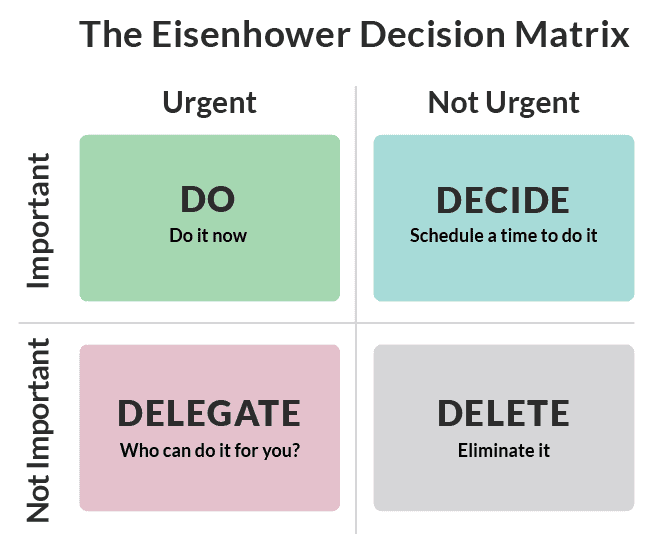
One of the biggest productivity hurdles we have today is a sense of urgency. So many things seem to come our way on tidal waves of urgency. We’re so busy and distracted that we don’t always take the time to consider if each task is also important.
This simple framework allows you to prioritize effectively in just minutes, so that you can spend your time on what truly matters, and practice letting go of the things that drain your time and give very little in return.
 Owning your time is so much more than success at work. It’s about cultivating a life of intention, living consciously, and making things happen for you. As I often say, what’s happening in one area of life will spill over into other areas. Lean into that concept to set off an inner domino effect.
Once you start practicing time ownership at work, you will naturally start to notice where you can apply it in other areas. There are 3 key areas where you may experience the biggest impacts:
Stop letting everything around you claim squatters rights on your calendar. Own your time and you will make huge steps towards becoming the CEO of your life.If you would like help making the mindset shift towards time ownership and putting it into action (or in making this happen for your team), I invite you to connect with me.

Let me ask you… how do you effectively influence people at work?
In today’s landscape, a successful leader is an agent of positive influence. That means being skilled at inspiring others to create with you. What’s most important to know about influential leadership is that it can be learned.
Yes, some people seem to be natural leaders, while others need to learn the skill. And, just as some people naturally take to swimming while others have to work at it, both end up in the same place, and both can benefit, at any stage, from developing their skills further.
In this way, you will come to know how to influence others without authority (even if you have authority… and why ditching traditional ideas of authority makes you even more influential), and develop your leadership toolbox to empower all of your interactions, both personal and professional.
(A note on responsibility: It’s not about blame, but about recognizing and embracing the simple truth no matter what is going on around you, how you show up is always a choice.)
Before we get into the hows, let’s consider the whys.

Why does positive influence matter? As a leader, why can’t you just demand that people do what you ask?
Influence needs to come from the heart, from good intentions, from being vulnerable. People can feel if you genuinely care or not. When your leadership comes from a good place, people feel it and automatically connect with you and want to co-create with you.
It’s about the unseen element: intuition. Everyone has a part of themselves that can sense – consciously or not – if someone is genuine. That intuitiveness – also consciously or not – will impact their sense of connection to you and your leadership.
When people feel connected to leadership, it shows up as:
That last point – sustainable mindset shifts – is really important. Mindset is where real change begins. Studies from McKinsey & Company have consistently found that failing to both recognize mindsets and shift them can stall just about any change effort within an organization. They reported, in fact, that not only do 70% of change efforts fail, but 72% of those report employee resistance or management behaviour as their greatest roadblock. Additionally, those organizations that do focus on mindset shifts are 4 times more likely to rate their transformation efforts as successful.
That means, the success of any new policies, objectives, or visions hinges on shifting mindsets. Let’s say, for example, you want to start empowering people to take more initiative. You can offer guidance, coaching, seminars, workshops and so on, but if people don’t shift to a mindset that believes it is safe to take initiative and that they are capable of taking initiative, the way they show up will not change.
Positive influence – when practiced consciously and consistently – is a key driver of mindset shifts that are sustainable, and that empower progress.
Positive influence is about focusing more on helping things go right, than on handling things that go wrong. It’s an overall approach that needs to become embedded in how you show up, every day.
The Arbinger Institute illustrates this through the Pyramid of Influence. In the pyramid, the bulk of an influential leader’s efforts are on that huge “helping things go right” base. These activities include coaching, providing feedback, asking powerful questions, building relationships, meeting people with curiosity, cultivating an environment of trust, encouraging creativity in the face of challenges, and so on. It’s only in the smaller tip of the pyramid where leaders focus on dealing with things that go wrong. And, if a healthy amount of time and effort is put into the larger base, there ideally should only be the occasional amount of work in the pyramid tip. If you feel stuck in the pyramid at any time, you can usually find your answer one step down.

Old-school, traditional leadership tends to be overly focused on the things that go wrong, or on preventing things from going wrong. The positive influence approach, on the other hand, focuses on how things can go well. It keeps returning to that broad, solid foundation of the pyramid to ensure stability within the team and the organization. Here are a few examples of influencing others at work using an old-school approach vs. a positive approach:
| Old Approach | Positive Approach | The Difference |
| “These are our corporate values. We all need to get behind these and live them day to day.” | “These are our corporate values. I’d like to explore our personal values and see how they can align with the corporate values. I’ll start with sharing mine.” | Old: Ignores the humanity of people and expects them to toe the line.Positive: Respects the humanness of others and invites them to explore how they fit within the organization. It also starts with vulnerability and living the example by sharing first. |
| “This needs to be done ASAP. We don’t have time to try new things, so just do it the usual way. We can talk about other ideas later.” | “This needs to be done ASAP. I feel anxious and tempted to just stick with the old way to get it done, but I know that isn’t always best. How do you feel? What else is possible here?” | Old: Shuts down any opportunity for co-creation or even discussion.Positive: Starts with vulnerability to connect at a human level. Conveys urgency as well as curiosity to keep the door open for other perspectives. Invites “us together” co-creation. Uses “opening up” questions to open up possibilities. |
| “These are our goals for the quarter. Here’s how we’re going to get them done.” | “These are our goals for the quarter. Does anyone see anything that concerns them, or anything that excites them?” | Old: Shuts the door on collaboration and ignores the wealth of ingenuity that different people bring to the table.Positive: Taps into the mind power of people by opening with a broad question that will start teasing out potential roadblocks in advance, and open up new alleys of possibility for the team and the organization. |
As you can see, positive influence looks a lot like trusting people; always assuming that they are capable of creating solutions, and welcoming them into a shared experience. It’s very much an “us together” approach that treats people as naturally creative, resourceful and whole. When people are treated this way – consistently – it challenges any old, limiting beliefs that may be holding them back from bringing their best self forward. This is when those critical mindset shifts begin to happen, both for you and the people you lead.
In her 2019 TED Talk, Halla Tómasdóttir – former presidential candidate of Iceland and CEO of The B Team, a global non-profit that promotes humanity and climate awareness in business practices – notes that we are experiencing a global crisis of trust in leadership, but that there does still exist trust between employers and employees. Because of this, corporate environments have great potential to become drivers of global change. Both employees and employers can lean into trust to drive positive influence and create shifts within the organization that may even spread beyond the business.
Increasing your influence with others starts with connecting within; with shifting your mindset.
When we think about how to influence others as a leader, we have to recognize that who we are as leaders is a direct reflection of our personal growth. The more we work on ourselves, the more confident we are, the more impact we can have on others.
 I cannot stress enough how important it is to start with you. If you aren’t in a good place with yourself, if you aren’t connected within, if you aren’t fully aligned with the approach you’re bringing forward, that will trigger other people’s intuition and create a roadblock to the human connection you need to create positive influence.
This is a journey. What’s great about this journey is that you start experiencing an impact on yourself and the world around you almost immediately, which continues to grow the further along you go.
Here are 5 steps (with resources) to get you started:
As you begin your journey to connect within, you can also start taking responsibility for:
Responsibility is about how you show up. It’s saying, “I can’t control other people’s behaviour or what happens around me, but I can control how I respond and the approach I take each and every day.”
Knowing what matters to people is probably the most valuable tool in creating influence.  When you know, for example, that a team member has a personal goal of being home in time for family dinner, you know that extra hours, even with a financial incentive, isn’t going to engage them. Instead, working with the schedule they value is how you show them they’re valued and get them engaged in co-creating solutions when workload is high. Know that sharing what matters to us or what’s going on in our personal lives takes some vulnerability. That’s scary for many people. Combat that fear by living the example. Be willing to get vulnerable first, showing people that it’s safe and acceptable to do so. It’s not about being vulnerable all the time, or over-sharing your emotions or experiences. It’s about those moments when you need to show people who you are and to share your truth, just as Starbucks CEO, Howard Schultz discovered by letting himself get emotional in addressing his employees. It’s been said that the currency of leadership is transparency. Don’t be afraid to be real when it counts. Beyond understanding how – and how not – to influence people, taking a genuine interest makes them feel seen and appreciated, and far more likely to follow your lead.
The secret to better conversations is how you listen. Not just hearing words and letting people speak, but really digging in and being with people, showing them that you genuinely want to hear them. When people raise concerns, objections, or differing perspectives, lean into what they’re saying. Repeat back – “I see what you’re saying. From where you’re sitting, this new feature is out of line with our overall objective.” – so they hear that you’ve heard, that you accept their perspective, and that their input matters. When someone raises an opinion that differs from yours, it can be reflexive to go on the defensive. But defensiveness has a negative influence – it pushes people away. Instead, lean into curiosity with powerful questions and listen. Listening to someone doesn’t mean they “win”. It simply means respecting different perspectives and considering all possibilities. And everyone wins that way.

In his much-viewed TED Talk, Simon Sinek stated (multiple times), “People don’t buy what you do, they buy why you do it.” True influence hinges on the ‘why’ and creating a shared sense of purpose is all about defining your ‘why’.We all have unique values, strengths and passions. When you can guide people to align those with a shared purpose – a collective ‘why’ – magic happens. Create a purpose statement for your team. Better yet, get your team to draft it together. If your organization has a mission statement, use that for inspiration and to stay aligned with corporate objectives, and ensure the purpose statement you arrive at is uniquely suited to your team – their contributions, their strengths, etc. Once you have a statement draft, get a discussion going around how each person feels that statement intersects with their own values, strengths and passions. You may even want to have each team member craft a personal statement that embodies their role and contribution within the team and/or organization. Then, make it a consistent element of your team’s day-to-day experience. At least once a week, connect to discuss how the team is collectively aligned with your ‘why’ and anything that feels out of sync. Put up posters as visual reminders and recognize, out loud, when you notice people working towards the team’s purpose. When people come together around a shared purpose and clearly see how they contribute and how the purpose serves them (personally or professionally), engagement, enthusiasm, motivation and collaboration naturally follow. That’s positive influence in action.
When people know you as someone who will say what needs to be said – even if it’s difficult – with compassion, curiosity and an us-together approach, you become known as someone to trust, and people are far more likely to follow someone they trust. Speaking your own truth is how it starts. From there, commit to cultivating an overall culture of trust, respect and engagement that creates a safe space for truth to come forward. Leading this safe space allows people to connect with you, and align with you, on a deeper level. Here are 9 practices for creating a culture of truth.
A person of influence understands their own strengths, values, challenges and perspectives, and does their best to understand the same in others. Using the mental models worksheet found here, you can actively develop your clarity on what truly matters to you and why. The worksheet will also help open your mind to what might matter most to others. This mind-opening exercise preps you to meet others with curiosity and compassion, showing them that you are a person of integrity, capable of truly listening, meeting people where they are, and co-creating solutions that work for everyone.
6. Focus on belonging.
People feel most engaged when they feel that they belong. Belonging is a powerful motivator and a genuine one when it is built around the belief that everything human is welcome. All experiences, ideas, perspectives, ways of being… all of it is worthy and welcome. Encourage people to bring their ‘weird’ to work – the things about them that aren’t weird at all, but are unique and human. Some companies have one day each month when employees share their side passions, interests, hobbies or even elements of their culture. Others weave this into their workplace fabric with potluck lunches, “lunch and learn” discussions, flexible schedules to accommodate personal lives, support for volunteering efforts, support for continued (not always work-related) education and so on. It’s about creating an environment where people belong, not because of their similarities, but because they’re uniquely human. This is at the heart of diversity and inclusion. Instead of getting people to fit into the system, true belonging asks, “How can the system shift/evolve/regrow to work for everyone within it?” When people feel and see that their humanity matters more than upholding old, broken systems, they can begin to feel a true sense of belonging that motivates and empowers them to align their strengths and passions with what you’re trying to create. Here are 5 ways to start putting the focus on belonging. As a leader, what you do ripples out. Focus on belonging with the team around you and it will impact the larger organization.
Influence really is all about you. How you consciously show up determines your impact, and your relationship with yourself determines how you show up. If you truly want to increase your influence at work, start within and let it grow from there.
If you would like guidance developing your influence and leadership, for yourself or your team, I invite you to connect with me.
Mélissa Dawn est la fondatrice de PDG de votre vie. En tant que conférencière motivationnelle, coach de vie et d’affaires, auteure, praticienne énergétique et autrefois VP marketing, Mélissa élabore des présentations non-conventionnelles, drôles et inspirantes qui aident les gens à se découvrir sous un tout nouveau jour et à prendre le contrôle de tous les aspects de leur vie. Elle est aussi l’auteure du livre I Attract What I Am: Transform Failure into an Orgasmically Joyful Life and Business, classé meilleur vendeur international sur Amazon. Mélissa a aidé des milliers de personnes à devenir PDG de leur vie professionnelle et personnelle avec confiance, succès et bonheur.
As seen on…..


 piret-ilver-98MbUldcDJY-unsplash


