



Every leader has experienced it.
A comment lands the wrong way.
A tone feels dismissive.
A reaction rises faster than reason.
In those moments, the mind fills in the blanks:
They don’t respect me.
They’re blocking progress.
They’re not capable.
These thoughts are human — but left unchecked, they quietly shape our leadership in ways we don’t intend.
When we pause — truly pause — something deeper becomes visible:
Our reactions are rarely about the other person.
They are about what is being projected.
Projection itself isn’t the problem.
Unowned projection is.
Owning projections is one of the most underdeveloped — and most powerful — leadership practices. It is how leaders move from unconscious reactivity to grounded, heart-led clarity.
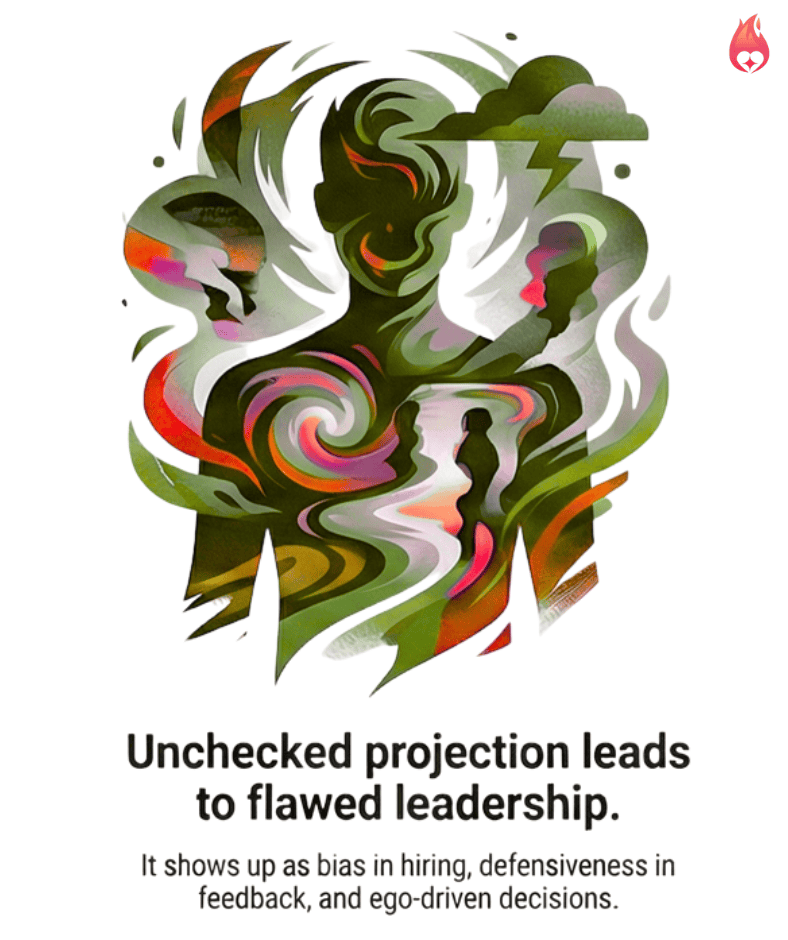
Projection is the mind’s habit of assigning our inner experience to someone else.
As Alberto Villoldo writes in The Four Insights, projection is “the mechanism that tells us: they are the problem.”
Everything we’ve lived, learned, and internalized becomes the lens through which we interpret people and situations. That isn’t a flaw — it’s part of being human.
Projection becomes problematic when leaders don’t realize they’re projecting.
In leadership, unowned projection often shows up as:
We all see through our own eyes. The goal is not to stop projecting — it is to develop awareness and ownership of our projections so we can fully own our leadership impact.
If you want another perspective on this idea in action, this is a helpful companion read:
https://conscious.is/blogs/think-youre-self-aware-try-eating-your-projections?


The Four Insights describes the Way of the Sage as an invitation to stop holding others responsible for our inner state.
Unchecked projection does the opposite — it assigns responsibility for our reactions to the people around us. This is shadow-led leadership.
The shadow is where we store the parts of ourselves we once decided were unacceptable — anger, fear, pride, longing, even brilliance.
The Way of the Sage is different.
Sage-led leadership is heart-centered, grounded, and rooted in radical self-acceptance. The Sage does not defend or suppress emotion. It examines it.
Where the Shadow reacts, the Sage asks:
“Why? Where is this coming from?”
Shadow-led leadership reacts.
Sage-led leadership reflects.
At the core of Sage-led leadership is a simple, powerful truth:
“The story is mine first.”
You may not control what happens around you — but you always control what you do next.
That shift alone returns you to the CEO seat of your leadership, allowing you to respond with clarity, confidence, and intention.
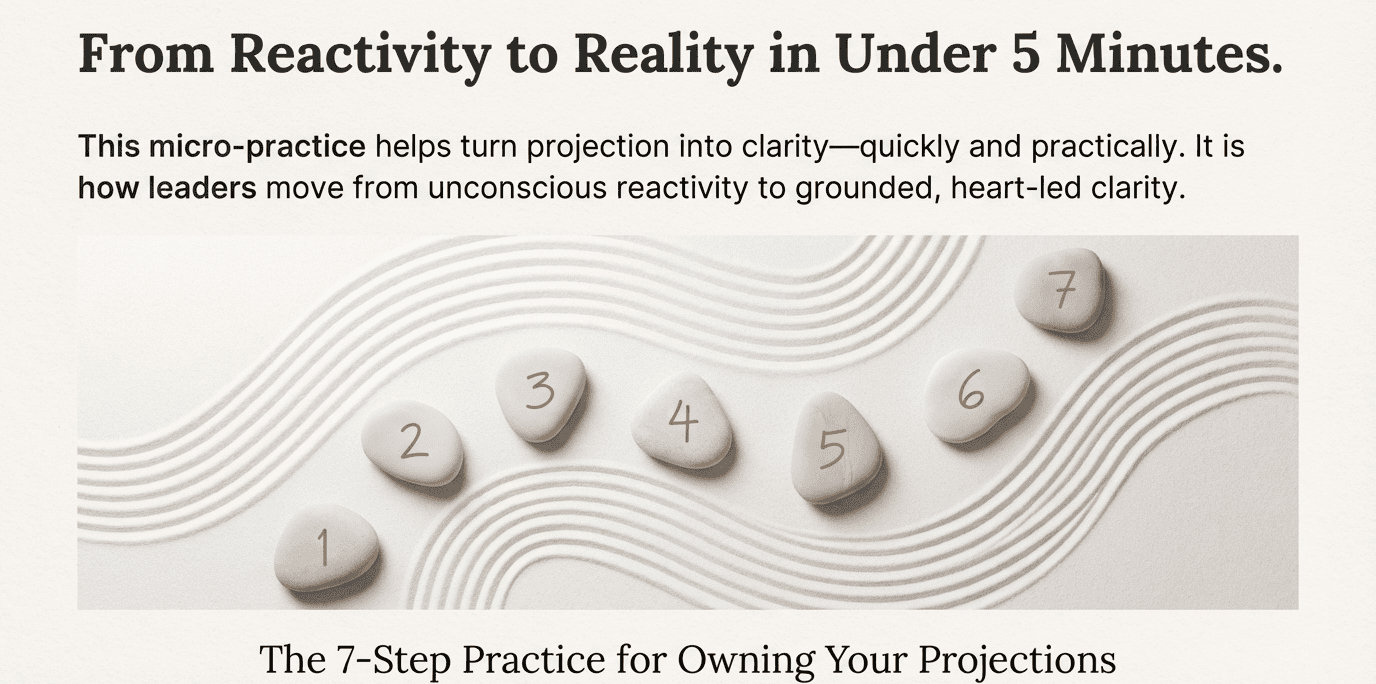
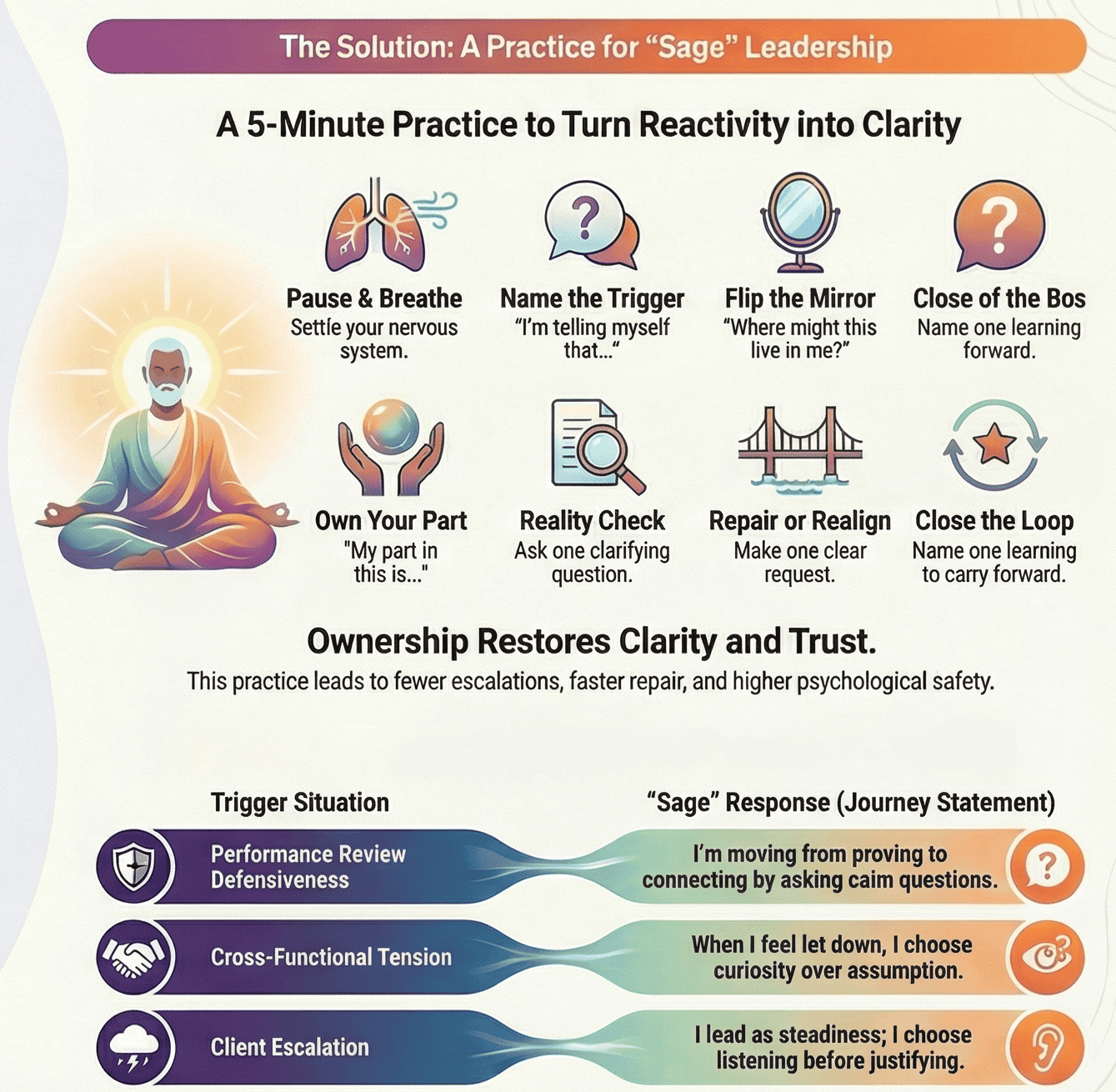
This micro-practice helps turn projection into clarity — quickly and practically.
Take two slow, five-count breaths. Let your nervous system settle.
“I’m telling myself that…”
(Notice the story that’s been activated. Whether it’s true or not is irrelevant for now.)
“Where might this live in me?”
(Projections reflect something happening internally.)
“My part in this is…”
(This is ownership, not blame.)
Ask one clean, clarifying question instead of assuming.
(From curiosity — not defense.)
Make one clear request or adjustment.
(Insight must be followed by action.)
Name one learning you’ll carry forward.
When you own your projections, you lead from reality — not fear.
We don’t only project what we reject.
We also project:
Marianne Williamson captured this perfectly: “It’s not our darkness we fear most; it’s our light.”
When we disown our strengths, we can feel triggered by them in others.
When we own them, comparison dissolves — and coherence rises.

Owning projections is the first step. The Sage goes further.
Villoldo calls this dreaming a new dream.
The Conscious Leadership Group calls it eating your projection.
Regardless of language, the essence is the same: turn insight into action.
A journey statement begins with one powerful question:
“What do I have to learn in order to move forward?”
Choose one of the following templates:
From–To Statement
“I’m moving from [old pattern] to [new way] by [practice], so [impact].”
Learning Pledge
“When I feel [trigger], I’m learning [quality], and I choose [behavior].”
Identity Shift
“I lead as [quality]; today I choose [new action] over [old reflex].”
These are not affirmations.
They are directional commitments.
Performance Review
Trigger: Defensiveness
→ “I’m moving from proving to connecting by asking calm, clarifying questions.”
Cross-Functional Tension
Trigger: Assuming resistance
→ “When I feel let down, I choose curiosity over assumption.”
Client Escalation
Trigger: Taking it personally
→ “I lead as steadiness; today I choose listening before justifying.”
Small inner shifts create powerful outer impact.

Leaders who practice projection ownership report:
Unchecked projections create stress and disconnection.
Ownership restores clarity and trust.
For seven days:
Most leaders report greater steadiness, presence, and clarity by the end of the week.

When you own your projections, you return to truth.
When you declare a journey statement, you choose to lead from your Sage.
The Sage does not ask, “Who’s wrong?”
The Sage asks, “What’s my part in this?”
That is where real leadership begins.
If you would like support integrating this practice into your leadership or organization, we would be honored to walk that journey with you. Connect with us today.


For busy executives, virtual coaching can feel like a gift. No commute. No rushing across town. Just you, your coach, and the space to show up as the whole person that you are, not just the title. Space to breathe, reflect, and connect with the leader you truly want to be.
If you’re like many leaders, you might also wonder… Can virtual coaching really be as effective as in-person?
The short answer? Yes, absolutely.
The longer answer? Virtual coaching becomes truly powerful when both you and your coach bring a little extra heart and presence to the screen, blended with strategic steps.
Because coaching isn’t about the room you’re in. It’s about the YOU who shows up.
Virtual coaching is real-time, face-to-face sessions over Zoom, Teams or another video platform. Just like in-person coaching, we talk, explore, get real, and create clarity and momentum together.
Also like in-person coaching, the real transformation happens between sessions. In the moments where you choose to pause, breathe, act intentionally, or lead from a more grounded place.
Whether meeting virtually or in-person, you and your coach co-design:
The structure doesn’t change. Only the medium does.

In person, your coach can see everything – posture shifts, breathing changes, micro-expressions and so on. It reveals more of what’s going on, beyond the words you’re saying.
Over video, those cues take more presence, heart, and practice to notice. A skilled coach will hear what you’re saying AND what you’re not saying, even over video.
And sometimes, we open up more easily online because we’re in our own space, hopefully feeling grounded and safe.
From a heart + strategy approach, we can see this as:
Both matter, and heart always leads.
Yes. Very.
An interesting effect of the pandemic is that we now have a global, real-world experiment showing that meaningful connection can happen through a screen, and that the connection largely depends on how we show up as human beings.
What we’ve learned, from research and leaders in the trenches, is that virtual coaching can increase:
And with more and more of us comfortable using virtual tools, online coaching now feels natural, accessible, and emotionally safe.
Approached with intention, virtual tools don’t dilute the coaching experience. In some cases, they can even enhance it.

Flexibility & Freedom
Access coaching from anywhere, on your own time – across timezones, between meetings, or from a quiet corner that feels like you.
Efficiency
No travel, no logistics, just meaningful connection and genuine transformation.
Confidentiality & Comfort
When you’re in a space where you feel safe to drop your masks, you show up more authentically.
Aligned with Modern Leadership
Virtual coaching supports the skills leaders need most: emotional intelligence, presence, self-regulation, and heart+strategy decision-making.
To get the most out of your sessions:
Small steps can make a big difference. They create conditions for deeper listening, stronger insight, and more powerful breakthroughs.

Many leaders opt for a hybrid model: virtual for rhythm, in-person for depth.
This mirrors how many organizations operate today. They connect virtually for rhythm and efficiency, then come together occasionally for deep collaboration, connection, and inspiration.
A hybrid model can give you:
Even when distance is an issue, a hybrid model can be possible through in-person workshops, retreats, or intensive one-on-one sessions where either you or your coach travel.

Virtual coaching isn’t “less than”. It’s evolution. It’s an impactful way to partner with someone who works in a way that truly works for you.
When you show up with presence, openness, and heart, the screen disappears. What remains is truth, alignment, strategy, courage, clarity… the real you leading from the inside, out.
If you’re ready to explore virtual or hybrid coaching, we would love to support you.
Let’s co-create a version of your leadership that feels aligned, powerful, and deeply human. Connect with us.

Leadership doesn’t begin and end with performance metrics. It begins with presence. It’s in the tone we set—through words, behavior, and even silence.
How we respond to the dynamics around us shapes team culture. It influences trust, engagement, and performance.
Microaggressions may seem subtle, but their cumulative impact breaks down psychological safety, trust, and inclusion. Left unaddressed, they create environments where people feel unseen, disengaged, and undervalued—undermining both culture and organizational results.
As Adam Grant reminds us, “The most important reason to treat people well is not what you’ll get in return. It’s who you hope to become.”
The heart of leadership isn’t just about strategy or outcomes—it’s about who we become along the way.
Ask yourself: Who do I want to become as a leader?
A leader known for accountability, integrity, and positive influence? Someone who navigates complexity with both clarity and compassion? A leader who drives results through engagement, support, development, and trust?
If so, alignment matters. Your response to harmful behaviors—especially subtle ones like microaggressions—sets the precedent for what your team will tolerate, expect, and even emulate.
Even in environments where open conversations about DEI are discouraged, how you show up still matters. Your presence, your choices, and your quiet leadership can still create powerful ripple effects.
Let your ideal leader take the wheel. Lead with strategy and heart.
Years ago, we wrote an article about letting “future you” make your decisions. Now, we’re asking you to let your “ideal leader self” steer the ship. When you make decisions from that place, you become the leader you want to be.

What is a microaggression? Microaggressions are subtle, often unintentional actions or comments that express bias toward marginalized individuals or groups. They may seem minor in isolation, but their cumulative impact is deeply harmful.
Microaggressions can be verbal, behavioral, or systemic, and may target race, gender, sexual orientation, religion, disability, or any marginalized identity.
The term was coined over 50 years ago by psychiatrist Chester M. Pierce, and while the language is now more widely used, the behaviors are not new.
Examples of Microaggressions Include:
And much more. Microaggressions are often subtle and nuanced, but easily recognizable to the people they target – and easy to learn to recognize by others.
Not every instance is automatically a microaggression. Saying “Your parents must be proud” might be kind in one context, and stereotypical in another. Interrupting a colleague is generally disrespectful—but repeatedly doing so to women or people of color can signal something deeper.
The point is this: impact matters more than intent. And as leaders, we must be tuned in to that impact if we want to create an environment of respect and belonging, where people are empowered to bring their absolute best to the work that they do.
As leaders, we often hear: “You’re not responsible for someone’s reaction. You’re responsible for your intention.”
That’s true — especially in personal growth work. When you’re setting boundaries, stepping into authenticity, or speaking your truth, that reminder is grounding and liberating.
But in leadership — particularly when power dynamics are involved — impact matters more than intent.
A well-meaning leader can still cause harm. And if we focus only on our good intentions, we risk ignoring the lived experiences of others.
Heart-centered leadership means holding both. It’s leading with clear, compassionate intent and staying open to feedback about your impact. When there’s a gap between the two, courageous leaders don’t defend — they reflect, take accountability, and realign.
That’s what builds trust. That’s what builds culture.

Responsibility assignments are a subtle but powerful way bias shows up in the workplace. They may be unintentional – but their impact is anything but “micro.”
Leaders may believe they’re simply choosing the “right person for the job,” but high-visibility assignments often go to those who look the part, based on unconscious bias—not capability.
This pattern has two serious consequences:
The unintentional nature of this issue is rooted in privilege—leaders don’t see the pattern because they’ve never had to think about it. Awareness is the first step in breaking that cycle.
Microaggressions can be subtle, coded, or even invisible to anyone but the person being targeted—a kind of “dog-whistle” communication that flies under the radar unless you know what to look for.
That’s why leadership discernment is essential. This goes beyond knowledge or intuition—it’s the ability to perceive what others might miss, and to act with empathy and clarity.
Here are three ways to sharpen your leadership discernment:
Strong leadership isn’t about having all the answers—it’s about being willing to see, learn, and evolve.
Microaggressions may seem small in the moment—but they carry a significant cost.
For those on the receiving end, the emotional and mental toll of constantly navigating or anticipating microaggressions is real. Over time, this erodes trust, motivation, and a sense of belonging.
As a leader, your mandate is to build a culture where every employee can bring their full potential forward. Microaggressions stand directly in the way of that.
Meanwhile, those who regularly engage in microaggressions—whether out of ignorance or unwillingness to grow—undermine collaboration, innovation, and psychological safety.
The Business Impact Is Clear:
In short: If people don’t feel safe, seen, and valued, they won’t stay—or perform at their best. Addressing microaggressions isn’t just a cultural imperative. It’s a strategic one.

As a leader, your responsibility is twofold:
Your goal isn’t to dig into motives, but to reinforce a culture of safety, respect, and learning. Beyond that, your goal is to position yourself as a safe, trustworthy leader for people who feel targeted, and for those who’ve made a mistake and want to grow.
Go back to the question: What kind of leader do I want to be?
Responding to microaggressions – especially if they’ve come from you – is part of this journey.
Do you want to be a leader who models accountability, humility, and resilience? Who understands the impact of strategy + heart?
If so, this is a moment to lead by example.
A direct approach might sound like:
“I’ve realized what I said was wrong. While it wasn’t my intent, I take full responsibility. I’m sorry.”
Be clear, sincere, and focused on impact over intent.
Strong leadership isn’t about never making mistakes—it’s about how you respond when they happen. That’s a big part of having positive influence as a leader.

The best way to address microaggressions is to prevent them. That starts with culture, and culture starts with leadership.
Here are five key strategies to help you lead a more inclusive, psychologically safe workplace:

Ideally, leadership means speaking your truth, even when it’s hard. At CEO of Your Life, it’s one of our core beliefs.
But, in some environments, addressing microaggressions directly may be prohibited or unsupported—especially where DEI efforts have been dismantled.
As a leader, you still have a responsibility to protect your people and foster respect, even if you need to be strategic about how you do it.
Use Subtle but Effective Language
If you can’t call it out explicitly, redirect the behavior with phrases like:
These responses defuse the moment, reinforce expectations, and create a boundary, without triggering policy pushback.
Support Targets Privately
Check in with team members who may be impacted. Validate their experience and strive to be on their side as much as possible within your constraints.
Advocate Behind the Scenes
Continue working toward a healthier culture where accountability and inclusion aren’t off-limits. Quiet leadership can still drive meaningful change.
Lead for the Culture You Want to Build
Microaggressions aren’t just personal missteps—they’re leadership signals. Every time we ignore, excuse, or minimize them, we send a message about what’s acceptable in our workplace culture.
As a leader, your influence is profound. You set the tone through your choices, your silence, your accountability, and your vision for what kind of organization you want to build.
So ask yourself:
If the answer to any of these is uncertain, that’s not a flaw—it’s an invitation. A call to lean in, get curious, and keep growing.
Be the kind of leader who doesn’t just respond to microaggressions—be the one who helps eliminate them.
The culture you lead is the legacy you leave. Make it one of inclusion, excellence, and courage.
If you’re serious about your legacy as a leader, let’s talk. Connect With Us / Explore Speaking & Workshops.

Leadership today requires more than expert strategy and masterful execution.
It also demands presence, clarity, and sustainable energy — and yet, so many high-performing leaders are running on empty.
It’s rarely the work alone that exhausts us — it’s the stress, pressure, expectations, and near-constant unpredictability.
These added strains can disconnect leaders from their WHY — the deeper purpose that fuels them. In particular, leaders driven by purpose, compassion, and a desire to uplift others seem most at risk for running on empty. In striving to do it all, they’re missing a key measurement: return on energy.
I’ve seen this pattern countless times with clients, and I’ve lived it myself, having hit burnout more than once. Each time, I came out with a deeper understanding that protecting energy isn’t optional. It’s essential. If I want to lead with clarity, impact, and heart, I need a sustainable approach to my own energy.

Leaders often tell me things like:
Does any of this sound familiar? If it does, I hear you. And you’re not alone.
What if there was another way? A way to lead powerfully, compassionately, and sustainably?

This isn’t just about wellness or productivity. It’s about treating your energy like any other vital resource. It’s human sustainability.
Energy fuels decision-making, guides interactions, and impacts leadership effectiveness. It helps you stay calm in times of stress and bounce back from setbacks.
Sustainable energy stewardship means managing your personal energy with the same intention and clarity you give to your leadership. Knowing where your energy goes, what drains it, what refuels it, and making conscious choices to protect it, is about having the strategic clarity to use your energy sustainably, for the greatest possible impact.
Essentially, it’s a strategic alignment of your energy reserves with organizational objectives.
The fact is, you can’t lead through change if you’re constantly depleted.

It’s helpful to see energy in 3 key components:
Each component is interconnected. When you feel emotionally drained, your body feels it too. When you’re physically exhausted, you get “brain fog.” Recognizing and managing these energy flows is critical to leadership endurance.
Think of it as your personal synergy. When the components work well together, the sum – your energy output – is greater than the individual parts.
On the flipside, when one component is depleted, the others can only bridge the gap for so long. Bringing them back into synergy is the only truly sustainable approach.
Try this exercise:
For three weeks, including weekends, journal daily – even if just for two minutes – on what fueled you and what drained you each day. Include your body, mind, and emotional state / inner being.
Don’t judge. Simply notice.
Over three weeks, patterns and insights will emerge. That awareness is a powerful first step — one that will guide your next leadership shift.
Remember, awareness comes first, then you can make informed decisions.
This awareness can also help identify warning signs of burnout early on, such as irritability, difficulty concentrating, and lack of motivation. These are warning signs that something needs to change.
Most of us recognize the need for nourishment, sleep and movement. We also know we need mental stimulation and brain breaks to clear our heads.
But what about emotional energy? Many of us have never learned much about it, let alone how to regulate it. Yet, in many burnout cases, emotional depletion is at the heart.
What drains emotional energy? Here are just a few causes:
Of course you can’t simply stop worrying about loved ones, or just not stress about money. What you can do, however, is let yourself recognize how these things impact your energy.
That brings us to GUILT.
What usually happens when we start feeling bad about things like caregiving, or getting trapped in a doom scroll? Or if we try to protect our energy with boundaries or rest? We feel guilty! And GUILT is a powerful energy drain.
Simply notice emotional energy drains without judgment. When that darn guilt creeps in, send it packing.

Energy resilience isn’t about controlling external circumstances. It’s about shifting how you respond to them.
Leaders face a myriad of challenges every day. Maintaining energetic endurance is crucial to navigating them effectively – both in the moment, and with the bigger picture in focus.
Take Julie*, an executive leading a growing team in a high-pressure environment. Between restructuring cycles, aging parents, and the demands of home life, she felt like there was never enough of her to go around.
On the surface, Julie was a successful high-achiever, showing no signs of burnout. Behind that mask, however, she was silently running on fumes. She was exhausted and disconnected.
When we started working together, Julie felt stuck. She couldn’t change her circumstances, so we focused on what she could change: her energy regulation.
Letting go of guilt and self-doubt was a powerful turning point. It released so much emotional energy and made her other shifts more sustainable.
None of Julie’s external circumstances changed, but her energy did. By identifying energy leaks and adding replenishing habits, she built resilience, which had ripple effects throughout her personal and professional life.
*Name and details changed for confidentiality.

Sustainable leadership isn’t about doing less. It’s about doing what matters most without losing yourself in the process.
Here’s what energy stewardship can look like:
✨ Check your energy before checking your calendar.
Before saying yes to that extra meeting or tighter deadline, ask yourself: Do I have the energy for this? If I say yes, what am I saying no to? Does this align with what’s most important right now? Energy is a leadership resource — treat it like one.
Some things we just have to do, even if our energy isn’t there. Asking yourself if it’s in alignment with what’s most important – your values and purpose, as well as personal and professional goals – can help prevent this from becoming a chronic drain.
✨ Stop glorifying exhaustion.
Rest is not a reward—it’s a requirement.
✨ Protect what fuels you.
Yoga? Quiet time? Friendship? Sleep? Connection? If it replenishes you, it isn’t a luxury–it’s a leadership essential, and it needs to be scheduled in your calendar.
✨ Reclaim energy leaks.
Worrying, overthinking, perfectionism, people-pleasing—these drain us more than we realize, and are all signs of saboteurs coming up. When you notice these voices peeping their heads, stop, take a deep breath and ask yourself, “What advice would my wiser future self give me right now?”
✨ Dig into anger.
Anger often masks fear, inadequacy, or shame. Uncovering the deeper emotion helps release energy drains. Take action by journaling, speaking to a coach or therapist, or burning the emotions.
✨ Avoid black and white thinking.
In challenging times, thinking can get rigid, and it blinds us to possibilities. When feeling stuck ask, “What else is possible?”
✨ Advocate for yourself with yourself.
Speak to yourself the way you would to a respected friend.
✨ Cut the noise. Focus on what matters.
Remember, it’s not about doing less, but about doing what matters without losing yourself. For a deeper dive, read about The Art of Non-Doing.

Heart-centered leaders give so much. While that’s part of what makes you a brilliant leader, it can also lead to burnout if it isn’t grounded in sustainable energy.
When you’re depleted:
When you’re nourished:

Energy stewardship is the key to leading with clarity, compassion, and endurance.
It’s about working smarter with your energy so your leadership can flourish.
So take the nap. Say no. Let the email wait. Dance in your kitchen. Steward your energy with care and intention.
The best leaders don’t just lead with strategy. They lead with heart. And they protect the power that makes it possible.
If you’re serious about showing up as your most effective, impactful self – your energy must come first. Let’s talk about how you can protect this most essential leadership asset. Connect With Us / Explore Speaking & Workshops.

Let me ask you… how would you describe a high-performance culture or team? Better yet, how would you go about creating one? And, if you’ve followed all the usual best practices out there, but feel your team still isn’t reaching its fullest potential, what else is possible?
A high-performance culture or team is one that works exceptionally well together, is highly focused, achieves results, easily overcomes challenges, adapts with ease, and has a profoundly positive impact on the overall organization.
It’s the kind of team or culture that organizations dream of having. Yet, it isn’t that common for people to experience, and it can be incredibly challenging to cultivate one. Why is that? What can you do differently? How can you shift your organizational culture so that high-performing teams are the norm for your organization?
In this article, we’ll explore:
There’s so much involved in the makeup of a really strong team, and each one will be different because every project, organization and industry is different. At a very high level, we can identify 4 basic, or foundational elements that high-performance teams have:
Those last two aren’t talked about enough, yet they are core to making high-performance possible on a wide scale. It’s because of those last two that conversations around high-performance teams must include organizational culture, and must include an honest assessment of your leadership and/or executive team.
In Teams That Work: The Seven Drivers of Team Effectiveness (on Amazon), authors Scott Tannenbaum and Eduardo Salas outline seven research-backed elements of successful teams. These 7 elements have been widely adopted as a blueprint for high-performing teams and are commonly referred to as “the 7 C’s.”
Those elements are:
BONUS: Psychological safety – How safe it is for people to drop their self-protective masks and bring their full strength and potential forward.

You could argue that psychological safety is an element of conditions and you wouldn’t be wrong. However…
We feel strongly that this needs to be a standout element when discussing how to make high-performing teams and culture possible within an organization. No matter what other elements you work on, without psychological safety, people can’t be their best, or be their best for those around them.
These 7 + 1 elements provide the ideal setting for people to recognize and embrace their fullest potential, and to drop any self-limiting behaviors or beliefs that may be holding them back. When you achieve that on an individual level, and combine it with supportive and co-creative leadership, magic happens.
Cultivating all 8 elements may seem daunting. Thankfully, there are practices you can put into place that touch on multiple elements at a time.
Let’s say you’ve worked on developing all of these elements. Most importantly, you’ve also worked on yourself and the impact you’re having. You feel you’ve made good strides as an executive or organization, but… those high-performing teams just aren’t happening!
What else can you do? What else might be possible? What can you do differently to achieve different results?
Rarely do we kick things off with something negative, but as this article discusses, the impact of just one toxic employee can be far reaching, and has the potential to derail an otherwise awesome team. If you have someone who is truly and consistently toxic, regardless of their expertise, remove them from the team. That doesn’t always mean termination, but do your best to get them out of the impacted team, and ideally into a role or situation where they will have the support and resources to turn their toxicity around.
To ensure you’re making the best possible hires and promotions in the future, you may consider a tool like Hogan assessments.

Sometimes bringing out people’s highest functions means supporting their most basic functions! As this article from Psychology Today discusses, how we eat impacts how our brains function.
It takes a lot of brain-power to bring your best to your work. And we’re asking this of people who have lives outside of work where they also want to bring their best. You can support that very basic need for good energy by having a strategy that makes nutritious eating easier for people. That could mean providing nutrient-rich snacks in the office, always having a pot of herbal tea ready at the start of meetings, providing protein-rich in-office breakfast, or even providing financial support for groceries.
Sometimes we can focus so much on the team that we neglect the individual development needed to form that team.
Switching your focus to individual strengths and needs can be a powerful investment in team development. This can mean coaching, an internal mentorship program, skills workshops, and so on. It can also be an investment in a program like Positive Intelligence, which empowers people to really tap into their strengths, push past their roadblocks and step into their full potential through intentional daily practice and habit forming. In a team setting, it can be the difference between having expertise and knowing how to use that expertise within a larger project.
This is essentially a growth mindset culture, but framing it as learning better captures the aspect of growth mindset that often gets ignored: mistakes. Mistakes are paramount to learning. Growth simply doesn’t happen within them.
Michael Jordan once said, “I’ve missed more than 9,000 shots in my career. I’ve lost almost 300 games. Twenty-six times I’ve been trusted to take the game-winning shot and missed. I’ve failed over and over and over again in my life. And that is why I succeed.”
Continual learning, with all the mistakes and failures that come with it, is what empowers progress and is the antidote to stagnancy. Embrace that.

For better or worse, the behavior and comportment of executives sets the tone for the overall organization. If you want a truly high-performing culture, where high-performing teams can develop and thrive, your executive and leadership teams need to adopt an approach such as transformational leadership – one that is deeply supportive and holds leadership accountable for the culture they promote.
Asking for help is one of the most productive, efficient and empowering things a person can do within a team. Unfortunately, far too many teams and organizations inadvertently make it unsafe to ask for help. Even if your organization isn’t one of those, it can be a learned and deeply ingrained fear for many employees because of past experiences. This is why modeling asking for help matters. Once again, executives and leadership need to blaze that trail and make it safe by practicing it themselves. It’s also important to regularly encourage others to ask for help, and openly recognize it when they do, but the first and foundational step is modeling.
This is an awesome idea borrowed from Harvard Business Review. Company values can be powerful drivers of employee engagement if those values are genuinely lived in the day-to-day workings of the organization.
To dilemma-test your values, look to past or current dilemmas, and imagine some scenarios that could arise down the road. Try to figure out solutions that align with your corporate values or mission statement. This exercise can tell you a few things:
When the behavior of leadership is aligned with company values, it shows integrity. It demonstrates, through actions, that you can be trusted and that you walk your own talk. That leads to higher engagement, and an engaged team is a truly powerful team.
People naturally work better together when they feel connected. Think about every person within the organization as potential future teammates and encourage that mindset for them. One way to do this is through workshops that aren’t narrowly job-focused. Workshops on communication, for example, can be valuable to anyone in any role, so you would get people from across departments working together. “For fun” workshops, clubs and events can also be really powerful in building relationships. Maybe a knitting circle, cycling club, walking group, pickleball league, pottery workshop, cooking class or book club. Initiatives like these foster relationships that wouldn’t otherwise happen, and that contributes to an overall culture of trust, respect and support.

Cultivating high-performance teamwork is ultimately dependent on the type of culture you allow to take root. There’s a saying that the grass is greener where you water it. If you want to empower high-performing teams in your organization, you need to “water” your organization with all the things that make such teams possible.
If you would like guidance in cultivating high-performing teams, transforming your corporate culture, or empowering your executives to be powerful agents of change, we invite you to connect with us.

Let me ask you… Is it safe to speak openly in your workplace? For everyone, and about all things? Is it safe to take risks and make mistakes? To ask for help? To innovate?
What I’m talking about is psychological safety, which is when all members of a group adopt and practice the belief that it is valuable to speak openly, disagree, take risks and even make mistakes, and that there will be no negative repercussions for doing so. In fact, there’s more likely to be positive recognition than anything else.
So, we want to make it safe to fail?
Yup! Personally, I don’t like the words “fail” and “mistake.” My belief is that what are often called failures or mistakes are just stepping stones of learning and progress. However, for this article, I’m going to talk about failures and mistakes because the fear of these things, and the negativity around them, prevent psychological safety, which hinders innovation, co-creation, engagement and growth.
Psychological safety empowers the habits, qualities, and ways of being that enable individuals, teams and organizations to pivot smoothly, achieve high level objectives, and continuously take themselves to greater heights. For that to happen, it must be ok to fail, be wrong, disagree, speak openly, challenge norms, and so on.
As a way of operating, psychological safety must be adopted and practiced by everyone at all levels, especially leadership.
If full, unconstrained openness and innovation are not thriving in your workplace, psychological safety is most likely where you need to put your focus. How do you do that? How do you create a culture of psychological safety in order to reap the full benefits and evolve your business?
In this article, we’ll discuss:
I love how McKinsey defines psychological safety as “the absence of interpersonal fear.” Really think about that. It encompasses everything about:
It’s all well and good to say we shouldn’t care what other people think, but the reality is that what people think about us at work has a direct impact on our success. Having psychological safety – an absence of interpersonal fear – frees people up to use the fullness of their strengths and talents. It empowers progress and innovation.

In her amazing TEDx Talk, Amy Edmonson – professor of leadership at Harvard Business School, and the person who coined the phrase “psychological safety” – refers to it as letting up on the brakes. You absolutely still want to motivate people, hold them accountable and nudge them toward their fullest potential, but you also must remove the things holding them back from actually doing that.
Taking your foot off the brakes means actively working to dismantle the fears, beliefs, expectations and mental models that keep everyone stuck.
What it comes down to, Edmondson says, is that no one wants to appear ignorant, incompetent, intrusive or negative. That’s the interpersonal fear and it drives people to put their energy into “impression management”, which is easy to do by simply never speaking up, disagreeing, asking for help, or challenging the status quo.
The belief that speaking openly could mean looking ignorant, incompetent, intrusive or negative is absolutely driven by workplace cultures. This isn’t an innate tendency to hold back; it’s people responding to their environment and their experience.
It can also manifest as interpersonal issues like gossip, toxic competitiveness, manipulation, gaslighting, and so on.
On the flip side, when a workplace has cultivated psychological safety, here are some of the qualities and habits that are empowered:
That last one is key because in many ways, speaking openly – especially with leaders – drives the other qualities and ways of being.
“Unfortunately, in many organizations, it is emotionally, politically, socially and economically expensive to say what people really think.” (Rashmi Fernandes, Agile Leadership Journey)
Think about what that statement means in terms of innovation. With those brakes on, the ideas, brainstorming, troubleshooting and creativity that naturally arise from open communication don’t have the opportunity to come up, and your team and organization stay locked in the status quo.
In addition to stifled communication, people are also hesitant to explore and try anything outside the box. It all comes back to not wanting to look ignorant, incompetent, intrusive or negative. The cost is too high.
Innovation demands a willingness to fail, so when only excellence is rewarded or recognized, or when failures and mistakes are met with shame or other negative reactions, that reinforces avoiding innovation. It creates a culture of interpersonal fear where it’s safer to stay inside comfort zones.

In order to innovate, people must be willing to take “the interpersonal risks of learning,” as Edmonson terms it. They have to believe, fully, that it is safe to fail and that they won’t be seen as ignorant, incompetent, intrusive or negative for trying.
When my son was little and picky about eating, I would always applaud him for trying a new food, regardless of whether or not he ended up liking it. The outcome didn’t matter; the trying is what counted. As a result, he was open to trying many things, which meant he discovered many foods he didn’t like, but also several he really enjoyed.
It’s the same idea with fostering innovation. Applauding the trying will absolutely result in more failures and mistakes. Those are inevitable. Let go of the outcomes. Continually applaud the trying, regardless of how it works out, and you will drive so much more success and progress than if you only applaud success and progress.
Maybe you’ve told people it’s safe, implemented a campaign, hosted a workshop, and continually repeated the message that speaking openly and making mistakes is welcome… And nothing’s changed. Why not??
Here’s the thing: people believe what they experience over what they’re told.
Sounds like common sense, right? But, far too often, organizations will say one thing, but create, foster or enable an experience that is totally different, even without realizing it. When employees don’t see something like this practiced at the leadership level first and consistently, they’re far less likely to adopt the initiative themselves. Worse still, when leadership fails to “walk their own talk”, it feels like a broken promise, which is a common cause of disengagement.
When it comes to psychological safety, it can only truly be initiated from the top because leadership always sets the tone for what’s safe, whether they do so intentionally or not.
Systems aren’t changed overnight, and neither is our way of being.

Put the bulk of your efforts into leadership, with the intention that your leaders will learn how to create psychological safety for the people they lead. Whether this is something you do fully in-house, or you engage external coaching, focus on ensuring your leaders gain the skills to create cultures of safety, are committed to doing so, and are actively putting concrete strategies into practice.
Leaders drive the culture. That’s where you need to make the biggest shift to ensure psychological safety is created for everyone, and the organization begins to see change.
McKinsey highlights three key skills for leaders to develop in order to begin creating psychological safety within their teams:
These skills cultivate trust between leaders and the people they lead, and trust is critical to creating psychological safety. It’s when employees start to truly believe that it’s safe to speak openly and step outside the box.
Honing these three skills within your leadership team will establish the groundwork for creating psychological safety because, once again, it’s your leaders who set the tone for what is safe. How leaders interact with the people they lead, and how they respond when things go wrong or during times of chaos or uncertainty is what creates (or impedes) psychological safety.
For your leaders to truly embody these skills, invest in their emotional development as part of their professional development. Leaders need to feel comfortable having difficult conversations and owning their areas of struggle. That’s not easy to do, so be prepared to really dig in and excavate some hard truths with your leadership team.
Open communication (or open-dialogue) is at the heart of psychological safety. If truly open communication isn’t currently built into your culture, it will be a challenge to achieve. To be able to communicate openly, people need to believe that it’s safe to do so. On the other hand, in order to believe that it’s safe, they need to have positive experiences of open communication. Chicken or egg?
Because of this, leaders must be prepared to initiate open communication in a variety of ways and situations, be prepared for progress to be slow and sputtered, and be committed to consistency, especially in the early stages when it might look like your efforts aren’t getting anywhere.
Trust and openness will not take off in just a few tries. It will take time, intention and commitment. There will be setbacks, failures and frustrations. Leaders must commit to seeing it through.
The following are 5 strategies to foster open communication and trust. These strategies will show results IF you are consistent and committed, even when it feels like a one-sided effort:
This article points out that when someone is first hired, they learn about the company’s purpose, values and objectives. Rarely does the company put much effort into learning the purpose, values and objectives of the new employee.
It’s often expected that employees should align their goals with company goals, but it actually needs to be a two-way street if we want people to be truly engaged, motivated and bringing their best to the work that they do.
It’s never too late to have these conversations and really get to know what matters to the people you lead. This opens up communication, builds connection, and gives insight into how you can tailor development initiatives for optimal outcomes.
If an employee is struggling to define their purpose, values or goals, that’s a great opportunity to steer them toward coaching or mentoring, which is not only in the company’s best interests, but also sends the message that, as a leader, you are there for their growth, not just their success. That builds trust and nudges those communication doors open even more.
Trust is so important to psychological safety. Often, when companies first start inviting feedback – either through surveys, anonymous suggestions, open meetings, etc – they will look for low hanging fruit to act on first. That can be a good strategy as it displays a willingness to change and an openness to input.
However, far too often, those quick wins become the only thing acted on. Worse still, some organizations will abandon change altogether thinking that the first burst is enough to make people happy. This comes across as a broken promise and that’s a surefire way to fuel disengagement.
By all means go for some low hanging fruit, or quick wins. Then start getting your hands dirty. Dig into bigger issues and, most impactfully, be open about progress.

Daily habits are what create corporate culture. Sure, there are benefits to team building events, rewards, periodic workshops, and so on. But those things are really only beneficial when there’s a foundation of supportive daily habits to build from.
What that means is, regular, even casual recognition of open communication in day-to-day life. That could sound like, “I appreciate you bringing up another side to this”, “You got us thinking about different angles and that’s important”, or “Thank you for not backing down today. Courage like that pushes us all to be better.”
Daily habits that foster communication can also mean leaders not shying away from tough topics or sharing their own struggles on a regular basis – “I feel like I’m really off the ball today,” “I’m nervous about this meeting coming up,” “I set this goal and I’m not making the progress I’d hoped for” – and regularly checking in with the people they lead – “You seem fired up today! What’s got your interest?” “You’ve got a lot on your plate this week. What can I help with?” “You seem frustrated lately. Is there anything you’d like to talk about?”
Daily habits are going to inform the transformation of your culture more than anything. As a leader, start each day by setting your intention, and end the day by reflecting on how you showed up. Let go of outcomes and focus on what you do control: you.
At a basic level, self-management means the ability, and willingness, to:
– Objectively assess your own thoughts, emotions and behaviors
– Understand their impact on you and the people around you
– Proactively regulate and adjust your thoughts, emotions and behaviors
Because leaders set the tone for safety, self-management is beyond critical. If you are not successfully managing your own thoughts, emotions and behaviors, you simply are not a person of psychological safety, and open communication cannot thrive within your leadership.
Don’t expect perfection from yourself, but do be open with the people you lead about any missteps or challenges you’re facing. Showing them that you’re working on yourself and openly experiencing struggles increases trust and makes you a safe person to be human with.
The Co-Active Training Institute outlines three levels of listening.
At level one, we hear what someone is saying, but we’re really only listening to ourselves by filtering everything through our own lens or agenda. It’s a disengaged form of listening where we aren’t putting much effort into understanding.
At level two, we’re fully focused on what the other person is saying and putting genuine effort into understanding.
At level three, we have that full listening engagement of level two, but now we’re also tuned into the unsaid – things like body language, gaze, energy levels, hesitations, changes in tone, and so on.
Level three listening really draws people in and makes them feel heard, understood and safe in what they have to say. It’s a technique that takes a lot of practice, but when done right, it’s so powerful in its impact.
What might some of these strategies and skills look like in practice? Here are a few examples:
A psychologically safe organization makes multiple channels for communication available, understanding that everyone has different comfort levels, and it’s the communicating that matters most, not whether or not someone says things face-to-face, for example.
In such companies, leaders also make use of those channels themselves. If someone isn’t approaching them, they make a point to reach out and try different channels to see what people seem most comfortable with.
When a psychologically safe organization must terminate someone’s employment, they commit to transparency with their remaining employees because they know that when it comes to fear at work, the fear of being fired or receiving a negative review is real.
These companies don’t violate privacy, but they do speak at a higher level about what led to the termination. They know that when we keep quiet, rumors start and that feeds interpersonal fear so fast.
Here are some in-depth tips on how to terminate employment respectfully.

Safe companies hold people accountable. A daily check-in such as a quick call, Zoom or in-person meeting for leaders to quickly share what they did yesterday in terms of fostering open communication, what they plan to do today, and if they are experiencing any challenges or roadblocks (similar to a daily scrum) holds everyone accountable for creating change within their teams.
This can be a powerful technique for keeping leaders engaged and motivated in adopting an approach of psychological safety, and shows other employees that the company is actively committed to change. It’s also an opportunity for leaders to get that critical practice of sharing vulnerabilities, which gives them a sense of what their employees may be feeling, which can help open up new perspectives on how to lead better.
Psychologically safe companies know that asking for help has many benefits and recognize that people have to feel safe doing so before they will ask for help.
Strong leaders may create safety by doing this themselves. They commit to asking for help – from the people they lead, their peers, those above them, and even outside support like a mentor or coach. They make sure to let their employees see them asking for help, tell them when they’ll be seeking support, and share their experiences of being helped.
They may also continually ask the people they lead how they can help them, and may reframe it as “I” requests. For example, “How can I be useful here?” or “What can I contribute?” This takes the pressure off of people so that, instead of asking for help directly (which they may fear makes them look ignorant, incompetent, intrusive or negative), they’re responding to their boss’s request to be involved.
Companies do better when they make psychological safety a priority. When you have psychological safety, it takes the brakes off of all the good things you want and need in order to thrive as an organization: innovation, creativity, adaptability, and so much more. But, it has to be fully adopted by leadership first so that they have the skills and openness to create it for their teams.
If you would like to discuss how your organization can prioritize psychological safety, I invite you to connect with me.

Let me ask you… How do you feel when someone is being phony or inauthentic with you? What about when they try to downplay bad news?
Letting an employee go is never easy, for either side, but the discomfort can be compounded when the delivery of the bad news feels phony, robotic, or lacking in humanity. It can amplify or even create feelings of anger, shame, bitterness, and so on.
Usually, when someone delivers news in a “phony” way, it’s because they’ve been advised by people trying to protect the company (which is valid and we’ll explore more), or they’re trying to minimize the discomfort of the situation (which is also valid and we’ll also explore). The problem is, neither of these goals are truly achieved when we remove humanness from the conversation.
In this article, we’ll explore:
To “fire well” means that you’ve done your due diligence in trying to make things work before deciding to fire, that you approach termination with empathy, dignity and compassion, and that you consider the well-being of your remaining employees.
Terminating someone’s employment doesn’t have to mean burning a bridge, and it’s in everyone’s best interests to lead from your heart in approaching the situation.
There are typically two reasons for terminating an employee:
In terms of the first reason, there isn’t much you can do aside from ensuring there truly is no other viable option for the organization. Some companies are looking at alternatives to layoffs, and it’s worthwhile to explore options such as furloughs and job sharing, but understandably, these alternatives just aren’t going to work for all organizations, industries or roles. Once it’s been determined that layoffs have to happen, there are some avenues to explore. In cases where a position is being cut in only one department, you may be able to suggest alternate roles within the company. I’ve seen some companies tell employees that major shifts were coming and give a period of time for people to volunteer to take a package. I’ve also heard of leaders reaching out to other companies that may consider hiring employees they had to let go. It matters to go above and beyond the “business case” and to reach for humanity. After all, it isn’t just the individual impacted, but their families, communities and others around them.

In terms of the second reason, make sure you truly have done everything you can to make things work for the employee. Have the difficult conversations that need to be had. Look into coaching, mentoring or development programs. Try different goal setting strategies. Strive to understand the employee’s perspective. Be as clear as possible about expectations and dig deep to understand why they are not being met. Ask yourself if you have done everything you can in terms of removing obstacles and/or providing resources. Involve HR or other leaders, if relevant.
Above all, make sure the termination does not come as a surprise. If there is a problem, termination should never be an employee’s first notice of that problem.
What are the key tips for terminating an employee with empathy, dignity, and compassion? Here are 7 best practices:
We’re all familiar with the analogy of putting our own oxygen mask on first. It means that if we want to be of any good to anyone else, we need to prioritize our own needs.
In the context of an air emergency, you could lose consciousness. In the context of a termination, if you haven’t addressed your own thoughts and feelings around the situation, you could so easily become triggered by their reactions, which could lead you to become hostile or defensive, to say things you shouldn’t say, to make it about you and your feelings, or some other reaction that only amplifies the difficulty for the other person, and even yourself.
Think of yourself as the flight attendant in the situation. You need to be at your absolute best so that you can remain calm, kind and supportive. Do the work to cultivate a sense of calm and connectedness within yourself. Ask yourself if you’re sliding into one of these disempowerment roles, and make a plan to stay out of that role. If you find yourself ruminating on possible outcomes and how the other person will react, explore how non-attachment can alleviate that stress and empower you to show up with compassion. Ask yourself what you need to do just before the conversation. Maybe you need to pray, meditate, exercise, listen to music, play with your dog, take a walk, call a friend or mentor. Think about what will help you bring your best self forward, and make a plan for it.
Speak like a person; like you. People can tell when they’re being fed platitudes and corporate speak, and that can add to the negative feelings that come up for them. It makes a difficult conversation so much more painful.
Often, HR will want you to follow a specific script, usually for legal reasons, but they may also be trying to make the experience as compassionate as possible, and have drafted a script that uses all the “right” phrases. The thing is, people know when they’re being fed a script and there’s no dignity or compassion in being on the receiving end of one.
By all means, use a script as a guideline, and absolutely be sure you know what you legally can and cannot say. But instead of a rote recital, tap into the part of your heart that recognizes the human being on the other side of the table, and use your own words. Let humanity come through in your tone, your eye contact, your body language. Lean forward, not away. Keep your arms and hands open, not crossed or fists clenched. Look the person in the eye when you deliver the news. Lean into transparency, which absolutely can be done while maintaining professionalism.
Let the person know that you are there to support them in any way you can (and within the company’s legal terms, of course). This can mean helping them with references or introductions, setting up regular meetings to offer advice on their job search, keeping your own ears open for potential job opportunities and so on.
Legal issues are not something I usually talk about, but I’m bringing the topic up often in this article because it is a critical part of a difficult task.
If there’s a provided script, do use that as a sort of outline and practice delivering the message in a more genuine way. Practice it out loud, and ideally practice with someone from HR who can give you pointers on what’s ok and what isn’t, but also practice with someone who can give you genuine feedback on the tone of your delivery.
Practicing out loud is actually one of the things that will put you most at ease (or as close to it as possible, given the circumstances) about the actual event, and will help you confront whatever emotions you’re experiencing beforehand. That will help you get out of any kind of disempowering mindset, and into a mindset of empathy, respect and humanity. I have done this with many clients and it helps relieve a lot of stress. It helps them feel more confident and genuine going into the conversation, which prevents putting any additional stress or discomfort on the person being let go.
One of the most critical steps you can take is to prepare yourself to not take anything personally. In fact, I strongly believe that taking things personally is one of the top things leaders should strive not to do, in all circumstances.
When you have to let someone go, emotions will likely run high, and as difficult as the task may be for you, the person on the other side of the conversation has a lot more at stake. Not only is this a loss of income for them, but also a loss of benefits, social connections, daily routine, and possibly even part of their self-identity. It can be a big blow.
However they react to the news is not personal to you. They may say things that you don’t deserve to have said to you. But you are not the one being cut loose. You’re not in the vulnerable position in that moment. Your feelings are valid and can be addressed on your own or with someone you trust later on. But for the moment, it isn’t about you. Respect that. Do the work in advance to protect your energy so that you aren’t triggered into a personal response to something that isn’t personal.

It does no one any favors to beat around the bush. Clarity is kindness. Deliver the key message within the first 30 seconds. “I’m sorry to say that we are letting you go.” (Do run this by HR or Legal as you may not be able to use the word “sorry”.) “I’m here with bad news today. We are terminating your employment.” “Unfortunately, your position here has been terminated.” Be brief and direct.
Brevity is key for legal reasons (it keeps you from saying things you shouldn’t say) and it’s respectful toward the other person.
Once you deliver the message, give a clear and concise explanation. Don’t over explain, but also don’t omit or gloss over the truth. Be honest, clear and respectful, and keep your own emotions out of the conversation.
In many situations, you may be turning the conversation over to someone from HR at this point. Some managers may choose to leave the room, but I strongly encourage you to stay for the full meeting. Good leaders stay for the hard stuff.
I don’t mean for you to rush people or yourself. As humans, we have a tendency to want to soften the blow when giving bad news and we think we’re being kind when we draw things out and pepper the discussion with apologies and platitudes. The truth is, it’s kinder to be quick.
Give them a pause to let things sink in a bit, then gently, but swiftly segue into next steps with something like, “If you need some time, let me know, but if it’s ok with you, I’d like to go over details of your severance package and how we will support you in finding a new role. I have all the information here, and we can take as much time as you need. If you prefer, we can also schedule a meeting in the next day or so to go over details.”
It should go without saying that you need to be fully informed of all details regarding severance, continuation of benefits, unused vacation, and so on before going into the meeting. You need to be fully prepared to say what needs to be said, and to answer any questions. Even if HR will be handling this part, you should be able to act as a resource as well.
At the end of the conversation, offer to walk them to their desk to gather up their things, and to walk out with them. If they prefer not to go back to their desk, still walk them out as a show of continued support. You may say something like, “I know this is a difficult situation. I’ll walk with you like it’s a normal day and we can keep up a conversation if that feels comfortable for you.” Tell them when you will check in with them and how they can contact you or HR between now and any scheduled follow up meeting.
In terms of severance, insurance details, information about unused vacation or sick days, and so on, there are probably standards the organization has in place, but if you can advocate for any additional benefits, do so.
If it’s the case, let them know that you or the organization will be happy to act as a reference in their job search, and provide the contact information they should use. If you feel you can honestly write a letter of recommendation, have a default one ready and offer to personalize it to specific roles or organizations when they start sending applications.
If there are any other ways that you or the organization can provide support, push for as much of it as you can. Are there recruiters you work with that you can refer them to? Do you have resources to help them update their CV and/or LinkedIn profile? Can you – or others in the organization – reach out to your network about employment opportunities? Can you offer them any career development resources? Whatever you can provide, do it.
A: Role playing with someone you trust (who you are legally allowed to discuss the situation with) is one of the best ways to prepare, and I cannot recommend it enough. Not only does it ensure you’re saying what needs to be said, in the best way possible, but it also gives you the opportunity to work through your personal feelings before meeting with the employee. When you’ve dealt with your feelings beforehand, it empowers you to fully show up for the other person.
As you practice, consider the different roles in the Triangle of Disempowerment: Victim, Persecutor and Rescuer. Ask yourself what role you might have a tendency to slide into and what steps you can take to stay in Hero-mode (if you haven’t, be sure to read the linked article because Hero does not mean saving anybody else). Then imagine scenarios where the other person might assume one of the three roles and determine how you can respond in a way that keeps you in Hero-mode and shines a light on more empowering choices for the other person.
Shining a light means offering guidance as well as attempting to divert their attention away from disempowering choices, but does not mean taking responsibility for what the other person ultimately chooses to do or say. It could sound like:
Essentially, establish tactics to continually bring the conversation back to next steps. The termination is happening and guiding the person toward how they can genuinely take control of the situation is not only compassionate, but respectful as well.

A: Everyone deserves to be heard, especially in times of crisis, which a termination will probably feel like (or actually be) for the other person. Active listening is allowing them to be both heard and understood.
Active listening is a technique that goes beyond simply hearing what’s said. It’s about being fully in the moment and tuned into the other person so that you notice non-verbal cues like body language and eye contact. It means listening to understand, and mirroring back what you’re hearing without judgment. Just as it’s so important to speak with dignity and compassion, active listening is how you listen with dignity and compassion.
Keep in mind that this may also be the one time this person feels able to speak freely to you, and things may be said that truly need to be said and heard. Don’t let that opportunity pass you by. Really listen and strive to understand. You may learn something that will make you a better leader for your remaining employees. If some hard truths do surface, you may also want to look at ways to cultivate a culture of openness so that truth becomes the new norm for your team or organization.
Accept that this will be hard news to hear. No amount of sugar coating will change that and there really is no way to say it that will make it feel like good news. Accept that. Fully.
Once you fully accept that, you’ll recognize that the most compassionate, empathetic way to communicate the decision is to be quick and clear.
Do not start off with small talk, make jokes, try to put everyone at ease, or beat around the bush in any way. Your body language and facial expression should convey that this is a serious conversation, but also an open one. You can do that by leaning forward and keeping your arms open, rather than crossed, and making eye contact.
Once everyone is seated, dive right in. That could sound like: “I’m sure you’re wondering why we’re here, so I’ll get right to it. We’ve had to make some hard decisions due to market shifts, and I’m sorry to say that your employment here has been terminated.” OR “… We’ve taken multiple steps to work with you on improving performance, but the data shows that no improvement has been made. We’ve made the decision and your employment has been terminated.”
A: This really depends on the reasons for termination. If this is a situation where you feel you can give a glowing recommendation and possibly even refer them to people in your professional circle, do that. Sit down with someone from HR and go through the full process of job hunting, from updating a CV, to searching for open roles, to reaching out for interviews. Identify any steps that the organization can potentially help with. You could even research coaches that specialize in supporting people through career transitions and consider offering that service as part of their severance package.
If the employee is not someone you can confidently recommend at this time, still consider offering coaching services, professional development options, or recruitment services as part of their severance package. You may be asking why you should bother in the case of a really problematic employee. Maybe their behavior was truly toxic. Why bother supporting them? As I mentioned before, you may find yourself having to work with them in some capacity down the road, but the most important and potentially influential side of the argument is the effect on your remaining employees. It matters for them to see that you handle even the most difficult situations with dignity and respect.
A: While there is no one specific technique, I would highly recommend following a formula of:
What I mean is much of what is outlined above. Deliver the news within the first 30 seconds of the meeting and keep the delivery brief. Absolutely speak from your heart in terms of your body language, tone and so on, but don’t pepper the conversation with your own feelings or perspective. If anyone is going to be openly emotional about the situation, it’s the other person. Respect that.
A: For starters, if you feel that you may be in physical danger, by all means shut down the conversation and get help. If violence or aggression is something you fear prior to meeting with the person, speak with someone above you about options, make sure you are not alone in the room, and have security standing by in the event they are needed.
That’s an extreme situation and one not to be taken lightly. However, most situations will not be like that and the emotions and reactions that come up – even the angry ones – should be addressed with humanity, compassion and respect.
As mentioned above, active listening is a powerful technique. When someone sees that they are truly heard and understood, that really can help calm difficult emotions.
Avoid telling them to “calm down.” That phrase has never helped anyone calm down, and can often have the opposite effect. Instead, opt for something like, “I hear you and I really do understand.”
Connect with your inner leader – your intuition – to help you dance in the moment and respond to what comes up. Does it feel helpful to redirect them towards next steps, or is your gut telling you they need time? Does it feel right to offer a follow up meeting once they’ve had time to digest? Do they seem ready to hear about severance details? Connecting with your intuition and striving to respond rather than react is another way you can bring humanity into the situation.
A: If this is a situation where the employee is being fired for cause, be forthright about the cause, but keep it brief. If the employee has made a genuine contribution to the organization or has displayed valuable skills/knowledge, bring that forward as well. “These are the areas where I see real potential and strength for you. Unfortunately, your employment here has come to an end, but in the future, these are some areas that I believe you can grow from.”
If the termination is about a financial or market shift, give an honest rundown of their contribution to the organization and how it has benefited the company. This makes it clear that the termination is in response to other circumstances, and is in no way a reflection of the employee. A termination can be a real blow to someone’s confidence, so do address strengths, just be sure it’s genuine and not flowered up. People can tell the difference.
As mentioned above, strive to continually steer the conversation toward next steps. What the person does next is where they truly have control and continually guiding them back to that can truly help preserve their dignity. It’s up to them to recognize and seize that control, but in a time of high stress, it can be helpful to have someone act as a beacon, guiding them in that direction.
On a more practical note, have a conversation with them about how they’d actually like to leave, and let them lead that. Would they like to pack up their own things, or would they prefer to have someone else handle that? Would they like the opportunity to say goodbye to colleagues or to send a leaving email? Are they ready to take those steps or would they prefer to return the following day? Obviously there may be company guidelines to follow, but strive to allow as much flexibility as possible.
A: A really important factor is to have all documentation printed, packaged and ready to hand to them, as well as digital copies emailed to their personal email address. This is so important in empowering people to move forward with dignity and respect. No one should be having to chase down paperwork in the days following a termination. It’s disrespectful to their situation and it keeps them tied to the company after they’ve left, which can hold them back from fully moving forward.
Above all, be honest and human.
Remember that how you handle issues with this employee will impact your other employees. They will be taking note of everything you say and do, and it will influence their trust in you and the organization, how safe they feel with you and the organization, and all of that will impact their engagement, which impacts their productivity, creativity, sense of loyalty, willingness to collaborate, and so on.
Be sure to also have a plan for handling the workload. Please ensure it’s a genuine plan and not just, “we’re all going to have to pick up the slack for now.” If people will need to take on extra work during the transition, be open about that, provide an anticipated timeline, and be prepared to provide compensation for additional work in the form of pay or paid time off.
If this is a situation where layoffs were due to financial strain and you cannot compensate employees for added workloads, be honest about that too. People will figure it out regardless of how you approach the situation. If you show up with honesty and transparency, they are far more likely to react positively and to be on your side.
Finally, if this is a situation where the person was fired for cause, recognize how your remaining employees are a good fit for the organization and its goals. Whenever someone is let go, it’s natural for others to start worrying that they will be next. While you can’t give confidential information about the terminated employee, you can calm fears and rumors by being open about your employees’ value. In fact, you should be doing this anyway ;)
Remember that people are deeply intuitive and will sense when something is “off” or inauthentic, even if they can’t quite put it into words. Be human. Be real. Be kind.
If you would like guidance on building strong teams, developing compassionate leadership, or empowering your organization to thrive through even the most challenging situations, I invite you to connect with me.
Be direct and clear, deliver the news in person and in private, let the employee speak, allow for a graceful exit, and offer practical support around references, benefits, and transition.
Lead with respect and brevity. Avoid surprises by ensuring there have been honest performance conversations beforehand. Focus on the path forward rather than re-litigating the past.
Don’t blame, don’t lecture, don’t soften with vague language that creates confusion, and don’t compare the employee to others. Keep the message clear and respectful.
Let me ask you… Do you feel guilty when you aren’t actively productive? Do you scroll on your phone while watching TV? Do you feel like no matter what you’re doing, you’re thinking about what else you should be doing?
If any of that is hitting a chord with you, I strongly encourage you to explore non-doing.
What is non-doing? For starters, it doesn’t mean doing nothing. Instead, it means doing what’s necessary in the circumstances; no more, no less. For many of us, it’s the “no more” part that we struggle with, but the “no less” part can bring its own set of challenges.
We are in a time where constant doing is what’s most validated. The always-on-call employee, the overworked parent, the exhausted student, the 24/7 leader… we know these aren’t healthy lifestyles, but we still hold them up as paragons of productivity and worthiness. The more productive someone is, the more worthy they are, and that’s just a terrible way to experience the world.
Non-doing is an antidote to the “always on” culture that we’ve enabled. It’s how you can start to reclaim your time, your energy, your relationships, and your joy.
In this article, we’ll explore:

“Non-doing” is most commonly associated with the Taoist practice of wuwei, which can be translated as “in-extertion” or “effortless action.”
In Taoism there’s an understanding of “tao” as the natural order of the Universe. This natural order creates a natural, organic flow of life. Wuwei is the practice of going with this flow rather than fighting against it.
Taoism is a Chinese belief system that goes back thousands of years, so it evolved during a time and place that would have looked very different from today’s western world.
Back then, people didn’t have smartphones in their pockets, spreadsheets to sift through, or overflowing inboxes. But they did have plenty of things that would have created urgency. Things like droughts, wars, famines and epidemics. They would have been very familiar with the feeling of needing to be constantly doing in an effort to survive. In that sense, we may have more in common than first thought.
With wuwei, the core idea is that when no action is needed, doing anything is over-doing, which can cause more harm than good. This article uses the example of caring for a plant. When the plant has adequate water, nutrients and light, there is no more to be done. Doing more would be over-doing, and could be harmful. For example, if you give a plant more water than it needs, the roots rot and it dies. Too much sun, and its leaves burn and fall off.
An example in our daily life would be excess worry. Worry – even anxiety – serves a necessary purpose. It helps us avoid danger, prepare for upcoming events, and so on. When worry goes into overdrive is when it causes us harm. We can become paralyzed by it, or exhaust ourselves.
Other examples could be over-working, overly tweaking our diets, micromanaging the people we lead, saying yes to things when we’re already overbooked, having a “rescuer” mindset, and a really sneaky one… guilt! When we feel guilty about not doing more, more, more, that’s over-doing sneaking into our lives.
On the flip side, there’s under-doing. I mentioned above how over-worrying can lead to a sort of paralysis. In that state, we often end up not doing things that really do need to be done. We can also let important things slip through the cracks when we’re over-doing in other areas. When we get inundated with all the little urgencies and distractions of daily life, the truly important stuff gets lost. That’s where over-doing can lead to under-doing, and where non-doing can help you combat both extremes.
It’s so important to repeat that non-doing is not “not doing”. It’s doing what’s necessary in the circumstances; no more, no less, which means your primary focus is tuned into genuine needs and priorities.
The benefits of this approach are far-reaching, and can include:
Non-doing is about filtering out the mind clutter, the to-do clutter, the unnecessary distractions, and all the things that take you away from what’s really important to you. That includes everything from your relationships at home to your goals at work. It means all those things in the back of your mind that you’ve mentally tagged “someday” start getting space to move into “today” and the richness that that brings to your experience of life is priceless.

How can doing less end up creating more?
In terms of creativity, it comes down to not being overwhelmed. The mind needs space to roam and explore in order to see possibilities and create solutions. When we’re overwhelmed, our minds get stuck in a sort of survival-mode. So much of our energy goes into putting one foot in front of the other that we have very little left to tap into our creative side.
What’s important to remember is that we’re not just talking about art or design. What takes a huge amount of creativity are activities like problem-solving, future-planning and strategic thinking. If we think of the human brain in terms of levels, it’s our “higher brains” that deal in creativity, and our “lower brains” that take over when we’re overwhelmed. Non-doing empowers you to tap into those higher brain skills.
With productivity, we all know the experience of constant busy-ness, without getting anything of substance done. Substance meaning it’s moving you closer to your goals, or addressing a very real need. I call this “hamster wheel-mode” because like a hamster in a wheel, we’re running ourselves ragged without actually getting anywhere.
Non-doing steers you away from that empty busyness and toward the actions and decisions that actually produce something for you. That can be productive choices at work, as well as choices in your personal life that produce meaning and fulfillment.
It may seem counterintuitive to have to do things in order to do less. But let’s remember what non-doing really is. It’s doing what’s necessary. Establishing balance in your life is necessary! Doing the work to learn about and incorporate non-doing is an act of non-doing.
Our natural state of being should be to feel at ease in our world. Not for life to be easy, but to feel confident about our ability to overcome obstacles, to have support when we need it, to feel that we’re investing our energy in the right things for us, and to not become burnt out by the challenges of life.
Doing things to incorporate non-doing is a natural and necessary form of doing, which will help protect you from the pull to overdo.
Here are 5 steps to incorporate non-doing into your life:
Your values and purpose serve as your personal guiding light. They will point you in the direction that’s right for you, realign you when needed, and guide you away from the things that don’t serve you (i.e. all the over-doing). If the idea of a life purpose doesn’t quite resonate with you, consider the concept of Ikigai. It’s about digging into what matters to you and what matters about it, so that you can consistently make choices that align with it. That’s where we create meaning in our lives.
You cannot control what’s happening around you, and will always be exposed to messages and energies of do, do, do.
Mindfulness practices are about awareness of the moment, without the need to do anything immediately, including judging what’s coming up.
Meditation is probably the most well-known mindfulness practice. Contrary to common belief, meditation is not about clearing your mind, but about calming your mind. In meditation, thoughts of your to-do list will still come in, but the practice is to try simply noticing those thoughts, acknowledging their existence, but not assigning them any urgency. This allows you to more clearly see how (or if) all of these things align with your values and purpose.

When we’re caught in a habit of over-doing, it really is hard to see the forest for the trees. Working to clarify what you really want for yourself will help you better identify what over-doing and under-doing look like for you.
Personally, I like to create a vision board once I’ve gotten clear on my big picture. I use them because they give you a visual reference point to evoke the energy of your ideal future. That’s a huge advantage when it comes to setting priorities.
If vision boards aren’t your thing, I encourage you to still go through the process of building a clear vision for yourself (click the vision board link above for how to do this) and write it all out. You can use full paragraphs, point form, word clouds – whatever makes sense for you, but strive for detail and to really dig into the energy of your big picture.
Take time, each day, to tune into your big picture vision. Doing this, even for just a few seconds, can leave an imprint – like a mental footprint – to keep you focused on what truly matters.
Guilt is a massive driver of over-doing, and even under-doing if your guilt is contributing to a sense of paralysis or powerlessness, or drawing you away from what’s truly meaningful to you. To me, guilt is one of our strongest Saboteurs. It’s like a gremlin in our minds, constantly telling us we aren’t enough. It’s also a big ol’ liar.
Explore your guilt. Look at it from all sides and get really familiar with it, so that you can easily recognize when it’s cropping up, then shut it down.
Unconditional responsibility may sound like the opposite of non-doing, but it’s actually a powerful tool in helping you clearly see what is truly necessary for you and what would be considered too much (or too little).
Practicing unconditional responsibility means recognizing that you are only responsible for your intentions, your choices and your responses. You are not responsible for how anyone else reacts or for things that come up around you. Even as a parent, you are 100% responsible for how you choose to parent, but you aren’t responsible for things like your children’s moods and – this may sound crazy – how they behave. With unconditional responsibility, you’re responsible for how you respond to how your children behave. The same is true in leadership positions. You aren’t responsible for how other people behave or the choices they make. What you’re responsible for is what you do in response.
Unconditional responsibility is about training your focus onto things that you have genuine control over so that you can direct your energy to where you can have the greatest impact, rather than dumping energy into thoughts, feelings and beliefs that keep you stuck.
Non-doing can be one of the most difficult habits to adopt because the world around us is designed for over-doing, and it all comes down to the idea of scarcity.
A scarcity mindset believes that there just isn’t enough of anything to go around. Enough money, jobs, housing, time, resources, and so on. In a scarcity-focused world, we have to do, do, do in order to have safety and security. If we don’t – if we stop to rest – we’ll miss out, not be good enough, or even lose something really important to us.
The scarcity and over-doing messages around us create a heightened sense of urgency and guilt, and that’s what you need to work through.
Here are 3 tools to help you overcome these obstacles:
In the steps above, we explored core values and life purpose as your guiding lights. They will keep you focused on doing only what truly needs to be done and empower you to recognize over-doing tasks. But, that’s easier said than done. Visual reminders are a powerful tool for embedding new habits because they keep your new habit top of mind.
As I mentioned, I use visions boards because they help me to really assume the energy of what I’m trying to create. If that doesn’t work for you, even something as simple as a post-it note in your workspace, a picture, or a meaningful knick-knack can help hone your focus.
The Eisenhower matrix is a task management tool for prioritization. Start by writing out your to-do list, or even just all the “shoulds” on your mind – things like, “my house should always be tidy”, “I should be staying later at work”, “I should be working out more”, and so on.
Once you have your list, get a second piece of paper and sketch out the matrix, or print one out (the link above has a printable PDF). You can even keep a stack of printouts on hand to really make this a habit.
Put each item on your list into one of the squares, using your values, purpose and visual reminder to guide your decisions.
This will help you stay focused on what genuinely matters to you. If something is urgent and important, it gets done first. If it’s important, but not urgent, it gets done next. If it’s urgent, but not important, you can delegate or even let it drop. If it’s neither urgent nor important… bye-bye!
As a tool, I love this question. Whenever I feel strongly that something matters to me, or I notice it’s taking up a lot of real estate in my mind, I ask myself, “What about this matters to me?” It helps me really dig into where my feelings are coming from and what outcome I’m expecting.
Sometimes this question helps me affirm my values, purpose and vision. I get clarity on how the issue fits into my personal big picture, and then I can prioritize it using the matrix.
Other times, I dig in and find that the feelings are influenced by something outside myself. For me, it’s often around making someone else happy, or worrying what someone will think. That clarity makes it easier (not always easy, but easier) to work on letting it go and avoiding falling into an over-doing cycle.

Non-doing is really about embracing a good-enough life. So many of us keep striving for better and better. That’s great for things you’re passionate about, but it becomes a form of suffering when we strive for perfection in all areas. We get overwhelmed, we burn out, we beat ourselves up, and worst of all, we don’t stop to just enjoy the good-enough, and celebrate ourselves for creating it.
What areas of your life, right now, are good enough? What do you criticize yourself for? How would it feel to say to yourself, “You know what? This is good enough. I’m going to feel proud of myself for it, and move on.”
You deserve to enjoy your life. Commit to breaking the cycle of over-doing.
If you would like guidance, for yourself or your organization, on ending the over-doing habit and focusing on what truly matters, I invite you to connect with me.

Let me ask you… When was the last time you asked for help at work?
Many of us struggle with asking for help. Myself included. Doing so at work can feel especially intimidating, and there are many reasons for that. We may fear being seen as incompetent or lazy, it might feel too vulnerable, we might worry that we’re burdening people with the request, and so on.
The thing is, asking for help is actually really important in work environments, and it’s more than just getting the support, answers or guidance you need. In fact, asking for help can be one of the greatest drivers of collaboration, inclusivity, complex problem-solving, increased productivity, higher engagement, trust and more. At a more personal level, it’s an opportunity to expand your knowledge and understanding, and it can be critical to balancing your workload, and preventing burnout.
In this article, we’ll explore:
There are benefits at all roles and levels of an organization. In fact, the impact can be significantly greater if you’re in a leadership position because how you show up sets the tone for what’s safe (and what isn’t) in your team.
The obvious benefit, of course, is getting the help, support or guidance you need. Beyond that, the benefits are significant. That’s because being asked for help is such a great thing. When someone asks for our help, it feels really good. We feel needed, valued, and recognized. It validates our usefulness in a team, and puts us on an even level with the person asking. That can help with everything from disengagement, to burnout, to things like imposter syndrome.
All that said, what are some benefits of asking for help at work? There are 4 core benefits:
“How do I overcome the fear of asking for help at work??” This is a question I get a lot.
Essentially, we worry mostly about how other people will perceive our need for help. And it turns out, we worry needlessly. In fact, a social psychologist at Stanford University looked at a variety of studies that found the opposite of our fears to be true. Most people want to help, are happy to be asked, and feel really good about it!
The fact is, there might be people on your team who perceive asking for help as a weakness, or may even try using it against you. These are toxic attributes that say more about where the other person is at than anything else. Don’t focus your energy on these people. What you focus on is what expands in your life, so strive to focus on the people you feel you truly can build trust with.
First, remember that you are worthy of support, and that by asking for help, you’re contributing to a better work environment for everyone. Before you start on the specifics of how to ask, get yourself into that headspace. I find guided meditations are impactful in helping me assume that empowering energy. For you, it may mean taking a walk, dancing to your favorite playlist, making yourself a cup of tea… give yourself that time and focus.
That, I would say, is the most important thing. The second most important thing is clarity. Strive to be as clear as possible about what you’re asking, and any relevant specifics, including a timeline. Clarity not only helps you, it also helps the other person, and is a way of showing respect for their time.
This article in Forbes recommends using the SMART technique, which is usually for goal setting. In the Forbes article, some of the words are changed slightly to fit with a help request:
I would add a “D” and a “G” to this, although then it wouldn’t spell out an easy-to-remember to word:
Here’s how a SMARTDG (See? Not a great acronym.) request might look like in practice:
Good morning Jen,
How are you?
I would really appreciate your help figuring out the reason the sales totals don’t match up in the two attached reports.
The issue is that the total sales amount from Source A is different from that of Source B, and they should be identical. I have tried X, Y and Z, but haven’t been able to figure it out.
These figures are being presented at the board meeting next week. This is why it is so important we have the correct number, and understand what’s causing the discrepancy.
I know you’ve worked through similar reporting issues in the past. Is this something you can help me with this week?
I know we’re all working at full tilt these days. I really appreciate any help you can give. I will make it up to you!
Thank you!!
Dan
As you can see, there’s a:
When is it appropriate to ask for help at work? In asking this question, we can be asking about time of day, or circumstances.
There really is no wrong time, although do try to tune into the other person’s energy and what is going on for them in the moment. For example, when someone just arrives at the office and is settling in, or they’re getting ready to leave for the day are not the best times, unless you’ve determined your request is both urgent and important.
There’s a simple matrix for helping you decide the importance and urgency of something. It looks like this:
Something that’s urgent means a deadline is fast approaching, or there’s some other element of timeliness. Something that is important is in alignment with the goals and purpose of the organization, or will otherwise have a significant impact on the organization.
Many things can feel urgent, but are they important? When that feeling of urgency fills our bodies, it can cloud our view of the important – the big picture vision. We don’t want to use up our own energy on things that keep us in hamster wheel-mode, and we don’t want to inflict that on others either.
If it’s a busy or stressful time – overall or for the person we’re asking – take the time to ensure that your request is both urgent and important before asking. If it’s important, but not urgent, ask later. If it’s urgent, but not important, consider other avenues, or even just dropping the issue. If it’s not urgent or important… let it go!
 Circumstances:
Under what circumstances is it appropriate to ask? Any situation where you feel in need of support is an okay time to ask. That said, working through fears and anxieties around asking for help is a struggle. Seeing how your request fits within the well-being of the organization can help build your confidence in asking.
Here are some common situations when it is not only appropriate, but so incredibly human to ask for help:
When it’s a question of expertise, you of course want to ask someone with the knowledge or experience needed. If it’s approval you need, then you need to ask whoever is able to grant that approval.
Often, what we really need is someone to share the load or help work through a problem, and in that case, it’s pretty open who you can ask:

For me, mistakes are really “mis-takes.” Just as I find it more useful to see failures as stepping stones, a mis-take is just an attempt that didn’t go the way we wanted or expected. It’s nothing terrible, it’s just something to grow from.
That said, we can also learn from the mis-takes of others. Here are 3 common ones I’ve come across, and tips to help avoid them.
I mentioned following up with gratitude. This is so important, and it’s part of what will contribute to an overall culture of trust, engagement and collaboration.
After you get the help you need, say thank you and be specific in your thanks. That might sound like, “Thank you for your last minute support. I know it meant working late that day, and because you did that, we were able to make our deadline. We really appreciate you.”
Here are some other ways to take your gratitude further, and keep that momentum going.
Gestures of appreciation are so meaningful. Everyone has experienced moments where their confidence has dipped, or they felt insecure about their contribution and value at work. Being recognized in this way makes people feel seen and appreciated, which can have a huge influence on their well-being and engagement at work.

What do you do if you don’t receive the help you need at work?
First, consider why you didn’t get what you needed. Was the other person too busy, or perhaps didn’t have what you needed? Were you not clear in what you were asking for? Could they not have seen your request, or maybe forgotten? Did they give you a flat out “no” without a reason?
Once you have some clarity on why you didn’t get help, then you can decide what to do. Here are some steps you might take, depending on the situation:
As a leader, you have two key roles to play in terms of asking for help:
We live in a society that celebrates independence to a fault. Meaning, people’s fears around asking for help are actually supported by the society they live in. So, when they do come to you, it’s taking a lot of courage and inner strength to take that step. Your job is to make sure you’re creating a safe environment to ask for help.
Start by thanking them for coming to you. That can be as simple as, “Thanks for bringing this to me.”
Assume an approach of servant leadership. Your goal as leader is to make sure the people on your team have the resources they need to succeed, and to do whatever you can to remove roadblocks. How can you do one or both of those things in the situation they’ve brought to you?
Remember, how you respond to requests for help will be remembered, and it will leave a deep impression on the person doing the asking, anyone who’s around when they ask, and anyone they speak to about their experience. This puts you in a powerful position to create either a positive, or negative impact that will have far-reaching consequences. Choose wisely and consciously.

As a leader, how you show up sets the tone for what’s safe for others. When do you ask for help? Are you open about your own needs for support and guidance?
The most effective leaders aren’t usually the ones who uphold personas of perfection. Usually, they’re the ones who are the most human. They aren’t afraid to be vulnerable, and asking for help can feel really vulnerable.
In my leadership training, we once did an exercise where we were all blindfolded and had to find our way out of a maze. We were not allowed to speak to anyone, but if we couldn’t find our way out, we could raise a hand and help would come. About 7 minutes in, I realized I just could not find an exit. I raised my hand and help came. The teacher lifted my blindfold and I saw… there was truly no way out! There were 25 people in the group and after an hour, a handful of people were still blindly searching for an exit, without raising their hands. The learning was, there is no progress without asking for help. Even for leaders. If you simply refuse to raise your hand, you’re just spinning in your own maze.
Raise. Your. Hand. Commit to openly asking for help. If you have a mentor, coach or higher-up who helps you, talk to your team about that. Share your experiences of needing help both as a leader, and before you were in that role. Share times when you should’ve asked for help, but didn’t, so that they can learn from your mis-takes. Make it as clear as possible that you value asking for help.

The impact of asking for help goes so far beyond having your needs met. It’s something that we should all be working to normalize and to make safe in our work environments. If you like guidance for yourself, your team or your organization on making asking for help safe and welcome, I invite you to connect with me.
Key Takeaways
When you ask for help, you contribute to creating an environment where it is ok to seek support, which fuels trust and engagement, empowers others, and helps prepare you and others for future roles.
Mélissa Dawn est la fondatrice de PDG de votre vie. En tant que conférencière motivationnelle, coach de vie et d’affaires, auteure, praticienne énergétique et autrefois VP marketing, Mélissa élabore des présentations non-conventionnelles, drôles et inspirantes qui aident les gens à se découvrir sous un tout nouveau jour et à prendre le contrôle de tous les aspects de leur vie. Elle est aussi l’auteure du livre I Attract What I Am: Transform Failure into an Orgasmically Joyful Life and Business, classé meilleur vendeur international sur Amazon. Mélissa a aidé des milliers de personnes à devenir PDG de leur vie professionnelle et personnelle avec confiance, succès et bonheur.
As seen on…..




