
The Way of the Sage at Work: Owning Your Projections
|
Getting your Trinity Audio player ready...
|
🌿 The Way of the Sage at Work: Owning Your Projections
Every leader has experienced it.
A comment lands the wrong way.
A tone feels dismissive.
A reaction rises faster than reason.
In those moments, the mind fills in the blanks:
They don’t respect me.
They’re blocking progress.
They’re not capable.
These thoughts are human — but left unchecked, they quietly shape our leadership in ways we don’t intend.
When we pause — truly pause — something deeper becomes visible:
Our reactions are rarely about the other person.
They are about what is being projected.
Projection itself isn’t the problem.
Unowned projection is.
Owning projections is one of the most underdeveloped — and most powerful — leadership practices. It is how leaders move from unconscious reactivity to grounded, heart-led clarity.

What Is Projection — and Why It Trips Up Leaders
Projection is the mind’s habit of assigning our inner experience to someone else.
As Alberto Villoldo writes in The Four Insights, projection is “the mechanism that tells us: they are the problem.”
Everything we’ve lived, learned, and internalized becomes the lens through which we interpret people and situations. That isn’t a flaw — it’s part of being human.
Projection becomes problematic when leaders don’t realize they’re projecting.
In leadership, unowned projection often shows up as:
- Hiring: Overvaluing or dismissing traits we’ve disowned in ourselves
- Feedback: Hearing judgment where there is only data
- Collaboration: Reacting to tone instead of intent
- Decision-making: Defending identity instead of exploring possibilities
We all see through our own eyes. The goal is not to stop projecting — it is to develop awareness and ownership of our projections so we can fully own our leadership impact.
If you want another perspective on this idea in action, this is a helpful companion read:
https://conscious.is/blogs/think-youre-self-aware-try-eating-your-projections?

From Shadow-Led to Sage-Led Leadership

The Four Insights describes the Way of the Sage as an invitation to stop holding others responsible for our inner state.
Unchecked projection does the opposite — it assigns responsibility for our reactions to the people around us. This is shadow-led leadership.
The shadow is where we store the parts of ourselves we once decided were unacceptable — anger, fear, pride, longing, even brilliance.
The Way of the Sage is different.
Sage-led leadership is heart-centered, grounded, and rooted in radical self-acceptance. The Sage does not defend or suppress emotion. It examines it.
Where the Shadow reacts, the Sage asks:
“Why? Where is this coming from?”
Shadow-led leadership reacts.
Sage-led leadership reflects.
At the core of Sage-led leadership is a simple, powerful truth:
“The story is mine first.”
You may not control what happens around you — but you always control what you do next.
That shift alone returns you to the CEO seat of your leadership, allowing you to respond with clarity, confidence, and intention.
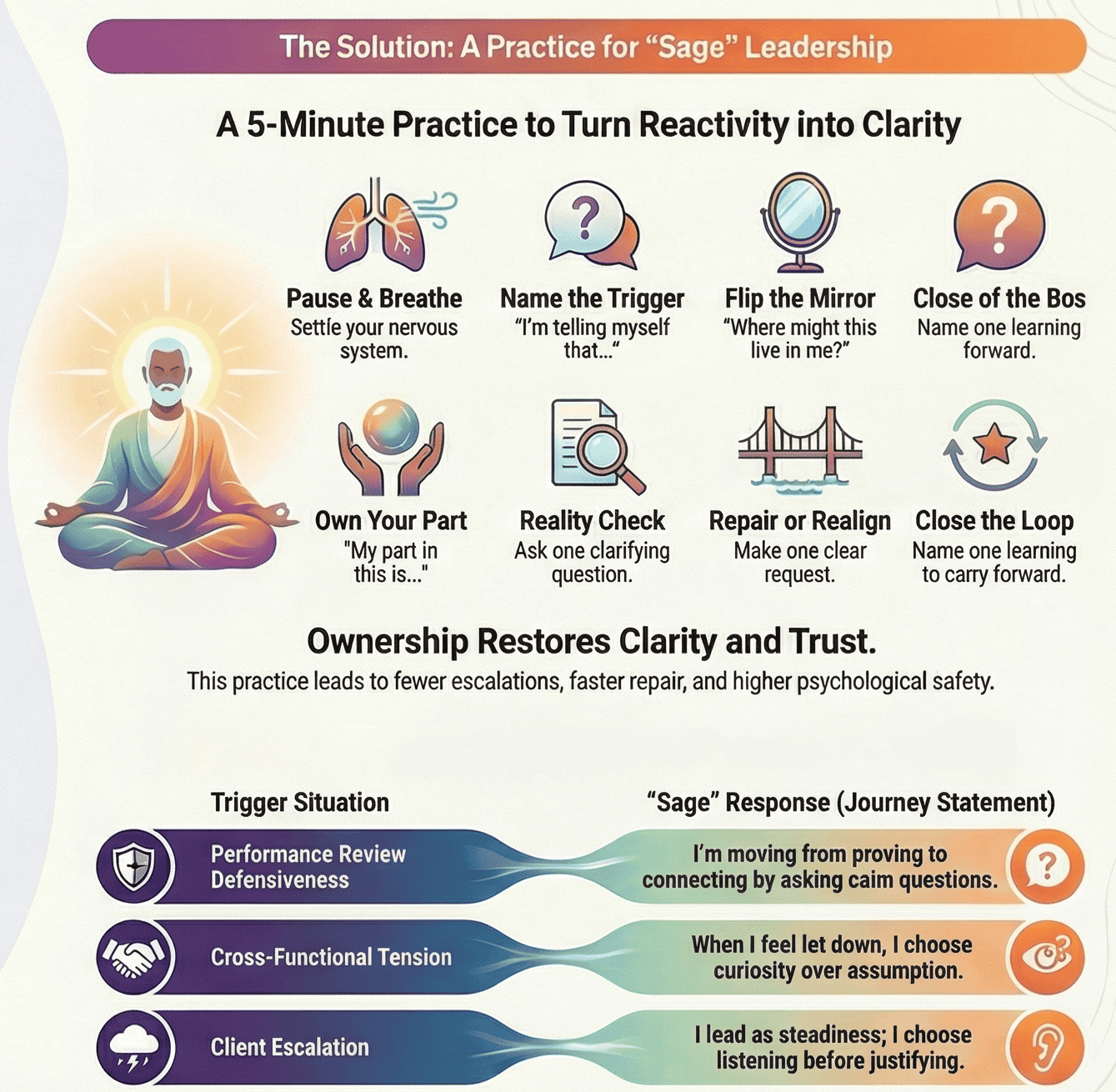
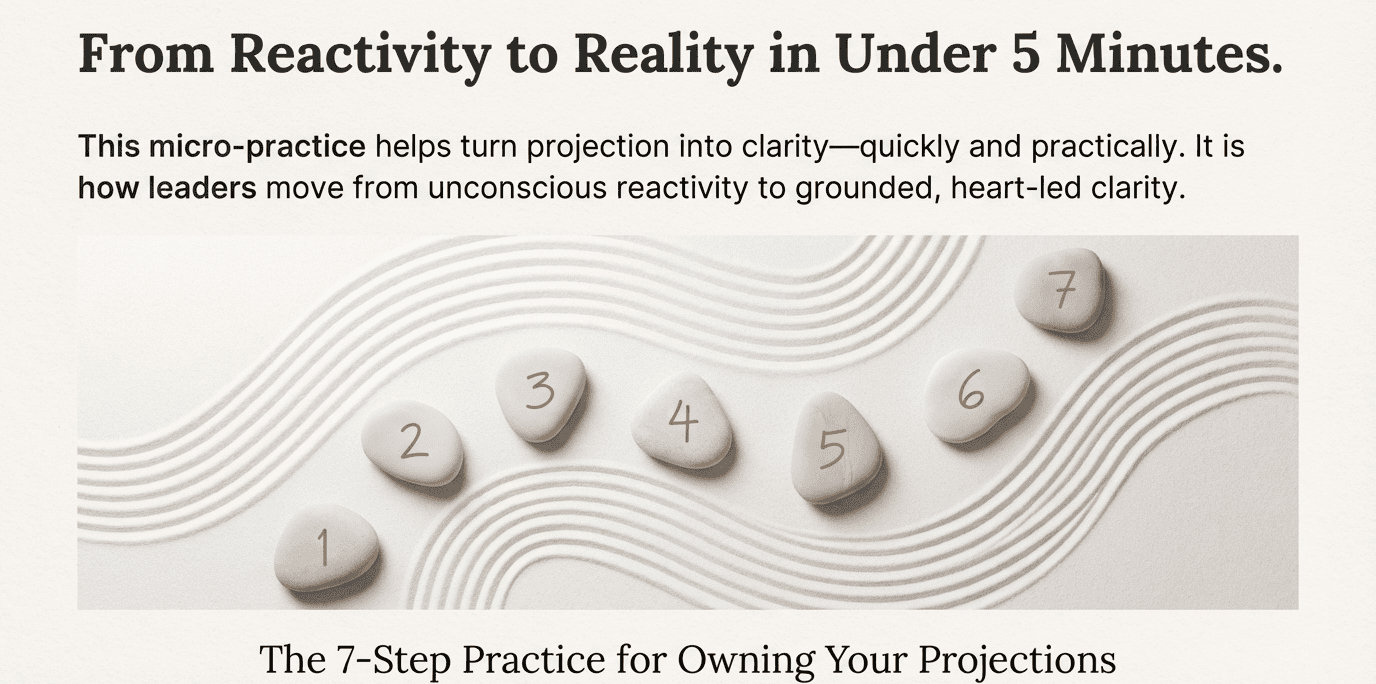
Owning Your Projections: A 7-Step Micro-Practice (Under 5 Minutes)
This micro-practice helps turn projection into clarity — quickly and practically.
1️ – Pause & Breathe
Take two slow, five-count breaths. Let your nervous system settle.
2️ – Name the Trigger
“I’m telling myself that…”
(Notice the story that’s been activated. Whether it’s true or not is irrelevant for now.)
3️ – Flip the Mirror
“Where might this live in me?”
(Projections reflect something happening internally.)
4️ – Own Your Part
“My part in this is…”
(This is ownership, not blame.)
5️ – Reality Check
Ask one clean, clarifying question instead of assuming.
(From curiosity — not defense.)
6️ – Repair or Realign
Make one clear request or adjustment.
(Insight must be followed by action.)
7️ – Close the Loop
Name one learning you’ll carry forward.
When you own your projections, you lead from reality — not fear.
Positive and Negative Projections (What Leaders Often Miss)
We don’t only project what we reject.
We also project:
- anger we were taught to suppress
- judgment we haven’t integrated
- brilliance we haven’t fully claimed
Marianne Williamson captured this perfectly: “It’s not our darkness we fear most; it’s our light.”
When we disown our strengths, we can feel triggered by them in others.
When we own them, comparison dissolves — and coherence rises.

Journey Statements: Turning Reactivity into Direction
Owning projections is the first step. The Sage goes further.
Villoldo calls this dreaming a new dream.
The Conscious Leadership Group calls it eating your projection.
Regardless of language, the essence is the same: turn insight into action.
A journey statement begins with one powerful question:
“What do I have to learn in order to move forward?”
Write Your Journey Statement in 90 Seconds
Choose one of the following templates:
From–To Statement
“I’m moving from [old pattern] to [new way] by [practice], so [impact].”
Learning Pledge
“When I feel [trigger], I’m learning [quality], and I choose [behavior].”
Identity Shift
“I lead as [quality]; today I choose [new action] over [old reflex].”
These are not affirmations.
They are directional commitments.
Executive Scenarios (Insight in Action)
Performance Review
Trigger: Defensiveness
→ “I’m moving from proving to connecting by asking calm, clarifying questions.”
Cross-Functional Tension
Trigger: Assuming resistance
→ “When I feel let down, I choose curiosity over assumption.”
Client Escalation
Trigger: Taking it personally
→ “I lead as steadiness; today I choose listening before justifying.”
Small inner shifts create powerful outer impact.

How You’ll Know It’s Working
Leaders who practice projection ownership report:
- fewer emotional escalations
- faster repair after tension
- higher psychological safety
- cleaner, less ego-driven decisions
Unchecked projections create stress and disconnection.
Ownership restores clarity and trust.
7-Day Leadership Experiment
For seven days:
- Notice one trigger
- Write one ownership statement
- Declare one journey statement
- Take one aligned action
Most leaders report greater steadiness, presence, and clarity by the end of the week.

Closing Reflection
When you own your projections, you return to truth.
When you declare a journey statement, you choose to lead from your Sage.
The Sage does not ask, “Who’s wrong?”
The Sage asks, “What’s my part in this?”
That is where real leadership begins.
If you would like support integrating this practice into your leadership or organization, we would be honored to walk that journey with you. Connect with us today.