


Leadership Coaching & Development: A Heart + Strategy Guide for 2026
|
Getting your Trinity Audio player ready...
|
Leadership Coaching & Development: A Heart + Strategy Guide for 2026
Leadership in 2026 isn’t about having the right answers. It’s about being the right person to respond.
Leaders today are navigating constant pressure, rapid change, and rising expectations – often while carrying the weight of responsibility alone.
At the same time, teams are craving something deeper from leadership – clarity, trust, and genuine human connection.
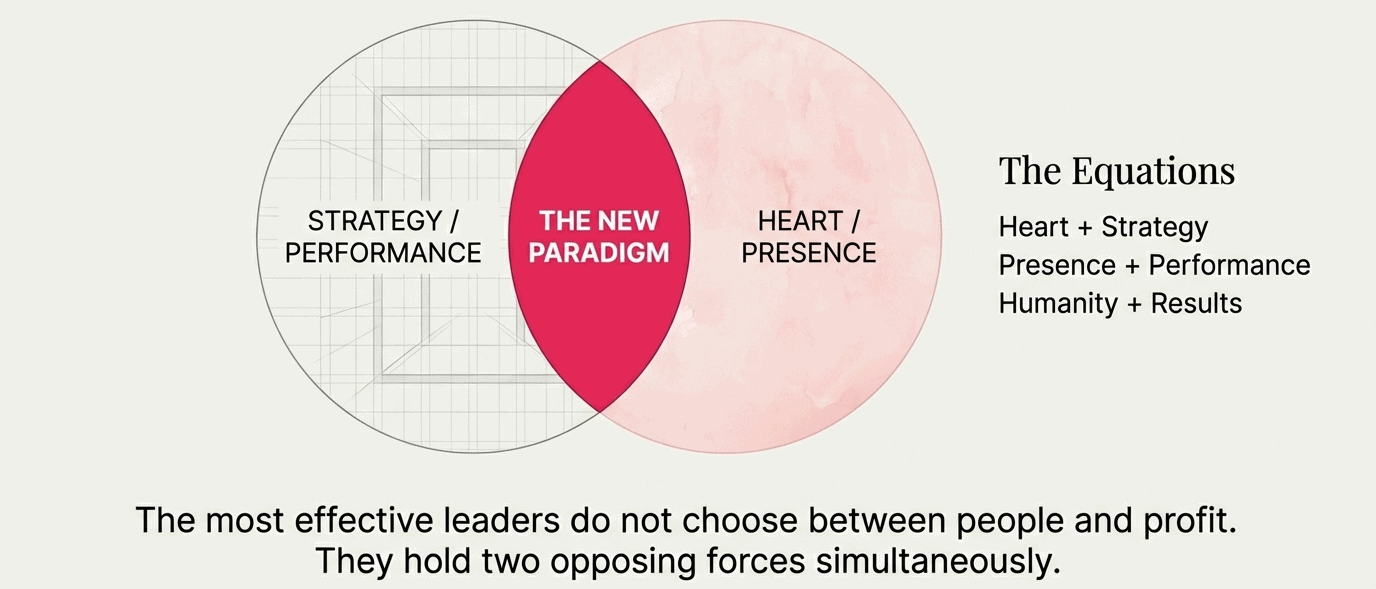
The most effective leaders are those who can hold both.
- Heart and strategy.
- Presence and performance.
- Humanity and results.
This is where leadership coaching and development meet.
What Is Leadership Coaching?
Leadership coaching is a partnership between a leader and a trained coach that supports clearer thinking, conscious leadership, and aligned action.
It combines personal guidance, structured reflection, and real-world behavior change to help leaders lead with greater awareness, effectiveness, and impact.
Leadership coaching helps leaders:
- Recognize strengths, patterns, and blind spots
- Communicate with greater confidence and presence
- Navigate pressure, change, and complexity
- Make grounded, aligned decisions
- Lead with emotional intelligence and authenticity
In my experience, leaders often come to coaching not because they lack skill, but because the way they are leading is no longer sustainable.
Unlike training programs, coaching is deeply personal. It meets leaders where they are, in the reality of their day-to-day decisions, conversations, and challenges.
What Is Leadership Development?
Leadership development is an organizational strategy that builds leadership capacity across all levels of an organization.
It includes formal programs such as coaching, mentoring, peer leadership circles, executive tracks, and emerging leader programs. It is most effective when it is embedded into everyday culture, not isolated to occasional workshops.
Embedded leadership development shows up in:
- How meetings are run
- How feedback is given
- How decisions are made
- How mistakes are handled
- How negotiations are approached
- Who gets opportunities and visibility
- What behaviors are rewarded
Leadership development becomes real when it is no longer something leaders attend, but something they practice daily, especially under pressure.

How Leadership Coaching and Development Work Together
Think of leadership development as the roadmap.
Leadership coaching is what helps leaders walk the map with awareness, courage, and accountability.
Together, they create sustainable change. Not just new ideas, but new ways of being and leading.
Why Leadership Coaching Matters
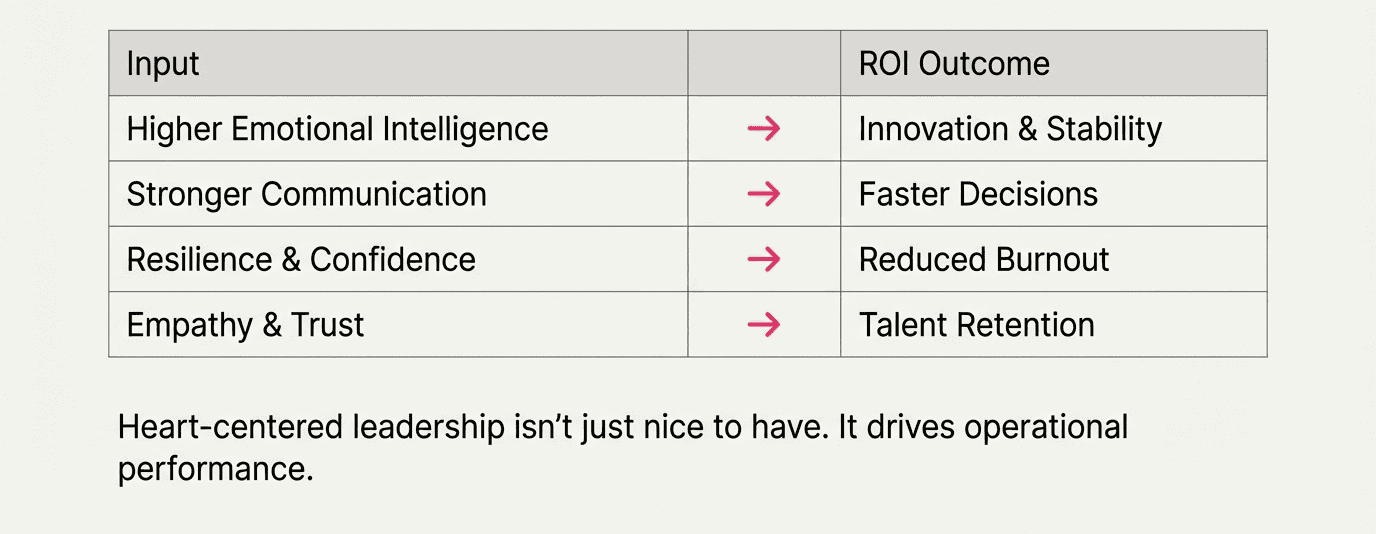
When leaders grow, the impact ripples far beyond the individual, and organizations grow in parallel.
| Benefit | Why It Matters | Impact |
| Higher Emotional Intelligence | Leaders respond with intention rather than reactivity | Greater trust, stability, and innovation |
| Stronger Communication & Alignment | Expectations, priorities, and direction are clear | Faster decisions and smoother collaboration |
| Resilience & Confidence | Leaders stay grounded under pressure | Reduced burnout and steadier leadership |
| Retention of Top Talent | People feel seen and supported | Less turnover and loss of experience |
| Better Strategic Thinking | Daily actions connect to long-term vision | Stronger organizational momentum |
Leadership Coaching Trends for 2025-2026
Technology – including AI – is increasingly used to support reflection, track progress, and reinforce habits between sessions.
But what will matter most is what remains human.
- Emotional intelligence
- Psychological safety
- Presence and empathy
- Thoughtful, grounded decision-making
Technology can support growth, and leadership continues to require human judgment, discernment, connection, and the ability to stay centered when things get hard.
| Trend | What’s Changing | Why It Matters |
| Technology-Supported Reflection & Accountability | Real-time prompts and insight between sessions | Growth continues beyond coaching conversations |
| Emotional Intelligence & Psychological Safety | Empathy and presence are core expectations | Teams perform better when they feel safe and heard |
| Hybrid Coaching Workflows | Coaching integrated into daily tools | Learning happens inside real work |
| Inclusive Leadership Development | Leadership is shared, not concentrated | Organizations become more adaptive, equitable, and resilient |
| Peer Coaching Circles | Leaders learn with and from each other | Builds trust and shared accountability |
The future belongs to leaders who strategically use technology as a partner for heart, human connection, and clarity.
How Leadership Coaching Works
Leadership coaching is about strengthening awareness and approach.
The process typically includes:
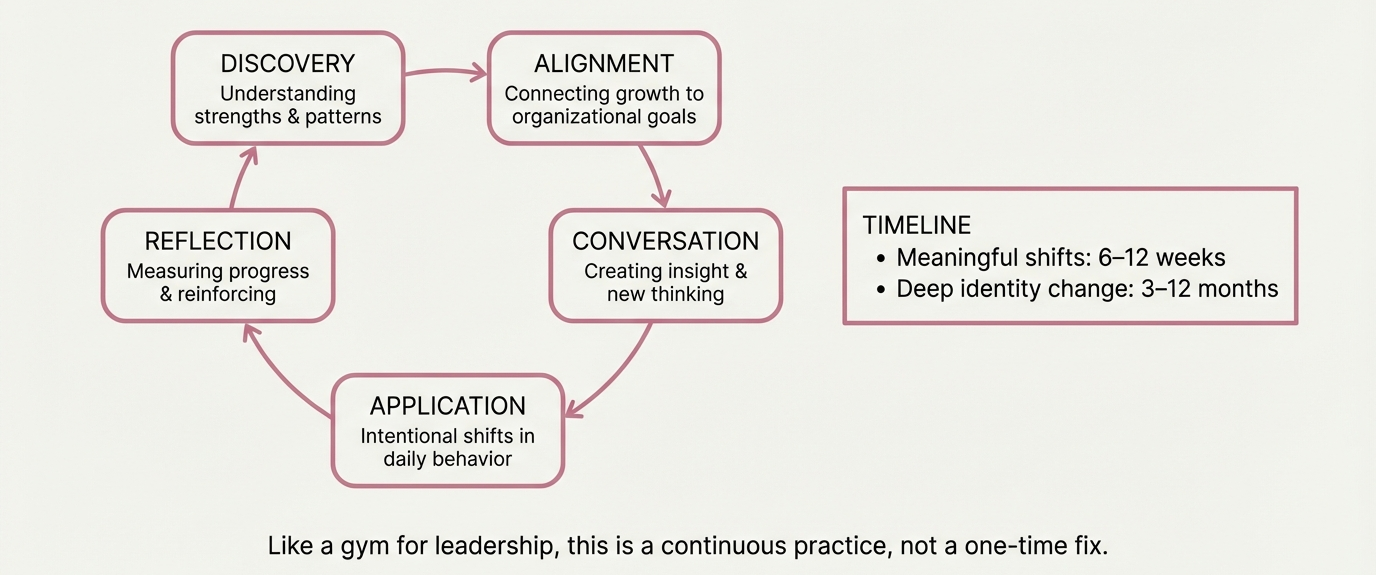
Discovery
Understanding strengths, values, patterns, and goals.
Alignment
Connecting personal growth with organizational priorities.
Conversation
Creating insight, clarity, and new ways of thinking.
Application
Practicing leadership in real situations through small, intentional shifts in daily behavior.
Review & Reflection
Noticing what is changing, measuring progress, and reinforcing growth.
Small changes in daily behavior lead to profound, long-term transformation. Leadership coaching and development are not one-time events. They are continuous growth practices.
Common Questions
How long does leadership coaching take?
Most leaders notice meaningful shifts within 6–12 weeks, with deeper changes in confidence, identity, and leadership style emerging over 3–12 months.
Much like having a coach at the gym, some leaders choose to continue working with a coach long-term — not because something is wrong, but because it provides an ongoing mirror as new challenges arise, helping them stay intentional rather than reactive over time.
Is coaching only for executives?
No. Leadership coaching is powerful for:
- First-time managers
- High-potential future leaders
- Team leads navigating change
- Senior leadership groups
- Founders and entrepreneurs
Organizations that invest in leadership at every level adapt faster and perform stronger.
What makes a great leadership coach?
A great coach brings empathy with accountability together. They offer perspective without judgment, challenge leaders to grow, and help translate insight into action – while creating space where leaders can think clearly and lead authentically.

A Practical Leadership Development Framework
| Skill | Description | Observable Behaviors |
| Self-Leadership | Managing mindset and emotional patterns | Calm presence, grounded responses |
| Communication & Influence | Clear, confident expression | People feel informed and aligned |
| Strategic Clarity | Knowing and choosing what matters most | Focused priorities and decisions |
| Empathy & Team Trust | Leading with humanity | High engagement and psychological safety |
| Execution & Accountability | Turning vision into action | Consistent forward movement |
The Business Case for Leadership Coaching
Strong leadership:
- Reduces conflict and misalignment
- Increases collaboration and innovation
- Improves motivation and engagement
- Strengthens culture and identity
- Drives sustainable growth and operational performance
As complexity, speed, and uncertainty increase, leadership effectiveness will depend less on having the right answers — and more on a leader’s ability to stay grounded, human, and clear.
Leadership coaching and development are not perks.
They are strategic infrastructure for resilient, adaptive, heart-centered organizations.
If you’re ready to strengthen leadership capacity in a way that honors both performance and people, let’s start a conversation.
| Skill Category | Description | Observable Behaviors | Business Impact | Associated Growth Benefit |
| Self-Leadership | Managing mindset and emotional patterns to ensure intentional leadership. | Maintaining a calm presence and grounded responses. | Reduces conflict and misalignment; increases collaboration and innovation. | Leaders respond with intention rather than reactivity; promotes greater trust, stability, and innovation. |
| Strategic Clarity | Identifying and prioritizing the most critical objectives for the organization. | Demonstrating focused priorities and decision-making. | Drives sustainable growth and operational performance; builds stronger organizational momentum. | Daily actions connect to long-term vision; improves strategic thinking capabilities. |
| Communication & Influence | Expressing ideas with clarity and confidence to align stakeholders. | Ensuring people feel informed, aligned, and motivated. | Enables faster decisions and smoother collaboration; improves employee engagement. | Expectations, priorities, and direction are clearly defined; builds stronger communication and alignment. |
| Empathy & Team Trust | Leading with a focus on human connection and psychological safety. | Fostering high engagement and a safe environment for teams. | Strengthens organizational culture and identity; reduces turnover and loss of experience. | Employees feel seen and supported; leads to the retention of top talent. |
| Execution & Accountability | Converting strategic vision into tangible actions and results. | Maintaining consistent forward movement on objectives. | Drives sustainable growth; ensures steadier and more reliable leadership. | Leaders stay grounded under pressure; leads to reduced burnout and higher resilience. |