



Leadership in 2026 isn’t about having the right answers. It’s about being the right person to respond.
Leaders today are navigating constant pressure, rapid change, and rising expectations – often while carrying the weight of responsibility alone.
At the same time, teams are craving something deeper from leadership – clarity, trust, and genuine human connection.
The most effective leaders are those who can hold both.
This is where leadership coaching and development meet.
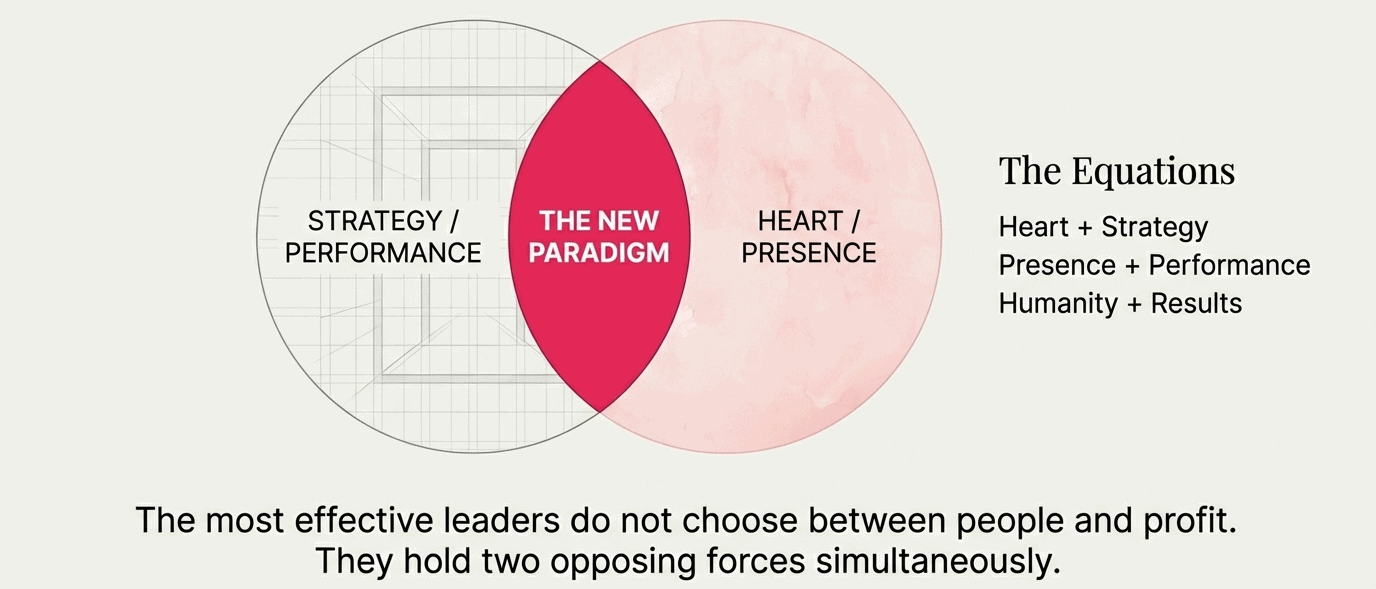
Leadership coaching is a partnership between a leader and a trained coach that supports clearer thinking, conscious leadership, and aligned action.
It combines personal guidance, structured reflection, and real-world behavior change to help leaders lead with greater awareness, effectiveness, and impact.
Leadership coaching helps leaders:
In my experience, leaders often come to coaching not because they lack skill, but because the way they are leading is no longer sustainable.
Unlike training programs, coaching is deeply personal. It meets leaders where they are, in the reality of their day-to-day decisions, conversations, and challenges.
Leadership development is an organizational strategy that builds leadership capacity across all levels of an organization.
It includes formal programs such as coaching, mentoring, peer leadership circles, executive tracks, and emerging leader programs. It is most effective when it is embedded into everyday culture, not isolated to occasional workshops.
Embedded leadership development shows up in:
Leadership development becomes real when it is no longer something leaders attend, but something they practice daily, especially under pressure.

Think of leadership development as the roadmap.
Leadership coaching is what helps leaders walk the map with awareness, courage, and accountability.
Together, they create sustainable change. Not just new ideas, but new ways of being and leading.
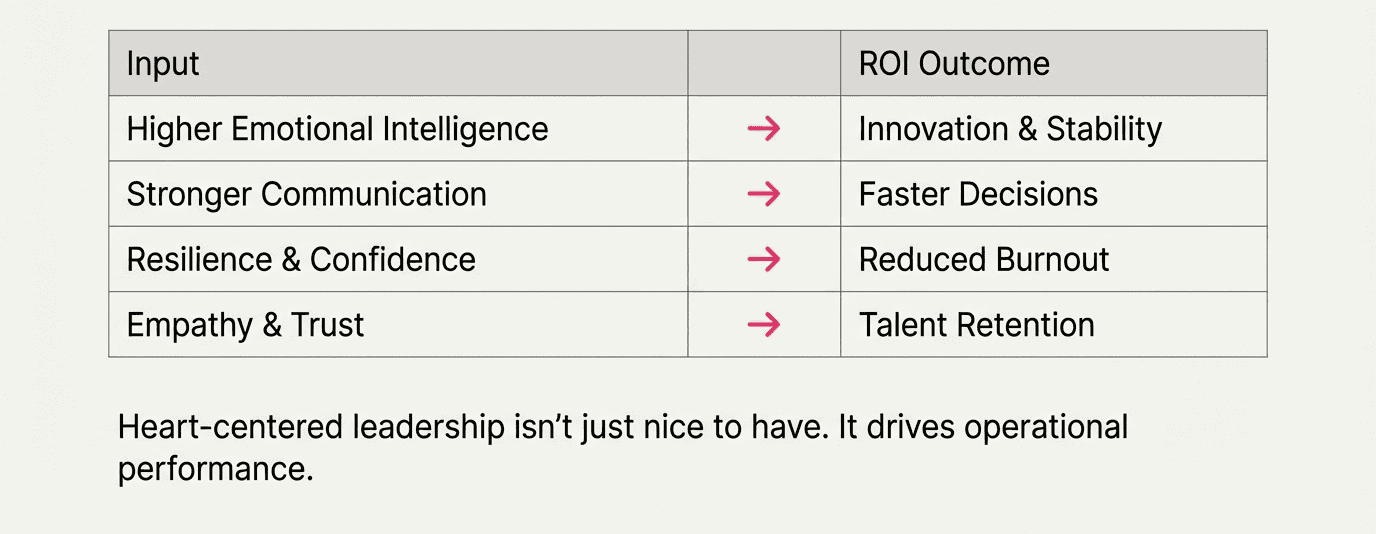
When leaders grow, the impact ripples far beyond the individual, and organizations grow in parallel.
| Benefit | Why It Matters | Impact |
| Higher Emotional Intelligence | Leaders respond with intention rather than reactivity | Greater trust, stability, and innovation |
| Stronger Communication & Alignment | Expectations, priorities, and direction are clear | Faster decisions and smoother collaboration |
| Resilience & Confidence | Leaders stay grounded under pressure | Reduced burnout and steadier leadership |
| Retention of Top Talent | People feel seen and supported | Less turnover and loss of experience |
| Better Strategic Thinking | Daily actions connect to long-term vision | Stronger organizational momentum |
Technology – including AI – is increasingly used to support reflection, track progress, and reinforce habits between sessions.
But what will matter most is what remains human.
Technology can support growth, and leadership continues to require human judgment, discernment, connection, and the ability to stay centered when things get hard.
| Trend | What’s Changing | Why It Matters |
| Technology-Supported Reflection & Accountability | Real-time prompts and insight between sessions | Growth continues beyond coaching conversations |
| Emotional Intelligence & Psychological Safety | Empathy and presence are core expectations | Teams perform better when they feel safe and heard |
| Hybrid Coaching Workflows | Coaching integrated into daily tools | Learning happens inside real work |
| Inclusive Leadership Development | Leadership is shared, not concentrated | Organizations become more adaptive, equitable, and resilient |
| Peer Coaching Circles | Leaders learn with and from each other | Builds trust and shared accountability |
The future belongs to leaders who strategically use technology as a partner for heart, human connection, and clarity.
Leadership coaching is about strengthening awareness and approach.
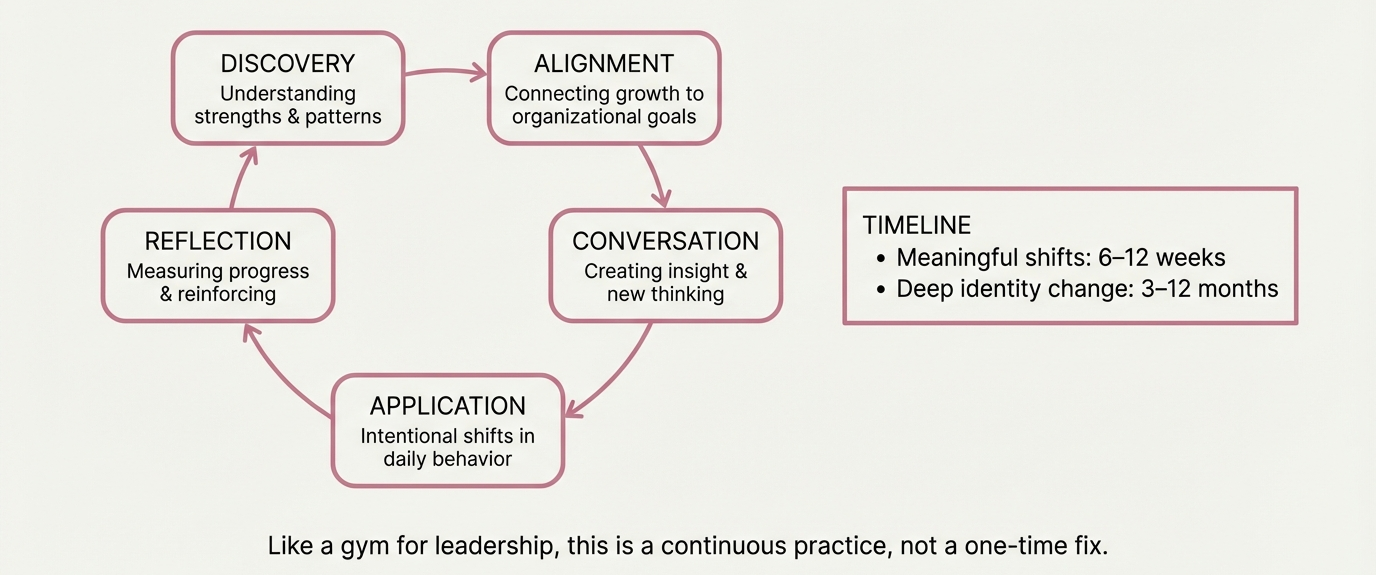
The process typically includes:
Discovery
Understanding strengths, values, patterns, and goals.
Alignment
Connecting personal growth with organizational priorities.
Conversation
Creating insight, clarity, and new ways of thinking.
Application
Practicing leadership in real situations through small, intentional shifts in daily behavior.
Review & Reflection
Noticing what is changing, measuring progress, and reinforcing growth.
Small changes in daily behavior lead to profound, long-term transformation. Leadership coaching and development are not one-time events. They are continuous growth practices.
How long does leadership coaching take?
Most leaders notice meaningful shifts within 6–12 weeks, with deeper changes in confidence, identity, and leadership style emerging over 3–12 months.
Much like having a coach at the gym, some leaders choose to continue working with a coach long-term — not because something is wrong, but because it provides an ongoing mirror as new challenges arise, helping them stay intentional rather than reactive over time.
Is coaching only for executives?
No. Leadership coaching is powerful for:
Organizations that invest in leadership at every level adapt faster and perform stronger.
What makes a great leadership coach?
A great coach brings empathy with accountability together. They offer perspective without judgment, challenge leaders to grow, and help translate insight into action – while creating space where leaders can think clearly and lead authentically.

| Skill | Description | Observable Behaviors |
| Self-Leadership | Managing mindset and emotional patterns | Calm presence, grounded responses |
| Communication & Influence | Clear, confident expression | People feel informed and aligned |
| Strategic Clarity | Knowing and choosing what matters most | Focused priorities and decisions |
| Empathy & Team Trust | Leading with humanity | High engagement and psychological safety |
| Execution & Accountability | Turning vision into action | Consistent forward movement |
Strong leadership:
As complexity, speed, and uncertainty increase, leadership effectiveness will depend less on having the right answers — and more on a leader’s ability to stay grounded, human, and clear.
Leadership coaching and development are not perks.
They are strategic infrastructure for resilient, adaptive, heart-centered organizations.
If you’re ready to strengthen leadership capacity in a way that honors both performance and people, let’s start a conversation.
| Skill Category | Description | Observable Behaviors | Business Impact | Associated Growth Benefit |
| Self-Leadership | Managing mindset and emotional patterns to ensure intentional leadership. | Maintaining a calm presence and grounded responses. | Reduces conflict and misalignment; increases collaboration and innovation. | Leaders respond with intention rather than reactivity; promotes greater trust, stability, and innovation. |
| Strategic Clarity | Identifying and prioritizing the most critical objectives for the organization. | Demonstrating focused priorities and decision-making. | Drives sustainable growth and operational performance; builds stronger organizational momentum. | Daily actions connect to long-term vision; improves strategic thinking capabilities. |
| Communication & Influence | Expressing ideas with clarity and confidence to align stakeholders. | Ensuring people feel informed, aligned, and motivated. | Enables faster decisions and smoother collaboration; improves employee engagement. | Expectations, priorities, and direction are clearly defined; builds stronger communication and alignment. |
| Empathy & Team Trust | Leading with a focus on human connection and psychological safety. | Fostering high engagement and a safe environment for teams. | Strengthens organizational culture and identity; reduces turnover and loss of experience. | Employees feel seen and supported; leads to the retention of top talent. |
| Execution & Accountability | Converting strategic vision into tangible actions and results. | Maintaining consistent forward movement on objectives. | Drives sustainable growth; ensures steadier and more reliable leadership. | Leaders stay grounded under pressure; leads to reduced burnout and higher resilience. |

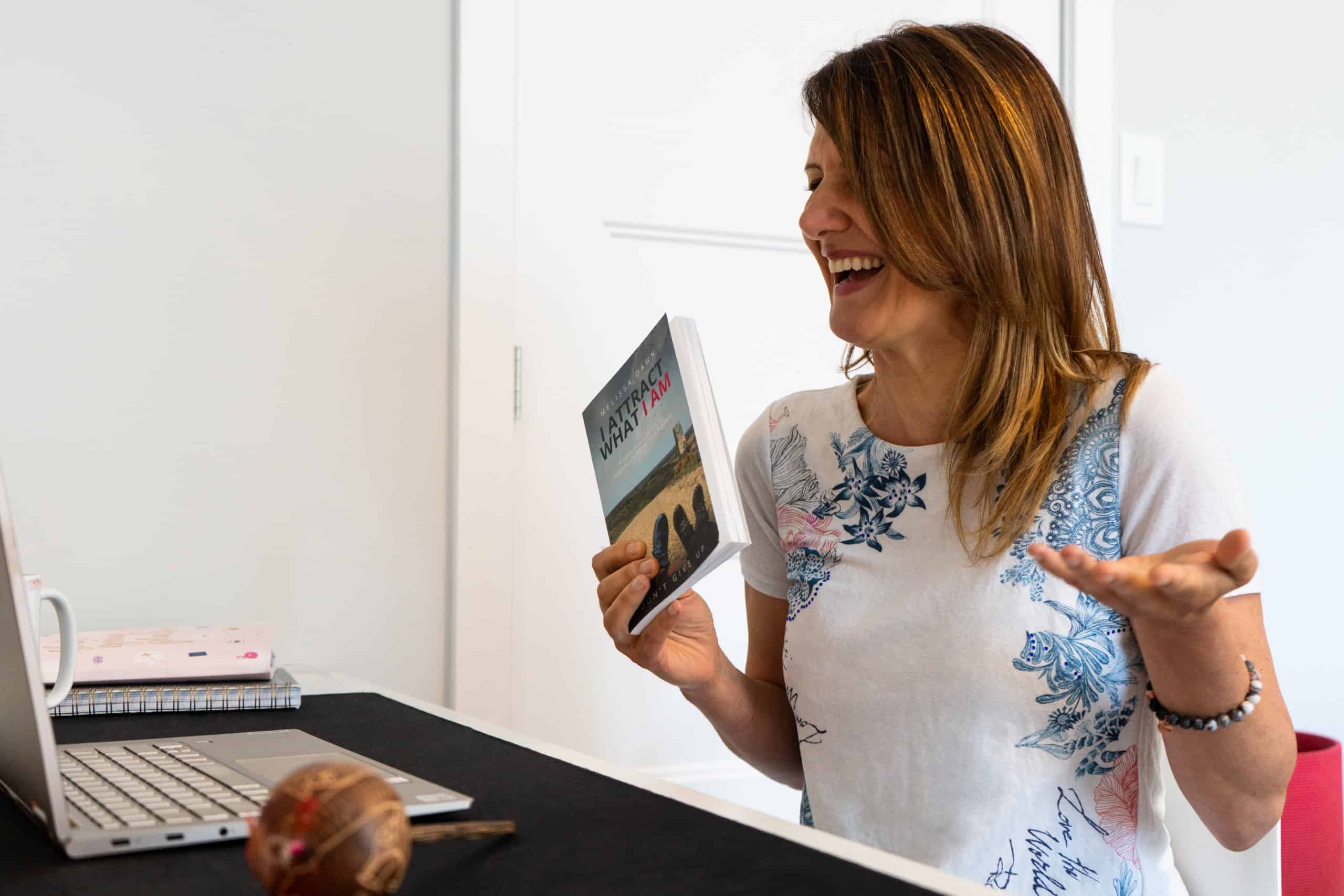
For busy executives, virtual coaching can feel like a gift. No commute. No rushing across town. Just you, your coach, and the space to show up as the whole person that you are, not just the title. Space to breathe, reflect, and connect with the leader you truly want to be.
If you’re like many leaders, you might also wonder… Can virtual coaching really be as effective as in-person?
The short answer? Yes, absolutely.
The longer answer? Virtual coaching becomes truly powerful when both you and your coach bring a little extra heart and presence to the screen, blended with strategic steps.
Because coaching isn’t about the room you’re in. It’s about the YOU who shows up.
Virtual coaching is real-time, face-to-face sessions over Zoom, Teams or another video platform. Just like in-person coaching, we talk, explore, get real, and create clarity and momentum together.
Also like in-person coaching, the real transformation happens between sessions. In the moments where you choose to pause, breathe, act intentionally, or lead from a more grounded place.
Whether meeting virtually or in-person, you and your coach co-design:
The structure doesn’t change. Only the medium does.

In person, your coach can see everything – posture shifts, breathing changes, micro-expressions and so on. It reveals more of what’s going on, beyond the words you’re saying.
Over video, those cues take more presence, heart, and practice to notice. A skilled coach will hear what you’re saying AND what you’re not saying, even over video.
And sometimes, we open up more easily online because we’re in our own space, hopefully feeling grounded and safe.
From a heart + strategy approach, we can see this as:
Both matter, and heart always leads.
Yes. Very.
An interesting effect of the pandemic is that we now have a global, real-world experiment showing that meaningful connection can happen through a screen, and that the connection largely depends on how we show up as human beings.
What we’ve learned, from research and leaders in the trenches, is that virtual coaching can increase:
And with more and more of us comfortable using virtual tools, online coaching now feels natural, accessible, and emotionally safe.
Approached with intention, virtual tools don’t dilute the coaching experience. In some cases, they can even enhance it.

Flexibility & Freedom
Access coaching from anywhere, on your own time – across timezones, between meetings, or from a quiet corner that feels like you.
Efficiency
No travel, no logistics, just meaningful connection and genuine transformation.
Confidentiality & Comfort
When you’re in a space where you feel safe to drop your masks, you show up more authentically.
Aligned with Modern Leadership
Virtual coaching supports the skills leaders need most: emotional intelligence, presence, self-regulation, and heart+strategy decision-making.
To get the most out of your sessions:
Small steps can make a big difference. They create conditions for deeper listening, stronger insight, and more powerful breakthroughs.

Many leaders opt for a hybrid model: virtual for rhythm, in-person for depth.
This mirrors how many organizations operate today. They connect virtually for rhythm and efficiency, then come together occasionally for deep collaboration, connection, and inspiration.
A hybrid model can give you:
Even when distance is an issue, a hybrid model can be possible through in-person workshops, retreats, or intensive one-on-one sessions where either you or your coach travel.

Virtual coaching isn’t “less than”. It’s evolution. It’s an impactful way to partner with someone who works in a way that truly works for you.
When you show up with presence, openness, and heart, the screen disappears. What remains is truth, alignment, strategy, courage, clarity… the real you leading from the inside, out.
If you’re ready to explore virtual or hybrid coaching, we would love to support you.
Let’s co-create a version of your leadership that feels aligned, powerful, and deeply human. Connect with us.

Asking for a raise can be nerve-wracking—even at the executive level. From sleepless nights to sweaty palms, the anticipation often feels worse than the conversation itself.
And yet, it can be more than just a request for higher pay. It’s a chance to practice strategic communication, advocate for your worth, and build deeper alignment with your organization’s goals.
In this article, we’ll walk through:
Individual circumstances will always differ, but there are some common and more general reasons asking for a salary increase can be important:

A raise doesn’t always come in the form of salary. Depending on your organization, non-salary options might even be more realistic, and just as valuable (if not more so) to you.
Examples of non-salary compensation include:
Non-salary benefits can often reduce your personal expenses, enhance quality of life, or build long-term wealth. They’re also often more flexible for the organization to approve.
Why might these benefits be more feasible? Examples of reasons include:

When is a good time to ask for an increase? There are two factors to consider: strong career moments and favorable company timing.
Strong career moments:
Favorable company timing:

One of our clients had a standout year. She surpassed every objective set for her — leading with vision, hitting targets, and elevating her team in the process.
But, when compensation decisions were announced, she received only a standard increase. The same as everyone else.
She felt disappointed and hurt. Her instinct was to stay quiet. Bonuses and raises had already been finalized. What difference would it make now?
But, in our coaching conversation, we reminded her: “Speaking your truth isn’t always about the outcome. It’s about honoring yourself. You’ll feel better knowing you said what needed to be said.”
So she did. Calmly and clearly, she requested a meeting and shared how she felt, not from entitlement, but from alignment. She named her contributions, her growth, and her desire to understand what it would take to be recognized more fully.
And here’s what happened: Her leader listened. The decision-makers reviewed her file again and agreed. She received an additional raise and a bigger bonus. Most importantly, they had a meaningful conversation about what success would look like in the coming year, setting the stage for more intentional recognition going forward.
Sometimes, even when it feels like the moment has passed, it’s still the right time to speak up. Because advocating for your worth isn’t just about money. It’s about trust, alignment, and owning your impact.


What if your request is denied? Let’s say you asked for the increase and you explored non-salary benefits, but still got the no. What next?
Advocating for a raise isn’t just about money. It’s about clarity, confidence, and leadership. Whether the answer you get is yes, not now, or no, each conversation helps define the path ahead – both for you, and the organization.
Approach it with preparation, self-respect, and curiosity. At the executive level, how you ask is as important as what you ask for. The more intentional you are, the more powerful and sustainable your success will be.
If you’re done waiting for permission to own your value—let’s co-create your next bold move.

Too many performance reviews are wasted opportunities. It’s time to change that.
When conducted with intention, performance reviews are strategic checkpoints in an ongoing growth journey for you, your employees, and your organization.
Done well, they’re a powerful opportunity to:
In fact, the term “performance review” barely scratches the surface of the full potential of these conversations. Many organizations now opt for terms like development review or growth alignment meetings.
This isn’t just slapping a new name on an old practice. It signals a deeper, forward-looking focus. One that will resonate with employees, when the term is backed up by action.
When approached with intention, these reviews can become one of your most effective tools for organization-wide success.

Start with this fundamental question: Why are we doing this?
If the answer is something like, to deliver feedback… you’re missing the bigger picture.
A strategic performance review should help:
Ultimately, it’s about so much more than looking back. It’s about setting the stage for what comes next.
When done thoughtfully, strategically and intentionally, these conversations can lead to:

Meet with your team in advance to share the “why” behind the review process. Discuss how it connects to your broader leadership approach, organizational goals, and what you hope for your team to gain from it.
People support what they help create. Bringing clarity and intention upfront helps people feel part of the process.
To get a well-rounded view, collect feedback from the people your team members interact with regularly. That could be peers, cross-team collaborators, clients, even vendors or suppliers, when appropriate.
Ideally, make these touchpoints throughout the year. This helps you better understand each employee’s contributions, challenges, and impact, well before you sit down for the review. It also helps employees feel truly seen.
Offer goal review exercises, self-reflection tools, and prompt questions like:
*Assure people that questions about personal lives do not need to be answered for anyone else, but are meant as self-reflection tools to help clarify needs, goals and growth direction.
Linking performance to pay is common. And perfectly acceptable. But linking the two conversations can derail deeper development discussions. Keep the conversation on growth distinct to maintain focus.

Reconnect within a few weeks to reinforce goals, address obstacles, support action plans, and discuss any issues or concerns that have come up with implementation.
This is about ensuring people are supported, unhindered, and any potential risks are addressed before they become full-on problems.
Whether it’s dedicated software or a spreadsheet template, give your team a system to track their goals and progress independently.
Think of performance reviews as a shared leadership moment. You’re not just evaluating. You’re partnering.
When leaders talk about being a team, or “in this together,” this is a situation where you, as leader, can truly walk your talk.
As a genuine partner in employee development, creating safe space sets the right tone for creating together.
A coach may lead the team, but is also part of the team, and deeply invested in guiding people to greatness, together.

When leaders treat performance reviews as strategic, co-creative conversations – not just check-the-box rituals – the impact is felt across the organization.
Growth becomes not just an individual responsibility, but a collective mission – a way of being that gets baked into your organizational culture.We partner with executives and organizations to create performance review processes that drive alignment, build trust, and inspire lasting development.
💬 Let’s connect: [Insert link or direction — e.g., Explore Speaking & Workshops]
🚀 Ready to turn your reviews into catalysts for engagement and growth?
We partner with executives and organizations to create performance review processes that drive alignment, build trust, and inspire lasting development.
💬 Let’s connect: Connect With Us / Explore Speaking & Workshops

Leadership doesn’t begin and end with performance metrics. It begins with presence. It’s in the tone we set—through words, behavior, and even silence.
How we respond to the dynamics around us shapes team culture. It influences trust, engagement, and performance.
Microaggressions may seem subtle, but their cumulative impact breaks down psychological safety, trust, and inclusion. Left unaddressed, they create environments where people feel unseen, disengaged, and undervalued—undermining both culture and organizational results.
As Adam Grant reminds us, “The most important reason to treat people well is not what you’ll get in return. It’s who you hope to become.”
The heart of leadership isn’t just about strategy or outcomes—it’s about who we become along the way.
Ask yourself: Who do I want to become as a leader?
A leader known for accountability, integrity, and positive influence? Someone who navigates complexity with both clarity and compassion? A leader who drives results through engagement, support, development, and trust?
If so, alignment matters. Your response to harmful behaviors—especially subtle ones like microaggressions—sets the precedent for what your team will tolerate, expect, and even emulate.
Even in environments where open conversations about DEI are discouraged, how you show up still matters. Your presence, your choices, and your quiet leadership can still create powerful ripple effects.
Let your ideal leader take the wheel. Lead with strategy and heart.
Years ago, we wrote an article about letting “future you” make your decisions. Now, we’re asking you to let your “ideal leader self” steer the ship. When you make decisions from that place, you become the leader you want to be.

What is a microaggression? Microaggressions are subtle, often unintentional actions or comments that express bias toward marginalized individuals or groups. They may seem minor in isolation, but their cumulative impact is deeply harmful.
Microaggressions can be verbal, behavioral, or systemic, and may target race, gender, sexual orientation, religion, disability, or any marginalized identity.
The term was coined over 50 years ago by psychiatrist Chester M. Pierce, and while the language is now more widely used, the behaviors are not new.
Examples of Microaggressions Include:
And much more. Microaggressions are often subtle and nuanced, but easily recognizable to the people they target – and easy to learn to recognize by others.
Not every instance is automatically a microaggression. Saying “Your parents must be proud” might be kind in one context, and stereotypical in another. Interrupting a colleague is generally disrespectful—but repeatedly doing so to women or people of color can signal something deeper.
The point is this: impact matters more than intent. And as leaders, we must be tuned in to that impact if we want to create an environment of respect and belonging, where people are empowered to bring their absolute best to the work that they do.
As leaders, we often hear: “You’re not responsible for someone’s reaction. You’re responsible for your intention.”
That’s true — especially in personal growth work. When you’re setting boundaries, stepping into authenticity, or speaking your truth, that reminder is grounding and liberating.
But in leadership — particularly when power dynamics are involved — impact matters more than intent.
A well-meaning leader can still cause harm. And if we focus only on our good intentions, we risk ignoring the lived experiences of others.
Heart-centered leadership means holding both. It’s leading with clear, compassionate intent and staying open to feedback about your impact. When there’s a gap between the two, courageous leaders don’t defend — they reflect, take accountability, and realign.
That’s what builds trust. That’s what builds culture.

Responsibility assignments are a subtle but powerful way bias shows up in the workplace. They may be unintentional – but their impact is anything but “micro.”
Leaders may believe they’re simply choosing the “right person for the job,” but high-visibility assignments often go to those who look the part, based on unconscious bias—not capability.
This pattern has two serious consequences:
The unintentional nature of this issue is rooted in privilege—leaders don’t see the pattern because they’ve never had to think about it. Awareness is the first step in breaking that cycle.
Microaggressions can be subtle, coded, or even invisible to anyone but the person being targeted—a kind of “dog-whistle” communication that flies under the radar unless you know what to look for.
That’s why leadership discernment is essential. This goes beyond knowledge or intuition—it’s the ability to perceive what others might miss, and to act with empathy and clarity.
Here are three ways to sharpen your leadership discernment:
Strong leadership isn’t about having all the answers—it’s about being willing to see, learn, and evolve.
Microaggressions may seem small in the moment—but they carry a significant cost.
For those on the receiving end, the emotional and mental toll of constantly navigating or anticipating microaggressions is real. Over time, this erodes trust, motivation, and a sense of belonging.
As a leader, your mandate is to build a culture where every employee can bring their full potential forward. Microaggressions stand directly in the way of that.
Meanwhile, those who regularly engage in microaggressions—whether out of ignorance or unwillingness to grow—undermine collaboration, innovation, and psychological safety.
The Business Impact Is Clear:
In short: If people don’t feel safe, seen, and valued, they won’t stay—or perform at their best. Addressing microaggressions isn’t just a cultural imperative. It’s a strategic one.

As a leader, your responsibility is twofold:
Your goal isn’t to dig into motives, but to reinforce a culture of safety, respect, and learning. Beyond that, your goal is to position yourself as a safe, trustworthy leader for people who feel targeted, and for those who’ve made a mistake and want to grow.
Go back to the question: What kind of leader do I want to be?
Responding to microaggressions – especially if they’ve come from you – is part of this journey.
Do you want to be a leader who models accountability, humility, and resilience? Who understands the impact of strategy + heart?
If so, this is a moment to lead by example.
A direct approach might sound like:
“I’ve realized what I said was wrong. While it wasn’t my intent, I take full responsibility. I’m sorry.”
Be clear, sincere, and focused on impact over intent.
Strong leadership isn’t about never making mistakes—it’s about how you respond when they happen. That’s a big part of having positive influence as a leader.

The best way to address microaggressions is to prevent them. That starts with culture, and culture starts with leadership.
Here are five key strategies to help you lead a more inclusive, psychologically safe workplace:
Ideally, leadership means speaking your truth, even when it’s hard. At CEO of Your Life, it’s one of our core beliefs.
But, in some environments, addressing microaggressions directly may be prohibited or unsupported—especially where DEI efforts have been dismantled.
As a leader, you still have a responsibility to protect your people and foster respect, even if you need to be strategic about how you do it.
Use Subtle but Effective Language
If you can’t call it out explicitly, redirect the behavior with phrases like:
These responses defuse the moment, reinforce expectations, and create a boundary, without triggering policy pushback.
Support Targets Privately
Check in with team members who may be impacted. Validate their experience and strive to be on their side as much as possible within your constraints.
Advocate Behind the Scenes
Continue working toward a healthier culture where accountability and inclusion aren’t off-limits. Quiet leadership can still drive meaningful change.
Lead for the Culture You Want to Build
Microaggressions aren’t just personal missteps—they’re leadership signals. Every time we ignore, excuse, or minimize them, we send a message about what’s acceptable in our workplace culture.
As a leader, your influence is profound. You set the tone through your choices, your silence, your accountability, and your vision for what kind of organization you want to build.
So ask yourself:
If the answer to any of these is uncertain, that’s not a flaw—it’s an invitation. A call to lean in, get curious, and keep growing.
Be the kind of leader who doesn’t just respond to microaggressions—be the one who helps eliminate them.
The culture you lead is the legacy you leave. Make it one of inclusion, excellence, and courage.
If you’re serious about your legacy as a leader, let’s talk. Connect With Us / Explore Speaking & Workshops.

Leadership today requires more than expert strategy and masterful execution.
It also demands presence, clarity, and sustainable energy — and yet, so many high-performing leaders are running on empty.
It’s rarely the work alone that exhausts us — it’s the stress, pressure, expectations, and near-constant unpredictability.
These added strains can disconnect leaders from their WHY — the deeper purpose that fuels them. In particular, leaders driven by purpose, compassion, and a desire to uplift others seem most at risk for running on empty. In striving to do it all, they’re missing a key measurement: return on energy.
I’ve seen this pattern countless times with clients, and I’ve lived it myself, having hit burnout more than once. Each time, I came out with a deeper understanding that protecting energy isn’t optional. It’s essential. If I want to lead with clarity, impact, and heart, I need a sustainable approach to my own energy.

Leaders often tell me things like:
Does any of this sound familiar? If it does, I hear you. And you’re not alone.
What if there was another way? A way to lead powerfully, compassionately, and sustainably?

This isn’t just about wellness or productivity. It’s about treating your energy like any other vital resource. It’s human sustainability.
Energy fuels decision-making, guides interactions, and impacts leadership effectiveness. It helps you stay calm in times of stress and bounce back from setbacks.
Sustainable energy stewardship means managing your personal energy with the same intention and clarity you give to your leadership. Knowing where your energy goes, what drains it, what refuels it, and making conscious choices to protect it, is about having the strategic clarity to use your energy sustainably, for the greatest possible impact.
Essentially, it’s a strategic alignment of your energy reserves with organizational objectives.
The fact is, you can’t lead through change if you’re constantly depleted.

It’s helpful to see energy in 3 key components:
Each component is interconnected. When you feel emotionally drained, your body feels it too. When you’re physically exhausted, you get “brain fog.” Recognizing and managing these energy flows is critical to leadership endurance.
Think of it as your personal synergy. When the components work well together, the sum – your energy output – is greater than the individual parts.
On the flipside, when one component is depleted, the others can only bridge the gap for so long. Bringing them back into synergy is the only truly sustainable approach.
Try this exercise:
For three weeks, including weekends, journal daily – even if just for two minutes – on what fueled you and what drained you each day. Include your body, mind, and emotional state / inner being.
Don’t judge. Simply notice.
Over three weeks, patterns and insights will emerge. That awareness is a powerful first step — one that will guide your next leadership shift.
Remember, awareness comes first, then you can make informed decisions.
This awareness can also help identify warning signs of burnout early on, such as irritability, difficulty concentrating, and lack of motivation. These are warning signs that something needs to change.
Most of us recognize the need for nourishment, sleep and movement. We also know we need mental stimulation and brain breaks to clear our heads.
But what about emotional energy? Many of us have never learned much about it, let alone how to regulate it. Yet, in many burnout cases, emotional depletion is at the heart.
What drains emotional energy? Here are just a few causes:
Of course you can’t simply stop worrying about loved ones, or just not stress about money. What you can do, however, is let yourself recognize how these things impact your energy.
That brings us to GUILT.
What usually happens when we start feeling bad about things like caregiving, or getting trapped in a doom scroll? Or if we try to protect our energy with boundaries or rest? We feel guilty! And GUILT is a powerful energy drain.
Simply notice emotional energy drains without judgment. When that darn guilt creeps in, send it packing.

Energy resilience isn’t about controlling external circumstances. It’s about shifting how you respond to them.
Leaders face a myriad of challenges every day. Maintaining energetic endurance is crucial to navigating them effectively – both in the moment, and with the bigger picture in focus.
Take Julie*, an executive leading a growing team in a high-pressure environment. Between restructuring cycles, aging parents, and the demands of home life, she felt like there was never enough of her to go around.
On the surface, Julie was a successful high-achiever, showing no signs of burnout. Behind that mask, however, she was silently running on fumes. She was exhausted and disconnected.
When we started working together, Julie felt stuck. She couldn’t change her circumstances, so we focused on what she could change: her energy regulation.
Letting go of guilt and self-doubt was a powerful turning point. It released so much emotional energy and made her other shifts more sustainable.
None of Julie’s external circumstances changed, but her energy did. By identifying energy leaks and adding replenishing habits, she built resilience, which had ripple effects throughout her personal and professional life.
*Name and details changed for confidentiality.

Sustainable leadership isn’t about doing less. It’s about doing what matters most without losing yourself in the process.
Here’s what energy stewardship can look like:
✨ Check your energy before checking your calendar.
Before saying yes to that extra meeting or tighter deadline, ask yourself: Do I have the energy for this? If I say yes, what am I saying no to? Does this align with what’s most important right now? Energy is a leadership resource — treat it like one.
Some things we just have to do, even if our energy isn’t there. Asking yourself if it’s in alignment with what’s most important – your values and purpose, as well as personal and professional goals – can help prevent this from becoming a chronic drain.
✨ Stop glorifying exhaustion.
Rest is not a reward—it’s a requirement.
✨ Protect what fuels you.
Yoga? Quiet time? Friendship? Sleep? Connection? If it replenishes you, it isn’t a luxury–it’s a leadership essential, and it needs to be scheduled in your calendar.
✨ Reclaim energy leaks.
Worrying, overthinking, perfectionism, people-pleasing—these drain us more than we realize, and are all signs of saboteurs coming up. When you notice these voices peeping their heads, stop, take a deep breath and ask yourself, “What advice would my wiser future self give me right now?”
✨ Dig into anger.
Anger often masks fear, inadequacy, or shame. Uncovering the deeper emotion helps release energy drains. Take action by journaling, speaking to a coach or therapist, or burning the emotions.
✨ Avoid black and white thinking.
In challenging times, thinking can get rigid, and it blinds us to possibilities. When feeling stuck ask, “What else is possible?”
✨ Advocate for yourself with yourself.
Speak to yourself the way you would to a respected friend.
✨ Cut the noise. Focus on what matters.
Remember, it’s not about doing less, but about doing what matters without losing yourself. For a deeper dive, read about The Art of Non-Doing.

Heart-centered leaders give so much. While that’s part of what makes you a brilliant leader, it can also lead to burnout if it isn’t grounded in sustainable energy.
When you’re depleted:
When you’re nourished:

Energy stewardship is the key to leading with clarity, compassion, and endurance.
It’s about working smarter with your energy so your leadership can flourish.
So take the nap. Say no. Let the email wait. Dance in your kitchen. Steward your energy with care and intention.
The best leaders don’t just lead with strategy. They lead with heart. And they protect the power that makes it possible.
If you’re serious about showing up as your most effective, impactful self – your energy must come first. Let’s talk about how you can protect this most essential leadership asset. Connect With Us / Explore Speaking & Workshops.

What keeps you up at night? If you’re like many in leadership, it’s things like:
What impacts all of those things? Change.
Sometimes change is intentional–a new corporate direction or strategy. Other times, it’s situational–economic shifts, evolving workforce expectations, global changes, market fluctuations, and so on.
Regardless of what drives the change, change is challenging. At the same time, transformation is how organizations thrive, and stay competitive.
With these critical concerns in mind (retention, engagement, well-being, agility) how can you, as a leader, navigate change successfully?
It’s simple (simple to say, at least). Leadership today demands strategy + heart.
In times of uncertainty, people need clear direction. In order to put that direction into action, they need connection, trust, and reassurance. That’s what heart-led leadership accomplishes.
Leading from the heart influences motivation, engagement, enthusiasm, innovation and all the things necessary to thrive through change. It’s what’s needed to:
This is why top leaders balance leadership with heart AND strategy. They know that how they lead through change determines whether their teams sink, stagnate or rise.
The bottom line is, top leaders don’t just drive results; they create cultures of trust, where people feel valued, empowered and committed. This is foundational to driving results and creating organizational resilience.
The essence of heart-centered leadership integrates empathy, emotional intelligence, and vision with strategic execution, for incredible, far-reaching outcomes.
But… What does it really mean to lead with heart? What does it look like in practice? How can leaders harness the heart-brain connection to guide their teams through any change that comes their way?
Did you know your heart and brain are constantly communicating? While the brain governs many functions, research from the HeartMath Institute reveals that this heart-brain connection goes beyond keeping a beat.
It seems, rather, that the heart-brain connection plays a crucial role in leadership, decision-making, and resilience. One major disruptor of this connection? Stress.
Studies from the American Psychological Association (APA) show that stress can:
For leaders, this often translates to frustration, decreased empathy, and lower team engagement—all of which impact retention and innovation.
HeartMath’s research highlights:
📌 The heart sends more signals to the brain than the brain sends to the heart.
📌 Stable heart rhythms improve cognition, emotional balance, and decision-making.
📌 Leaders who regulate their heart rate variability (HRV) remain calm under pressure and inspire confidence.
Think about it – when challenges arise, how does your heart respond? Does stress take over, or do you stay clear, calm and composed?
Yes, strategy is crucial as it provides the roadmap. But heart fuels the motivation and courage to follow it.
🔹 Watch this HeartMath video to explore the heart’s role in leadership and resilience.
🔹 What’s more? Your heart’s rhythm directly influences those around you—set the tone for your team. Read the HeartMath findings here.

Image source: https://www.heartmath.org/articles-of-the-heart/global-interconnectedness/each-individual-impacts-the-field-environment/
💡 Have you ever experienced a leader who led with heart during a major change? How did it impact your experience?
💡 Have you experienced a leader who led from stress, urgency or agitation? How did that impact you?
Change is one of the most stress-inducing experiences for teams. That’s why it’s common for people–even leaders–to resist change. That resistance isn’t just down to the logistics of change, but often fear, uncertainty, and emotional discomfort.
💙 A heart-driven leadership approach helps bridge that gap by:
✔️ Creating a sense of safety and trust
✔️ Encouraging open, transparent communication
✔️ Helping people emotionally regulate during uncertainty
✔️ Strengthening team resilience in the face of challenges
❌Leaders who ignore the emotional aspect of change risk:
⚠️ Higher resistance to new initiatives
⚠️ Decreased engagement and productivity
⚠️ Increased stress and burnout among employees
Instead of forcing change through strategy alone, leading with heart during change creates cultures where people feel seen, supported, and empowered to embrace transformation.
Why does that matter? When change is embraced, instead of resisted, there’s less disruption, progress moves faster, and transformation goes through with greater ease.
When people embrace transformation, it’s like moving with the current, instead of fighting against it.

A misconception about leading with heart is that it puts empathy over results. In reality, integrating emotional intelligence with strategic thinking enhances performance and drives sustainable success.
When heart and strategy are aligned, you unlock engagement, innovation, resilience, and long-term success.
Practical Steps for Leading with Heart and Strategy:
✔️ Communicate with authenticity. Transparency builds trust. Acknowledge challenges, address emotional concerns, and create space for open dialogue.
✔️ Empower your team. Invite people into the process to give them ownership over the transition. Seek feedback, listen with curiosity, and ask open-ended questions like:
✔️ Model resilience. Emotional intelligence is contagious. What’s more, leaders set the tone, for better or worse, within teams and organizations. Demonstrate self-regulation by acknowledging challenges without letting them dictate your leadership. That’s true resilience.
✔️ Validate concerns. There’s a tendency for leaders to try to placate or calm fears. Instead, ground people with validation. Simple phrases like “That’s a valid concern,” or “I appreciate you bringing that up” help foster trust and psychological safety. Follow up with clear action steps, but always validate first and foremost.
Protecting Your Energy as a Leader:
Leading with heart requires emotional endurance—and endurance demands recovery. You wouldn’t run a marathon while lifting heavy weights or sprinting at full speed. The same principle applies to leadership during high-demand periods.
Remember, your well-being can indirectly influence the well-being of the people around you. Protecting your energy is as much about effectively leading others as it is about self-care.
During high-stress times, here are ways to protect your energy:
It’s important to remember: Emotional strength is not about suppressing emotions. Suppression leads to volatility—like a shaken soda bottle ready to explode at the wrong nudge. Over time, this weakens resilience and clouds decision-making.
True emotional strength is the ability to recognize, accept, and respond to emotions with intention. This creates clarity, composure, and alignment between your leadership, your team, and your vision.

Can leaders be too empathetic? Where should they draw the line?
The key is intentional balance – leading with heart while maintaining a big picture, strategic vision. Empathy doesn’t mean lowering expectations; it means supporting people while holding them accountable.
Here’s how leaders can integrate both:
✔️ Set Clear Expectations
Great leaders combine high expectations with strong support. Servant leadership is just one example of how you might approach this. It’s an approach that recognizes challenges, equips people to overcome them, and works to remove roadblocks, without lowering the bar on expectations.
✔️ Foster Psychological Safety & Belonging
True innovation happens when people feel safe enough to stumble and learn. When employees trust that they can take risks, innovate, and voice concerns without fear of retaliation, they become more engaged and solution-oriented.
Further, a sense of belonging strengthens psychological safety. When people feel valued within a team, they collaborate, problem-solve, and adapt with greater ease.
✔️ Stay Adaptable
Heart-centered leadership is fluid. It adjusts to both organizational demands, and human needs, recognizing that the shortest distance between two points isn’t always a straight line – it’s the line that moves most efficiently through roadblocks.
Neuroscientist John Lilly said, “Our only security is our ability to change.”
In times of change or uncertainty, people seek out stability. Remind them that adaptability itself is a constant. It’s what makes individuals, teams, and organizations resilient and ready for whatever comes up.
💬 What practical steps can you, as a leader, take today to start leading with both heart and strategy?

An approach that integrates heart and strategy might sound compelling, but does it actually drive success? These real-world leaders have shown that it does:
1️⃣ Jacinda Ardern (Former Prime Minister of New Zealand)
Ardern led New Zealand through multiple crises—COVID-19, the Christchurch mosque attack, and natural disasters—using compassionate, transparent communication, combined with decisive action. She didn’t just make strategic decisions; she made people feel seen and heard.2️⃣ Satya Nadella (CEO of Microsoft)
Under Nadella’s leadership, Microsoft transformed from a rigid, competitive culture to one centred on growth mindset, emotional intelligence, and collaboration. This shift fueled innovation, employee engagement, and market growth, proving that a people-first culture drives real results.3️⃣ Howard Schultz (Former CEO of Starbucks)
Schultz built Starbucks into a brand known for people-first leadership, from providing employee healthcare to taking a firm stand on social issues. His notable commitment to connection and empathy helped shape a culture that strengthened both employee and customer loyalty.
These examples illustrate a critical truth: During times of stress, many leaders resort to fear-based, urgency-driven decision-making. But those committed to leading with empathy and heart don’t just succeed in the moment; they create lasting, sustainable transformation with powerful ripple effects.

Great leadership isn’t just about results—it’s about lasting impact. Leading with heart helps you:
💙 Build trust and psychological safety for high performance.
💙 Cultivate resilient, engaged teams that embrace change.
💙 Navigate uncertainty with clarity, confidence, and purpose.
🚀 Ready to integrate heart and strategy in your leadership approach?
We help executives and high-level leaders develop resilient, heart-led teams that thrive through change.
💬 Let’s start the conversation. Connect With Us / Explore Speaking & Workshops

“Whether you practice them consciously or not, your life is filled with regular habits and rituals that hold you where you are. Consciously creating new ones is a vital part of taking authorship of your life. It’s where you start to put theory into action.”
— Melissa Dawn, Why Can’t I Just Be Me
Imagine stepping into each day with clarity, confidence, and a deep sense of purpose—fully present and leading with intention.
What would that look like to you? What would it create for you in life and leadership?
How you start your morning shapes how you lead, how you connect, and how you navigate challenges. It sets the tone for your energy, decision-making, and emotional resilience.
In fact, many executives and high-level leaders attribute their success to structured, mindful morning routines. They know that how they begin the day impacts their ability to respond, rather than react, and empowers them to approach whatever the day brings with intention and purpose.
A well-crafted morning routine is one of the most powerful tools you have—not just for personal fulfillment, but for leading with heart and strategy, in even the most challenging times.
✔️ The leadership impact of daily routines
✔️ Why is a morning routine important for leadership presence?
✔️ How your habits influence your team and organizational culture
✔️ The power of momentum tunnels—and how to harness them
✔️ How to create a morning routine that stick (5 steps)
✔️ Strategies for sustaining long-term success
The small things we do every day—our habits, rhythms, and routines—create the foundation for our leadership or executive presence.
Studies show that intentional routines:
✨ Reduce stress and decision fatigue
✨ Increase focus and productivity
✨ Enhance emotional intelligence and resilience
Conversely, unstructured or reactive habits can contribute to burnout, distraction, and decision fatigue.
When we consciously design our routines, we create momentum that fuels both our leadership and well-being.
That’s why it’s essential to:
🌿 Practice routines with intention—aligning them with the kind of leader you want to be.
🌿 Reassess them when you want to grow—because leadership is an ongoing journey.

How you begin your day influences how you show up for others.
🌤️ A rushed, chaotic morning? Likely leads to scattered focus and reactive decision-making.
🌿 A mindful, intentional morning? Sets the foundation for confidence, clarity, and presence.
Think of it like planting seeds. The habits you cultivate in the morning determine the type of leadership energy you bring into the day, which influences what grows within and for your team.
Take a moment to reflect:
🔍 How does my current morning routine shape my leadership presence?
🔍 Am I setting a tone of clarity, focus, and responsiveness?
🔍 What small shift could help me show up more intentionally?
A great morning routine isn’t just about productivity—it’s about leading yourself first, so you can lead others more effectively.
Leadership is not just about what you say; it’s about the energy you bring into every interaction. This is a critical part of the type of influence you have as a leader.
🌊 When you start your day calm, focused, and centered, your team feels that.
🌊 When you start rushed, reactive, and overwhelmed, that energy carries through as well.
Just as a strong leader creates stability in times of change, a strong morning routine creates internal stability, allowing you to lead with confidence and heart.

Every habit—whether intentional or not—creates a momentum tunnel, a pattern that gains traction over time.
If your current habits generate stress, distraction, or exhaustion, you are reinforcing negative momentum. The good news? You can shift momentum in a new direction.
✨ Pause negative momentum – Identify habits that drain your leadership energy.
✨ Build new momentum – Establish rituals that align with your leadership vision.
✨ Close the exits to old habits – Remove easy temptations that pull you back into old routines.
Let’s say your first action each morning is checking your phone. This might:
⚠️ Pull you into reactive mode instead of setting your own priorities.
💭 Flood your mind with outside demands before you’ve had time to ground yourself.
🌊 Trigger stress and decision fatigue before the day even begins.
By replacing this with five minutes of mindful breathing or strategic reflection, you begin shifting momentum in a positive direction.
So… What does a good morning schedule look like? It’s one that is aligned with your inner leader to create tunnels of positive momentum for yourself, and your entire team.
Change doesn’t stick when easy exits are left open. Here’s what closing an exit could look like:
🚪 Habit to Shift: Checking emails first thing.
🔑 How to Close the Exit:
⏳ Habit to Shift: Hitting snooze repeatedly.
🌞 How to Close the Exit:
Small, intentional shifts like these close off exits, reinforce new momentum, and increase your probability (and speed) of success.
Understanding the power and pull of momentum tunnels provides key insight into how to build a morning routine that actually sticks.

Before changing your routine, define what success looks like for you.
📖 What values do I want to lead with each day?
📖 How do I want to feel in the morning?
📖 Does my current routine set me up for that vision?
📖 Does my routine align with my purpose?
Note that not everyone resonates with the idea of a singular life purpose. If that’s you, consider a concept like Ikigai, which infuses daily actions with a sense of purpose.
🌱 Focus on just one key change at a time.
🔹 Pause a habit that no longer serves you.
🔹 Introduce a habit that fuels your leadership.
Choose something that feels motivating and easy enough to integrate. Think of it like building momentum on a bicycle. You don’t start by trying to pedal uphill. Start on level ground and build from there.
A well-rounded morning routine supports:
🧠 Mind – Reflection, journaling, strategic planning.
💪 Body – Movement, hydration, nourishing breakfast, sunlight.
❤️ Spirit – Mindfulness, gratitude, meaningful connection.
In designing your morning routine, consider your WHOLE LIFE fulfillment. What areas do you need to work on? What areas can you build from? To get a full picture, download our whole life assessment wheel.
🔹 Layer in new habits over time—small wins create lasting success.
🔹 Adjust as needed—your routine should evolve with you.
🔹 Expect a dip—motivation fluctuates, but consistency sustains progress.
🔹Commit to your new routine for a set time (e.g., 30 days).
🔹Reflect: What’s working? What needs adjusting?
🔹Optimize: Make small shifts to keep momentum going.
Intentional reassessment is part of an intentional routine. When you do so, you’re not just optimizing your day, you’re leading yourself with intention, which will propel you to new heights in your work and life.
Your morning routine isn’t just about habit-building—it’s about setting the foundation for how you lead.
✨ When you lead yourself with clarity and heart, you lead others more powerfully.
✨ When you begin your day with intention, you elevate not just your own experience, but the experience of everyone around you.
If you are ready to cultivate routines that fuel your leadership—and want expert guidance from Master Certified Coaches who specializes in heart-centered executive leadership—we would love to support you.
Let’s start the conversation. 🌿

An estimated 40% of people feel isolated at work. For younger generations, that number is even higher. Think about how that impacts productivity, collaboration, and overall performance.
A culture of belonging is more than a trend. It’s one of the most impactful things organizations can invest in.
A true sense of belonging at work empowers people to contribute fully, share ideas, ask for help, and engage in meaningful and productive collaboration.
In fact, workplace belonging is associated with a 56% jump in employee performance.
It’s more than having a social life at work – it’s having the freedom to thrive.
I opened my latest book with a memory of being excluded from school activities because of my family’s religious requirements. Instead of finding to keep me with my classmates, in a way that respected my situation, I was simply removed from the class and left alone in a hallway.
It was an awful feeling that I didn’t fully understand as a first grader. Ultimately, it set me on a painful, and decades-long path of trying to fit in, instead of seeking out places, careers, and relationships where I felt I belonged, exactly as I was, with my own dreams and perspectives.
When I finally learned to drop my masks, and bring my whole self forward, the shift was huge. It reached all corners of my life. My relationships improved, my self-acceptance skyrocketed, I took my career in directions that energized me, and I began to experience what it means to truly thrive. That shift not only impacted me, but also the people around me – from my son, to my partner, to my clients and colleagues.
When talking about workplace cultures, it’s so important to distinguish belonging from “fitting in.”
Making this distinction matters because we know that employees do better when they can align their work with their values. And, when the culture actively fosters belonging, that drives happiness, engagement, and productivity.
On the other hand, a culture that demands fitting sacrifices psychological safety and trust.

A big question we often get is how can organizations measure workplace belonging. Measuring the effectiveness of workplace belonging strategies (or where you’re at today) comes down to the core benefits of belonging.
Those core benefits include:
Greater Engagement
Increased Productivity
Higher Retention
Creativity & Innovation
Greater Well-Being

How do you create a culture of belonging in the workplace? As a leader, it starts with establishing strategies for yourself that positively influence the people you lead, and ripple out through the organization.
What are the key elements of a culture of belonging at work? It comes down to a culture of openness, trust and respect, where everyone feels accepted, valued, supported, included and welcome.
Here are 7 actionable strategies you can undertake to create that:
Non-belonging can show up as lack of engagement, hesitancy to contribute, lack of social connections, and also overly defensive behaviors or even arrogance.

Belonging isn’t a “nice-to-have.” It’s a competitive advantage that drives engagement, innovation and performance.
As an executive or high-level leader, your influence shapes your organization’s culture. By fostering belonging, you build a legacy of inclusion, equity, and trust.
It’s not about sweeping gestures, but about the intentional choices you make every day – inviting others into conversations, recognizing all contributions, challenging outdated systems, and striving to lift everyone up.
Reflect on the strategies outlined here. Pick one to implement today. Notice what shifts. Build on that momentum. With consistent effort and inclusive leadership, belonging becomes the cornerstone of a thriving workplace.
People want to work for great companies, and they want to feel that they truly belong, as they are. That’s your opportunity. So, what step will you take next?
Sources:
https://hbr.org/2019/12/the-value-of-belonging-at-work
https://inclusiveleadership.com/wp-content/uploads/2022/02/The-Importance-of-Belonging-in-the-Workplace.pdf
Mélissa Dawn est la fondatrice de PDG de votre vie. En tant que conférencière motivationnelle, coach de vie et d’affaires, auteure, praticienne énergétique et autrefois VP marketing, Mélissa élabore des présentations non-conventionnelles, drôles et inspirantes qui aident les gens à se découvrir sous un tout nouveau jour et à prendre le contrôle de tous les aspects de leur vie. Elle est aussi l’auteure du livre I Attract What I Am: Transform Failure into an Orgasmically Joyful Life and Business, classé meilleur vendeur international sur Amazon. Mélissa a aidé des milliers de personnes à devenir PDG de leur vie professionnelle et personnelle avec confiance, succès et bonheur.
As seen on…..




